


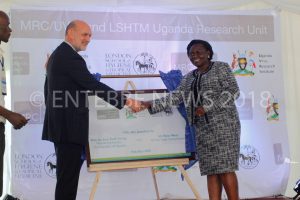
With Uganda’s increasing clinical studies at the four main sites namely in Kyamulibwa, Masaka, Entebbe and Kampala which require good and adequate facilities in order to meet national and international standards, the United Kingdom government (UK) through the Medical Research council (MRC-UK) and the Wellcome Trust will construct a 900,000 British pound clinical research center in Entebbe approximately 3.6billion Uganda Shillings.
The clinical research Centre, according to UVRI Director Prof. Pontiano Kaleebu will create an integrated, multidisciplinary facility where patients’ rooms, clinical research labs, and support spaces, are designed to ensure efficient and effective patient management.
Prof. Ponsiano Kaleebu revealed during the laying of a foundation stone, of the new clinic on Friday that the Medical Research (MRC-UK) contributed £650,000 and about £200,000 from the Wellcome Trust, also a UK based organization.

“We are happy that both the MRC-UK and the Wellcome Trust have provided us funding. About £650,000 from the MRC-UK and about £200,000 from the Wellcome Trust. We are grateful to Entebbe hospital with whom we have collaborated for many years, we have our clinics at both grade A and B. Most of the clinical research work in Entebbe has been conducted at the Entebbe Hospital but the increase in patient management under the expanding work requires additional consulting and clinical service/research rooms that are not available within the Entebbe surrounds”, Prof. Ponsiano Kaleebu disclosed.


The clinical research centre is expected to be completed at the end of the year.
Meanwhile, the collaborative partnership between the MRC/UVRI and the London School of Hygiene and Tropical Medicine (LSHTM) was also officially launched.
In his remarks, Prof. Ponsiano Kaleebu disclosed that About 3 years ago a decision was made to broaden the MRC activities into other infections especially emerging and re-emerging, neglected and endemic diseases and also to expand the work in non-communicable diseases such as Diabetes, kidney infections and cancer.
Prof. Ponsiano Kaleebu also disclosed that already important information has started being generated in these areas stressing that the MRC embarked on the transfer of its intramural units to universities.
“After wide consultations and discussions, including those that involved key partners such as UVRI, UNHRO, the Ministry of Health, the Attorney General’s office and Ministry of Finance, the MRC made a decision to transfer its Uganda Unit to the LSHTM with the official transfer effected on 1st February, 2018. This transfer is expected to build on the existing strong relationships between LSHTM and the Unit, ensuring even stronger scientific collaboration as well as new career opportunities for researchers. The LSHTM and our unit have therefore created a new partnership that will boost research capacity into some of the current and emerging health issues in Africa and the world”, Prof. Ponsiano Kaleebu stressed.
He added.
As a result of our broadened mission to include other infections beyond HIV and the inclusion of NCDs together with the transfer of the MRC Uganda to LSHTM, the unit’s name has changed. We are now being called Medical Research Council/Uganda Virus Research Institute and London School of Hygiene & Tropical Medicine Uganda Research Unit (MRC/UVRI and LSHTM Research Unit). These changes have been endorsed by the key parties, such as the Uganda Government, the UK Government, the MRC and LSHTM requiring an addendum to the existing MOU.
The Director London School of Hygiene and Tropical Medicine (LSHTM), Prof. Baron Peter Piot lauded Uganda for playing a pioneering role in making the lifesaving ARV drugs accessible and re-affirmed that the collaborative partnership between MRC/UVRI and LSHTM is a bright future for the MRC/UVRI.
“I see a brilliant future for MRC/UVRI to continue making great scientific contributions for better health to make the joint venture a success. UVRI and Uganda can and should become a center for original innovation for new ways to prevent HIV”, Prof. Baron Peter Piot.
Chief Guest, Hon. Sarah Opendi, State Minister for Health (General Duties) revealed that the clinical research centre will benefit Uganda through capacity building of Ugandan researchers.
“The bringing onboard of the London School of Hygiene and Tropical Medicine is an important component because the expertise in the UK will be brought to Uganda and the Ugandan researchers will be trained. The clinical research centre will create job opportunities in the fields of research and of course Uganda will be looked at as a center of excellence in viral research”, Minister Sarah Opendi stated.