

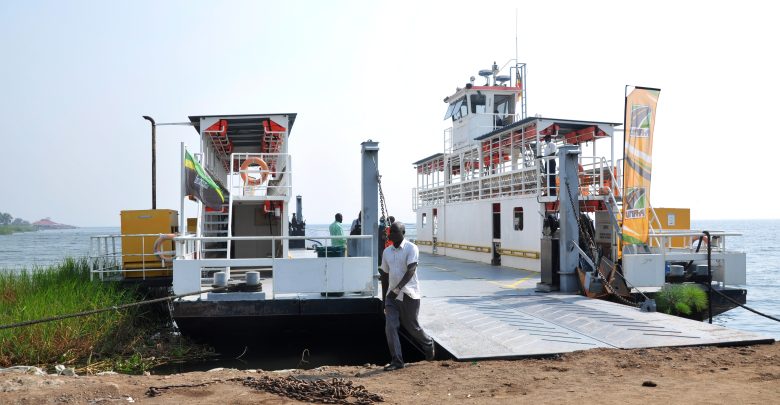
Despite the increased accidents on Ugandan water bodies, many ferries continue to operate in dangerous mechanical conditions, a special audit has revealed.
The Auditor General (AG) in his report for the year ending June 2023, noted that “in some instances, ferries operated without seaworthiness certificates, insurance, adequately qualified staff, rescue boats, or accessibility for persons with disabilities.”
“These safety and accessibility gaps could result in exclusion of PWDs, loss of lives and/or financial loss to the government in case of accidents,” said the AG.
Concerns about limited connectivity, ferry breakdowns, and makeshift boat use persist in Uganda, with up to 5,000 deaths occurring annually on Lake Victoria alone, due to boat accidents.

The Ministry of Works and Transport (MoWT), Uganda Railways Corporation (URC), and the Uganda National Roads Authority (UNRA) are responsible for shaping Uganda’s transport landscape.

Water transport is a lifeline for many, connecting islands in lakes and bridging shores separated by rivers and lakes.
There was an increase in the number of ferries operated by MoWT, UNRA, and URC from 14 in 2018/19 to 17 in 2023/22.
Ferry capacity rose from 1,702 passengers in FY 2018/19 to 2,112 passengers in FY 2021/22, and the cargo capacity from 2,830 tonnes in FY 2018/19 to 4,390 tonnes in FY 2021/22.
Of the 17 ferries, UNRA and MoWT run 15 ferries on inland water crossings in Uganda, while URC operates two ferries on Lake Victoria, linking Port Bell and Jinja Port (Uganda) with the ports of Kisumu (Kenya) and Mwanza (Tanzania).
Challenges
The AG observed “instances of delayed servicing of engines of UNRA vessels including MV Sigulu, Masindi Port ferry, Laropi ferry, and Kyoga II ferry. In addition, some engines had non-functional running metres e.g., Laropi ferry, MV Obongi, Kyoga I ferry, Nakiwogo ferry, and Masindi Port ferry where servicing was approximated. This made it difficult to accurately track the engine running hours.”
It was observed that UNRA did not have a standardised system for documenting and reporting on supervision and monitoring undertaken, making it difficult to track and analyse performance.
“There was no coordination framework in place to ensure that the different implementing agencies i.e., MoWT, UNRA and URC were aligned in their planning, budgeting, and implementation of ferry-related activities. This results in haphazard planning and implementation of activities, which may result in inefficiencies,” reported the AG.
“Although the number of ferries has been increasing in terms of passenger and cargo capacity, the current ferry services in Uganda still fall short of demand, and some of the populace is still not reached by the existing ferry routes, limiting their ability to safely access important services,” the report reads in part.
“Ferry support infrastructure was also inadequate. No single ferry had in place all the minimum requisite infrastructure to support provision of ferry services as at the time of audit. Specifically, no ferries had docking sites that incorporated high and low water levels.”
The AG advised UNRA to “regularly assess and compare efficiency of ferries across Uganda to identify opportunities for improvement or optimization” and “put in place adequate ferry support infrastructure at all landing sites to ensure smooth, efficient and dignified ferry service provision.”
“Ensure timely inspection of ferries, renewal of Seaworthiness Certificates and insurance cover in order to guarantee passenger safety,” the AG’s report noted.
The average cost of transporting each passenger for one kilometre on UNRA- operated ferries ranged from Shs 324 – Shs. 1,629, compared to Shs. 2,080 – Shs. 4,041 on the government funded but privately operated ferries supervised by the Ministry of Works and Transport.
For KIS-operated ferries, a contract signed with the government of Uganda requires them to undertake a fixed number of trips per day (at least 16), regardless of the passenger traffic, resulting in inefficiencies.
The AG advised the Works Ministry to re-negotiate terms with private ferry operators in order to obtain more favourable rates for passenger transportation per kilometre.
UNRA said it is currently undertaking the construction of 12 ferries which, when completed, are expected to increase the passenger and cargo carrying capacity by at least 1,570 passengers and 990 tonnes, and reach some of the currently unserved areas.