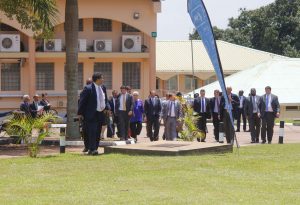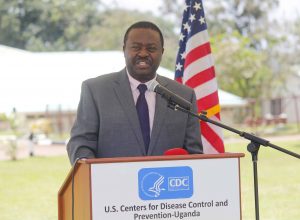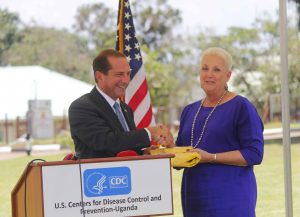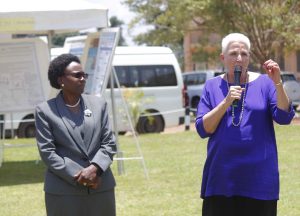


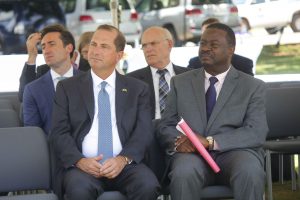
On Tuesday, the Uganda Virus Research Institute (UVRI) was privileged to host the United States Secretary Of Health And Human Services whose visit is primarily to follow up on the current Ebola threat from the Democratic Republic of Congo (DRC) and also reflect on the collaboration between Uganda and the United States that began over 25 years ago. In his remarks, US Secretary of Health, hailed UVRI for its continued readiness to contain the Ebola Virus.
Today, the infrastructure that UVRI helped build has played a key role in preventing the spread of Ebola from the Eastern Democratic Republic of Congo across the border into Uganda. UVRI itself is a testament to Uganda’s history of accomplishments in Public Health and Biomedical Science. Ugandans have helped identify the viruses that I, as the US Health secretary hear about and have to monitor all the time, viruses like the Zika virus, West Nile Virus and others. UVRI has also played a key role in developing Uganda’s epidemiological surveillance capabilities which set the standard among African nations, Secretary Alex Azar Stated.
He added;

UVRI is not just a successful scientific and Public Health institution, it is also a remarkable model for International Co-operation. The United States has a close relationship with Uganda, particularly in health research. Uganda is home to one of the largest Centre for Disease Control (CDC) field Offices and CDC has been providing technical support to Uganda since 1991 and nowhere is that relationship more obvious than at UVRI where we have CDC Staff working directly on-site and we are grateful for the job that they do.
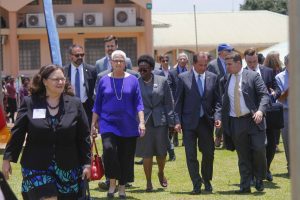
On her part, Minister of Health Dr. Jane Ruth Aceng thanked the United States Government for their continued collaboration with Uganda, particularly in the Health Sector.
As a country we are excited that the US Secretary Of Health and Human Services could take off time from his busy schedule to pay us a visit, we’ve had him in Uganda for two days and he is in Uganda to follow up on the current Ebola threat from the Democratic Republic of Congo (DRC) and also monitor progress on control of Ebola from DRC and discuss with Uganda as well as with the DRC some of the things that we are doing to control Ebola and ensure Global Health Security. The US Secretary Of Health is also in Uganda to reflect on the collaboration that we’ve had for over 25 years and the collaboration has seen the US government support the health sector in several areas including HIV/AIDS, Tuberculosis and control of emerging and re-emerging infections, Dr. Aceng stated.
She added;

It has been a great opportunity for us to share our research and innovation based on evidence on the ground regarding what we are doing together with the US Government to respond to the health needs of the Population but also to ensure global health security. Secretary Azar had the opportunity to visit Uganda’s emergency operating center which is situated in Kampala as well as visit the National Institute for Public Health. He also visited the International Organization for Migration (IOM) where refugees in the camps interested in going to the United States are screened, followed up, treated and then they go to the United States. He also visited the central Public Health Laboratory which is the biggest Laboratory in Uganda and which was set up with support from the US Government. The central Public Health Laboratory not only sets standards for all Laboratories in Uganda but also follows up specifically on transportation of potential samples that are highly pathogenic including testing for viral loads, Hepatitis B, sickle cell disease and other infections. He also visited the landing sites at Entebbe and had a chat with the fishing community that is benefitting from the Antiretroviral drugs (ARVs).
UVRI Executive Director Prof. Pontiano Kaleebu had this to say;
Uganda is a key player in the region in fighting diseases like Ebola and the US Health Secretary’s visit strengthens and cements our working partnership with the US Government in the fight against Ebola. The United States gives us a lot of support through institutions like the Centre for Disease Control (CDC) and we hope we shall have more partnerships and collaborations and probably even more funding so that we can continue to do our job in the region.