

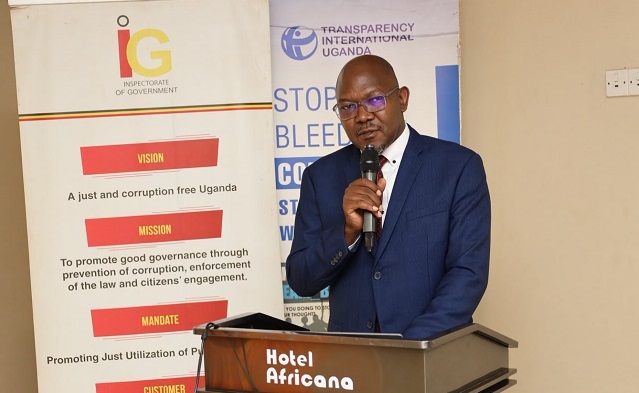
Kampala, Uganda | PATRICIA AKANKWATSA | Uganda’s efforts to improve its global corruption ranking are facing renewed scrutiny after anti- corruption agencies and stakeholders warned that the country’s stagnating performance on the Corruption Perceptions Index (CPI) reflects deeper institutional and societal challenges.
Officials from the Inspectorate of Government (IG), Transparency International Uganda and other stakeholders have called for a coordinated national response, including the creation of a CPI task force, stronger enforcement of anti-corruption laws and improved public engagement.
The call follows a multi-stakeholder retreat that brought together 67 participants from government institutions, civil society, development partners, academia, the media and the private sector to examine why Uganda’s CPI performance has remained largely unchanged over the past decade.

Gerald Gwaira, Director of Research, Education and Advocacy at the Inspectorate of Government said Uganda’s target under the Fourth Sector Development Plan (SDP4) is to achieve a CPI score of 31% by 2030, but warned that the country is currently moving in the opposite direction.
“Our target in the SDP4 is 31% by 2030. That should be our score as a country,” Gwaira said.

He noted that although an earlier target under SDP3 had aimed for 35%, stakeholders later revised the ambition after assessing the country’s ability to achieve it.
“We said we should aim where we can, where we can hit. So the target is 31%. But considering the fact that while we have a target of 31%, we seem to just be receding, going backwards, we failed to do so,” he said.
The CPI, developed by Transparency International, measures perceived levels of public sector corruption across 180 countries using multiple independent data sources. Countries are scored from zero to 100, with higher scores representing lower perceived corruption.
Peter Wandera, the executive Director at Transparency International who presented an overview of the CPI methodology, explained that the index combines 19 global data sources, with eight sources contributing to Uganda’s score.
He said the CPI assesses issues including public finance management, government operations and institutional accountability, but does not measure private sector corruption or illicit financial flows.
Uganda scored 25 out of 100 in the latest assessment, placing it among countries struggling to make significant progress in reducing perceptions of public sector corruption.
Wandera said understanding the sources behind Uganda’s score is critical to identifying areas for improvement.
“The important thing is to examine the backend sources that contribute scores to the index,” he said, explaining that Uganda’s final score is calculated from the combined assessment of different international institutions.
A decade of stagnation
Stakeholders at the retreat noted that Uganda’s CPI performance has remained largely stagnant, with limited improvement since methodological changes introduced in 2012 that allowed year-on-year comparisons.
Gwaira said Uganda’s highest CPI score remains 29 percent, achieved in 2012, but the country has struggled to build on that performance.
“Uganda’s highest score so far in CPI has been 29%, and this was way back in 2012. Since then, our performance has not been very good,” he said.
He added that Uganda’s performance remains below regional benchmarks, noting that the East African average stands at about 32 percent.
“Even our targets of 31% are still below the regional average, but it is still good enough when we move in that direction,” Gwaira said.
Professor Michael Kiwanuka an economist and scholar said Uganda’s ranking has continued to raise concern both globally and regionally.
He noted that Uganda was ranked 149th globally and remains behind several African and East African countries.
“We are still below the African ranking. We were 149th on the world ranking,” Kiwanuka said.
He added that Uganda’s trend analysis shows a pattern of stagnation.
“The curves are flat, indicating no change. No change at a very low score,” he said.
According to Kiwanuka, Uganda’s continued poor ranking has placed the country among the weaker performers in East Africa.
“This is not a very pleasant situation,” he said.
Corruption becoming normalised
The retreat identified several factors contributing to Uganda’s stagnation, including weak enforcement of existing laws, limited access to information, inadequate protection for whistleblowers and declining public confidence in accountability institutions.
Gwaira said participants observed that corruption has increasingly become normalised in society.
“Corruption is now seen more as normal. It is no longer the exception; it is the norm now,” he said.
He said some citizens no longer view corruption as a serious wrongdoing, with some seeing it as a way to access services or influence systems.
The discussions also highlighted concerns about public perceptions of selective justice and limited prosecution of high-profile corruption cases.
“There is also selective justice and challenges in prosecuting high-level corruption cases,” Gwaira said.
He cited findings from Afrobarometer showing that 72% of Ugandans believe the government is performing poorly in fighting corruption.
Calls for coordinated action
Stakeholders proposed the creation of a CPI task force to coordinate Uganda’s response and engage institutions responsible for assessing the country’s corruption performance.
Gwaira said the task force would examine the data sources used to score Uganda and engage the organisations behind the assessments to better understand areas requiring improvement.
“What is it that we can do to improve? Are you scoring us because you don’t have enough information about our efforts? Are you scoring us because there are other issues? Let us interrogate that and address those issues,” he said.
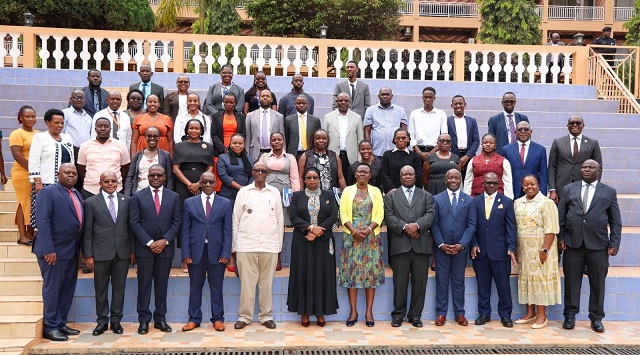
Other recommendations included strengthening accountability and enforcement, accelerating digital transformation, improving access to public information, enhancing communication about anti-corruption efforts, promoting civic engagement and strengthening coordination among institutions.
Gwaira said Uganda also needs to communicate more effectively about successful investigations, prosecutions and asset recovery efforts.
“Many times we report our arrests, and then people are taken to court, but many times we have not communicated the results of those prosecutions,” he said.
He argued that citizens need to see tangible outcomes from anti-corruption efforts to rebuild trust.
Learning from better performers
The retreat also examined countries that have improved their CPI scores, including Rwanda, Botswana and Ghana.
Gwaira said Rwanda’s progress demonstrates that improvement is possible through consistent institutional reforms and stronger accountability systems.
“Rwanda is still improving. What this shows is that it is possible to improve, and our neighbours did it, then we can also do it,” he said.
He said Uganda could also adopt Botswana’s approach of creating “islands of efficiency” by improving specific institutions and replicating successful models across government.
Stakeholders also pointed to Ghana’s collaboration between government agencies, civil society and private sector actors as a model Uganda could strengthen.
The road to 2030
The Inspectorate of Government said Uganda still has time to reverse the trend and achieve its 31 percent CPI target by 2030, but this will require sustained political commitment and institutional cooperation.
“Uganda possesses a strong institutional anti-corruption programme. However, progress in CPI performance requires stronger enforcement, data coordination, transparency, enhanced citizen engagement and effective communication of results,” Gwaira said.
He expressed confidence that coordinated action could improve Uganda’s ranking in future assessments.
“When we do all this, I am very sure that by 2029-2030, our CPI score will be way above the 31 percent target,” he said.
The post Uganda’s anti-corruption push under pressure as CPI stagnation fuels reform demands appeared first on 1:.