

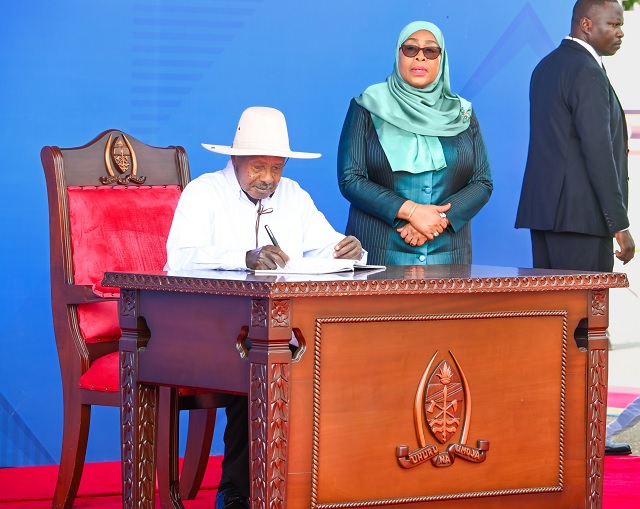
Dar es Salaam, Tanzania | URN | President Yoweri Kaguta Museveni of Uganda and Samia Suluhu Hassan of Tanzania have endorsed a landmark Memorandum of Understanding (MoU) aimed at reshaping East Africa’s energy economy by shifting the region’s focus from crude oil exports to building an integrated regional energy and industrial hub.
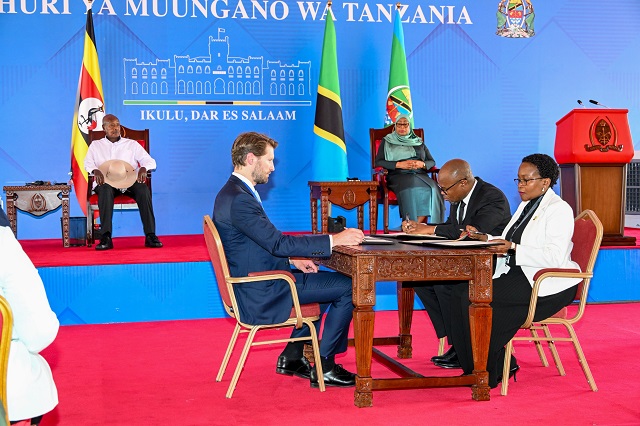
The agreement, signed on Thursday by the Uganda National Oil Company (UNOC), the Tanzania Petroleum Development Corporation (TPDC) and Vitol Bahrain E.C., provides the framework for the proposed Tanga Regional Energy Hub. The project will integrate petroleum refining, storage, logistics, petrochemicals and cross-border energy infrastructure along Tanzania’s Indian Ocean coast.

Building on the East African Crude Oil Pipeline (EACOP), government officials estimate the initiative could attract investments exceeding US$20 billion, making it one of Sub-Saharan Africa’s largest integrated energy developments if fully implemented.
The project marks a strategic evolution of East Africa’s petroleum sector, shifting beyond crude oil transportation towards regional industrial value chains capable of creating skilled jobs, strengthening energy security and increasing domestic value addition.
“EACOP transports molecules. The Tanga Regional Energy Hub transforms those molecules into prosperity,” Tanzania’s Minister for Energy, Deo Ndejembi, said, describing the project’s broader industrial vision.

Uganda’s Minister of Energy and Mineral Development, Dr Monica Musenero Masanza, said the initiative aligns with Africa’s long-standing ambition to industrialise its natural resources instead of exporting raw commodities.
She said East Africa must move beyond exporting raw materials and instead capture value locally by building a knowledge-based economy supported by high-skilled employment in engineering, operations, maintenance and technical analysis.
Her remarks resonate with the aspirations of the African Union’s Agenda 2063, which prioritises industrialisation, regional value chains and value addition to Africa’s natural resources as key drivers of sustainable economic transformation.
Officials said the proposed hub is intended to complement, rather than compete with, Uganda’s planned Hoima Oil Refinery, whose Final Investment Decision (FID) has been pushed to early 2027, with commercial operations expected between 2029 and 2030.
While the Hoima refinery is designed primarily to meet Uganda’s domestic refining needs, the Tanga facility is envisioned as a regional logistics and industrial platform serving East and Central African markets.
The latest agreement builds on more than a decade of bilateral energy cooperation between Uganda and Tanzania. IIts legal foundation stems from the 2017 Uganda–Tanzania Inter-Governmental Agreement, followed by the 2021 Host Government Agreements, the EACOP Shareholders Agreement, and Uganda’s East African Crude Oil Pipeline (Special Provisions) Act, 2021, which provides the legal framework for implementing the cross-border pipeline.
The initiative also aligns with regional integration commitments under the Treaty for the Establishment of the East African Community and the East African Community Common Market Protocol, both of which encourage member states to jointly develop strategic infrastructure, harmonise energy markets and promote cross-border investment.
Regulatory oversight continues to be coordinated by Uganda’s Petroleum Authority and Tanzania’s Energy and Water Utilities Regulatory Authority (EWURA) to ensure harmonised supervision of cross-border petroleum activities.
Beyond crude oil transportation, the MoU significantly expands the scope of Uganda-Tanzania energy cooperation. Feasibility and Front-End Engineering Design (FEED) studies for a proposed bidirectional refined petroleum products pipeline linking the two countries are expected later this year, while parallel studies for a cross-border natural gas pipeline are on course for completion by October 2026.
Uganda has also secured US$250 million in World Bank financing for its section of a planned 400-kilovolt electricity interconnector, which is expected to strengthen regional electricity trade under the Eastern Africa Power Pool (EAPP) and eventually link East African power markets with Southern Africa.
The participation of Vitol Bahrain E.C., part of one of the world’s largest independent energy trading companies, is expected to enhance the project’s commercial credibility. Vitol already partners with UNOC in petroleum storage and downstream logistics in Uganda, and its involvement is expected to improve access to international financing, technical expertise and global petroleum markets.
The proposed hub will leverage the 1,443-kilometre East African Crude Oil Pipeline, projected to become the world’s longest electrically heated crude oil pipeline, capable of transporting approximately 230,000 barrels of waxy crude oil per day from Uganda’s Albertine Graben to the Port of Tanga.
Commercial oil production remains targeted for 2026–2027 as development of the Tilenga and Kingfisher oil fields advances towards completion. Uganda currently spends an estimated US$2 billion annually importing petroleum products.
Tanzania has reiterated its support for Uganda’s refinery programme, describing both projects as complementary elements of a broader regional industrialisation strategy rather than competing investments.
However, EACOP continues to face sustained criticism from environmental organisations, climate campaigners and sections of the international financial community over concerns related to biodiversity conservation, greenhouse gas emissions, land acquisition and the displacement of project-affected communities.
Several international financial institutions have adopted increasingly cautious positions on financing large fossil-fuel infrastructure projects amid accelerating global commitments to decarbonisation and the transition to renewable energy.
Consequently, the proposed Tanga Regional Energy Hub is expected to face similarly rigorous scrutiny over its environmental safeguards, climate resilience, local content implementation, regulatory compliance and long-term commercial viability.
The post Uganda, Tanzania seal deal to develop Tanga into regional energy hub appeared first on 1:.