

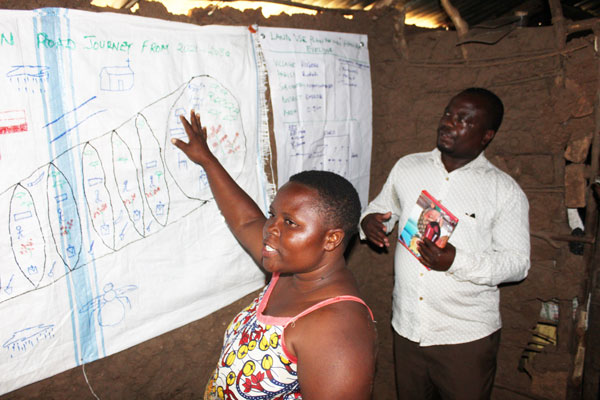
For Evelyne Masika in Kasese, carbon payments have become livestock, school fees and a plan that runs to 2030.

Kasese, Uganda | ENTEBBENEWS.NET | On her half-hectare farm in Kogere Village, Rukoki Sub-county, Kasese District, Evelyne Masika has transformed how she uses her land. Until 2021, the mother of seven mainly grew maize and beans. That changed when she joined the Kogere Busumba Tree Farmers Group and agreed to plant trees under a carbon-finance programme.
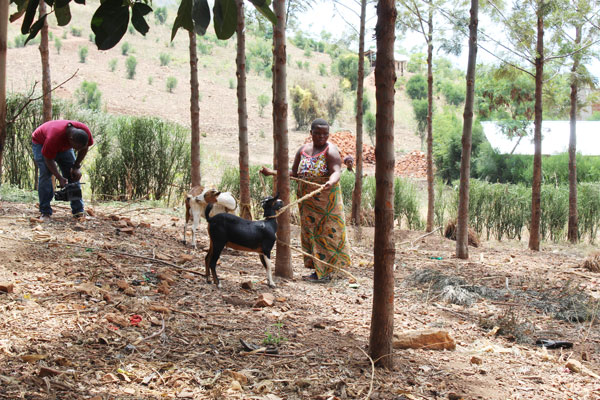
Masika started with 100 trees. When her first carbon payment arrived, she invested in two goats.
Carbon credits are generated when activities reduce or remove greenhouse gases from the atmosphere. The credits sold through ECOTRUST’s Trees for Global Benefits programme come from the trees farmers plant and maintain on their land.

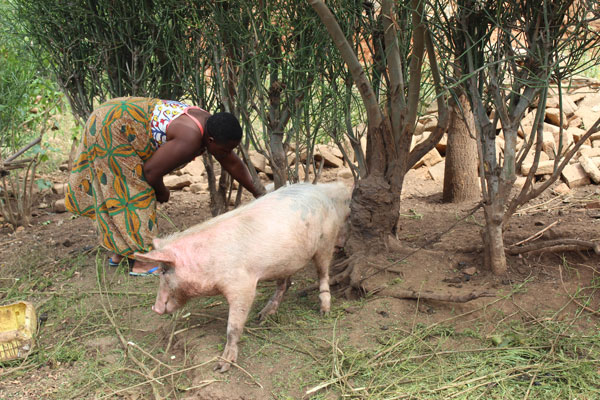
“I joined in 2021 and have since been able to buy goats and pigs to start a small farm and pay school fees for my children. Meanwhile, we enjoy a cool environment from the trees. I am happy I agreed to plant them,” she says.
Alongside the trees, she developed a clear land-use plan whose vision runs from 2021 to 2030. For a smallholder farmer whose livelihood depends largely on what can be produced from a limited piece of land, planning that far into the future represents a significant shift from the immediate pressures of farming for the next harvest.
Masika is among more than 31,000 smallholder farmers enrolled in the Trees for Global Benefits programme across the Rwenzori Landscape, which stretches across four districts and 56 sub-counties. ECOTRUST introduced the programme into the region in 2012, using Kasese District as its launchpad. What began with sixteen farmers has grown into one of East Africa’s largest smallholder carbon programmes.
Why carbon dioxide matters
To understand how payment for planting and maintaining trees reaches a farmer like Masika, it is necessary to understand what is being traded.
Carbon dioxide is a greenhouse gas that traps heat in the atmosphere. When fossil fuels are burned or forests cleared, more CO₂ accumulates, strengthening the greenhouse effect and contributing to global warming. At community level, the consequences are visible through unpredictable rainfall, prolonged droughts, soil erosion and flash floods.
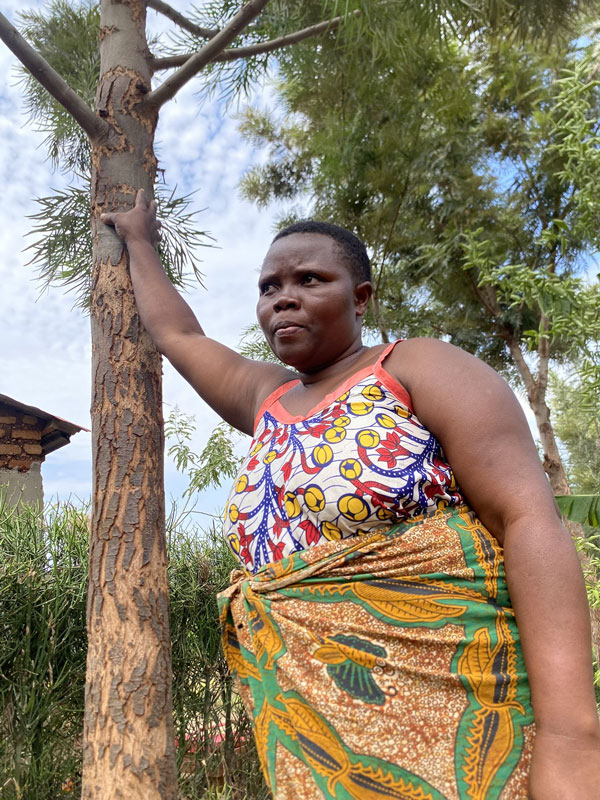
Carbon credit is intended to mitigate these consequences. When Masika plants trees, they absorb carbon dioxide. The amount stored is estimated through measurements including tree diameter, wood density, species, bole height and crown width. The resulting carbon removal is independently verified and converted into a credit.
“One certificate is equivalent to removing or preventing one ton of carbon dioxide,” explains Pauline Nantongo Kalunda, Executive Director of ECOTRUST. One acre of trees captures five to 10 tons of carbon, generating five to ten certificates. “A farmer can calculate the value and then decide whether to plant maize and beans, or trees,” she says.
Who pays, and why
The money reaching farmers like Masika comes through the international voluntary carbon market, where international corporations seeking to reduce their carbon footprint buy credits from projects that remove or prevent emissions.
Buyers include airlines, banks, technology companies and consumer brands. Many have made net-zero commitments but cannot yet eliminate all emissions. For example, flying aircraft, producing cement and operating global supply chains remain difficult to fully de-carbonise. Such companies pay for carbon credits and use them to account for emissions not yet eliminated.
When a Swedish or Swiss company buys a credit from ECOTRUST’s programme, it receives a certificate representing one tonne of carbon dioxide removed on its behalf. ECOTRUST has signed long-term purchase agreements with buyers including through intermediaries such as ZeroMission and MyClimate. Of every $10 paid, $6 goes directly to farmers as performance-based payments. This creates a link between decisions on individual farms like that of Masika in Kasese and climate commitments made by companies thousands of kilometres away.
Protecting the land while improving livelihoods
The need for credible carbon finance is particularly important in a region where environmental degradation is already affecting communities. Augustine Kooli, the Kasese Senior Environmental Officer, says the district is experiencing extensive degradation caused by indiscriminate tree cutting and destruction of vegetation cover.
Kooli argues that environmental degradation cannot be separated from the economic circumstances of communities in these landscapes. He describes poverty as both physical and intellectual — some people destroy environmental resources because they need money, while others lack even resources to meet basic household needs.
“You see somebody who is physically rich, he has the money but decides to cut down an entire forest simply because he needs more money and fails to recognise that whatever he is doing is detrimental to the entire community. That is intellectual poverty. But with physical poverty, these community members are unable to raise even a bundle of firewood.”
This is one reason carbon-finance programmes do more than increase tree numbers.
The trees coexist with farming systems that support livelihoods. For farmers like Masika, the trees become part of a wider system in which conservation, crop production, livestock and additional income are connected.
For Winnie Namirya, who joined the programme in 2012 and is now Rwenzori Landscape Coordinator at ECOTRUST, the significance of the programme goes beyond the number of trees planted or the money paid to farmers.
“It is not just looking at the tree,” she says, “but what comes with the tree. It is not just looking at the money, but what comes after the money.”
That “after” is an important part of the story.
The national picture
While farmers like Masika in Kasese participate in a voluntary carbon market linking them to corporate buyers abroad, Uganda is also developing a national system for climate finance.
In October 2025, Uganda became the first African nation to receive a results-based payment from the Green Climate Fund. The $31 million payment rewarded the country for eight million tonnes of verified CO₂e reductions achieved between 2016 and 2017.
The payment was not a grant for future activity. It was money awarded for results already delivered. This distinction matters because it reflects a broader shift in climate finance towards systems in which countries demonstrate results before receiving payments. It also raises questions about how global climate commitments translate into national systems and eventually local action.
Aaron Werikhe, a senior planner at Uganda’s National Planning Authority, describes the challenge.
“A treaty is not a law, and a law is not an institution,” he told journalists at an ECOTRUST training workshop in Kasese. For climate commitments to translate into action, each level — global, regional, national and local — must be built into the system. The challenge is also financial: international commitments do not automatically translate into the resources required to implement them.
What it means for a farmer
For Masika, carbon credits mean two goats that multiplied into a livestock venture that enabled her to pay school fees and develop a land-use plan stretching to 2030.
That process is how carbon income is converted into the forms of capital ECOTRUST describes as financial, human, social, physical and natural, each potentially reinforcing the others.
RELATED VIDEOS
But the model has limits, and ECOTRUST acknowledges carbon income cannot be the only reason farmers participate.
The issue is more complicated where land has multiple rights holders, such as landlords and tenants, because long-term investment in trees requires agreement between people whose interests may differ.
For households with very little land, planting too many trees can threaten food security by reducing space for food crops.
The market itself is another source of uncertainty. Uganda’s farmers and conservation programmes are selling into a global voluntary carbon market that has already experienced a major loss of confidence. When trust falls internationally, the consequences reach back to rural projects by suppressing prices and reducing financing for projects whose environmental claims may nevertheless be genuine.
The question that remains
The trees on Masika’s farm are still growing, and her land-use vision runs to 2030. The benefits she has received show what carbon finance can mean when a global environmental market reaches an individual household. Other community members also have tangible benefits — Milton Thembo a neigbour has bought a motorcycle, while the nearby Kyarumba Banywani Cooperative has a showroom stocked with coffee and honey.
But whether these gains can be sustained extends far beyond what any individual farmer can control. It will depend on whether the voluntary carbon market can be trusted; whether Uganda’s new regulations are effectively enforced; whether a national registry is established; and whether money received through results-based climate finance is reinvested in the systems needed to deliver future results.
Masika’s experience does not tell the whole story of carbon finance in Uganda. But it provides a useful place to begin understanding what happens when an international climate market reaches the lowest level of the economy.
That is where the story starts.
****
This feature was produced with support from ECOTRUST Uganda and draws on field reporting in Kasese District.
The post How carbon finance is reaching smallholder farmers in the Rwenzori region appeared first on 1:.