

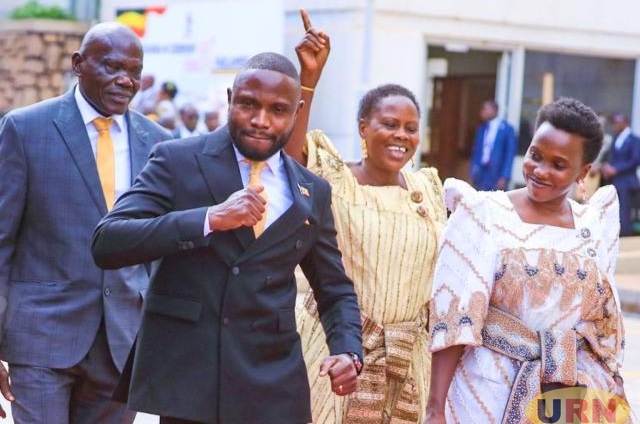
Kampala, Uganda | URN | The mood outside Parliament was euphoric on Wednesday as Peter Paul Emaju took the oath as Kasilo County MP, cementing one of the most symbolic political victories in Serere District.
Flanked by supporters, Emaju walked into the Parliamentary precincts amid cheers, ululations, and celebration, symbolising not merely the swearing-in of a new legislator, but halting the political career of Elijah Okupa, who has been one of the longest-serving MPS from Teso.
For Kasilo County, Emaju’s swearing-in represented a historic political transition, the end of Elijah Okupa’s 25-year dominance.

It was a significant milestone for the ruling National Resistance Movement (NRM) that had failed to recapture Kasilo right from the time Elijah Okupa took up the seat as an FDC candidate.
“This is not just a political victory; it is a renewal of hope for our people,” Emaju told journalists moments after taking the oath of allegiance and oath of office before the Clerk to Parliament.

“The people of Kasilo have entrusted me with a historic responsibility. I pledge to serve with humility, integrity, and unwavering commitment to transforming our communities,” Emaju said.
His election and subsequent swearing-in now position him among a new generation of legislators expected to shape the direction of Uganda’s 12th Parliament amid rising public demands for accountability, service delivery, and inclusive development.
Kasilo County had long been considered a political bastion of veteran legislator Elijah Okupa, who represented the constituency continuously from 2001 to 2026.
Okupa first entered Parliament during the 7th Parliament and went on to become one of the longest-serving MPs from the Teso sub-region.
Over the years, he built a reputation as a seasoned parliamentarian with strong grassroots networks and experience in committee work.
Initially elected under the opposition Forum for Democratic Change (FDC), Okupa later contested as an independent candidate after internal political realignments.
Yet despite his deep political roots, the 2026 elections produced an outcome few anticipated several years ago.
Emaju, contesting on the NRM ticket, defeated the veteran legislator in what political observers described as one of the most symbolic victories in eastern Uganda.
Kasilo’s shift may have also indicated growing voter fatigue with long-serving politicians amid mounting youth unemployment, poor road networks, and demands for faster local development.
Before entering Parliament, Emaju had steadily built political influence within Serere District, particularly through mobilisation structures linked to the NRM and the Patriotic League of Uganda (PLU), where he served as district coordinator.
His emergence gained national attention during the heated NRM primaries in August 2025, where he secured the party flag with 9,420 votes, representing more than 65 percent support in a competitive race.
Supporters portrayed him as a youthful and energetic mobiliser capable of reconnecting national government programmes to local communities.
Throughout his campaigns, Emaju focused heavily on infrastructure rehabilitation, market development, agricultural support, and fisheries improvement, key concerns in Serere District, where many households depend on subsistence farming and fishing activities linked to nearby wetlands and water bodies.
Among his pledges were improving community access roads, upgrading market stalls, and advocating for better fish preservation and storage facilities to reduce post-harvest losses.
“Leadership must unite people, not divide them. Development comes when leaders work together regardless of political differences,” Emaju said.
Emaju now enters Parliament at a time when public scrutiny of legislators has significantly intensified.
The 11th Parliament, in particular, faced criticism over controversial legislation, allegations of excessive political partisanship, and concerns about shrinking civic space. A
As a first-time legislator from the ruling party, Emaju will be closely watched on whether he prioritises constituency interests over partisan loyalty.
Governance expert Sarah Bireete of the Centre for Constitutional Governance has previously argued that the strength of Parliament depends on legislators who can independently scrutinise government actions while remaining responsive to citizens’ needs.
Despite his electoral defeat, Elijah Okupa leaves behind a substantial political legacy. For a quarter-century, he remained one of the most recognisable political voices from Teso, surviving shifting party dynamics and changing electoral cycles.
His longevity reflected not only personal political resilience but also the trust many constituents placed in his leadership.
Political historian Dr. Jimmy Spire Ssentongo has previously observed that Uganda’s electoral landscape is gradually evolving from personality-driven politics toward performance-based expectations, particularly among younger voters.
As celebrations fade and parliamentary business begins, Emaju’s political honeymoon may quickly give way to the difficult realities of governance.