

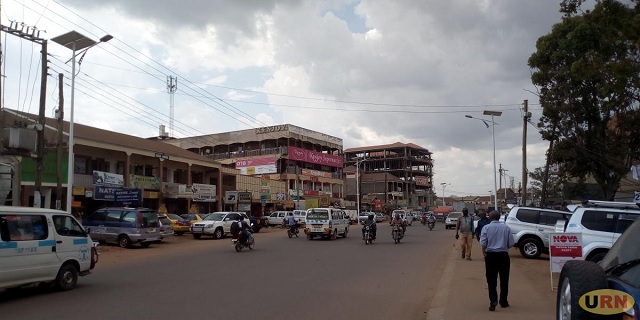
Kampala, Uganda | URN | For residents living along Hoima Road in Nansana, crossing from one side of the road to the other has become one of the most dangerous parts of daily life. A routine trip to a shop, church or taxi stage can mean waiting for up to 15 minutes for a break in traffic, with the wait often stretching even longer during peak hours.
Pedestrians watch for a break in the steady flow of vehicles before making a decision that often comes with little margin for error. Mike Kamya, a resident of Nansana East 2B near Total Nabweru, said pedestrian crashes are common along the road, but many never reach police records because victims are often taken to nearby clinics.
“Police only show up when what they call major accidents happen, and these usually involve vehicles. But pedestrians, including children and adults, are being knocked here every day while trying to cross the road. In most cases, the culprits are boda boda riders,” he said.

A visit to the affected sections of Hoima Road found police officers deployed mainly at three points: Lubigi, Masitowa and Kyewamala. At these locations, officers and traffic guides were largely focused on controlling vehicle traffic rather than helping pedestrians cross safely. At Lubigi, near Ganda Road, a boda boda rider narrowly avoided hitting a woman crossing the road with luggage balanced on her head.
The woman raised one arm to signal that she was crossing, but the rider appeared not to notice her until the last moment. He swerved to avoid her, then insulted her and accused her of being careless.

The encounter captures the daily risk faced by pedestrians along the stretch of Hoima Road from Lubigi to Naluvule.
The area has become heavily urbanised and now functions as the de facto main street of a fast-growing municipality. Shops, markets, homes, churches and other businesses line both sides of the road, forcing residents to cross regularly to reach essential services.
However, the road infrastructure has not kept pace with this transformation. Long sections have no marked zebra crossings. In places where crossings once existed, the markings have faded to the point of becoming difficult to see. Residents in the Kibuloka area told our reporter that the only clearly marked zebra crossing they know of is near Pastor Wilson Bugembe’s Worship House church.
“Even there, motorists rarely stop to give way to pedestrians,” Margaret Namugga said. Namugga identified two groups of motorists as posing the greatest danger to pedestrians: heavy truck drivers and boda boda riders. She said truck drivers often pass through the area with little regard for people on foot, while boda boda riders frequently ignore traffic rules and slow down mainly when picking up or dropping off passengers.
For some residents, traffic congestion has become an unlikely aid to pedestrian safety. Suliaman Tebi said pedestrians often find it easier to cross when traffic is heavily congested because vehicles are moving slowly or have stopped altogether.“During a traffic jam it is better, and pedestrians are also praying for gridlock, because during it you can move through better,” he said.
Juma Katende said children, especially those walking to school, are among the most disadvantaged because there are few designated points where they can safely cross the road. He said some children spend a long time trying to find a safe gap in traffic before crossing. A few schools, particularly those located along the roadside, have guides who help pupils cross the road, but many schools lack such support.
A highway serving as a town street
Residents say the problem goes beyond a shortage of zebra crossings. They argue that Hoima Road was designed for a different purpose from the role it now plays. Much of the road was developed as a national highway intended to move vehicles efficiently between urban centres. But rapid development along the Nansana corridor has transformed the road into a busy urban street, with pedestrians, businesses and local traffic competing for space with long-distance vehicles and heavy trucks.
This creates a design mismatch recognised by the Ministry of Works and Transport in its revised Urban Roads Design Manual, updated in 2023. The manual notes that differences between road classes can create safety problems, particularly where a highway enters an urban area. “In the case of assessing the road safety of an intersection, it is clear that where a difference in intersecting road classes exists, road safety problems can occur due to the difference in function, for instance where a highway enters a town,” the manual states.
The Ministry has developed design standards that recognise the need for roads in built-up areas to accommodate pedestrians and other forms of local traffic. The Urban Roads Design Manual and Non-Motorised Transport Manual provide for facilities such as pedestrian walkways, cycle lanes, roadside parking, street lighting and safe crossing facilities. However, national highways passing through growing municipalities often retain much of their original highway design even as surrounding communities become more densely settled.
Rapid urbanisation can therefore leave roads serving two competing functions: moving traffic between towns while also acting as the main street for communities that have grown around them. The concerns in Nansana are not new. In 2019, Nansana Municipal authorities petitioned the defunct Uganda National Roads Authority, UNRA to adjust Hoima Road to better fit the municipality’s development plans.
Municipal leaders argued that the road had been built largely according to a standard highway design, with limited additions such as walkways and street lighting, despite its growing role as Nansana’s main street. The campaign was led by then Town Clerk Ambrose Atwoko and former mayor Regina Bakitte.
Bakitte noted at the time that although the road was wide enough, its design did not adequately provide for street parking and pedestrian crossing points through what she described as the central business district. She later called for targeted changes to improve road safety and provide green belts along the route. The municipality even offered to co-fund the proposed changes, committing between Shs180 million and Shs240 million toward implementation.
Six years later, the road carries more traffic and passes through a more densely developed urban area than when the petition was made. Tonny Kabiito, a youth leader in Buganda Kingdom’s Nabweru Mituba II, urged authorities to reconsider the road’s design by adding more zebra crossings, pedestrian bridges and signal-controlled junctions at sections with heavy pedestrian traffic.
David Lubega, another resident, said zebra crossings alone would not solve the problem. “We need zebra crossings to help people cross, but I do not think they are enough. Authorities should consider pedestrian bridges at some sections, especially where traffic is heavy. That would offer a safer option,” he said.
Lubega also pointed to traffic lights as another possible solution, citing the work on Entebbe Road, where timed traffic lights have been installed at several junctions between Mpala Interchange and Kitooro. He also cited pedestrian overpasses in other parts of the city as an option authorities could consider at busy crossing points.
Allan Ssempebwa Kyobe, a Senior Communications Officer at the Ministry of Works and Transport, said road safety remains a priority and the ministry, together with police and other stakeholders, can review the road.
Ssempebwa said safety measures, including road signs and speed humps, were incorporated during the construction of Hoima Road. He rather acknowledged that Nansana has developed rapidly since the road was constructed, meaning some of the measures originally provided might no longer match conditions on the ground.
He stopped short of committing to pedestrian bridges or traffic lights but said residents, local leaders and other stakeholders could submit written proposals to the ministry for consideration. Ssempebwa also stressed the need for greater discipline among all road users, saying compliance with traffic rules offers the most immediate short-term and medium-term response as residents await a broader review of the road.
He said enforcement and responsible road use would help reduce risks in the meantime, while longer-term interventions could follow after the road’s safety needs are assessed.
The response leaves the immediate question of how pedestrians should safely cross the road unresolved, even as development along the corridor continues. The risks faced by Nansana pedestrians reflect a wider national road safety problem.
According to the Uganda Police Force’s 2025 Annual Crime Report, Uganda recorded 26,044 road crashes in 2025, a 3.7 per cent increase from 2024. The crashes claimed 5,383 lives, an average of about 15 deaths every day. Pedestrians were among the most vulnerable road users. At least 1,776 pedestrians were killed in 2025, a 6.6 per cent increase from the previous year.
Of those deaths, 43 per cent occurred while victims were crossing the road, while 32 per cent occurred as pedestrians walked along the roadside. Pedestrian collisions accounted for roughly one in every five road crashes recorded nationwide. For Nansana residents, those figures translate into a daily reality on Hoima Road, where crossing the street is less a routine part of movement than a calculation of traffic, speed and risk.