

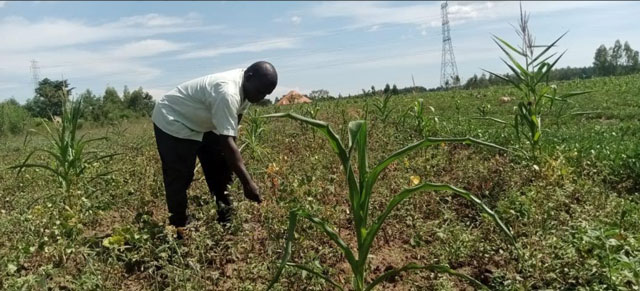
SPECIAL REPORT | As unreliable rainfall leaves smallholder farmers across the country counting losses, the government is preparing to expand irrigation infrastructure. Solar-powered pumps could help farmers take greater control of water; but affordability, access to water and the delivery of public programmes will determine whether the technology reaches those who need it most, Ronald Musoke reports.
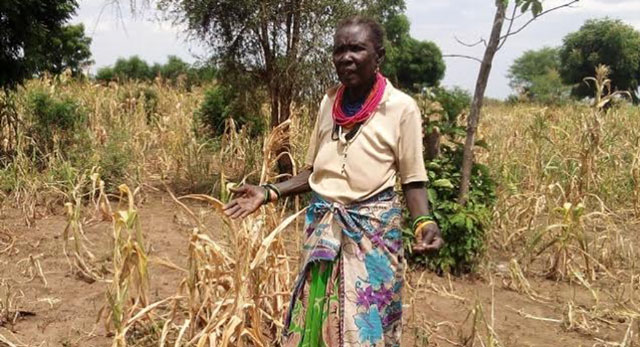
ACROSSmost parts of Uganda, the agricultural season has become a test of patience, money and survival. Farmers who recently planted in anticipation of the rains have watched their gardens struggle to establish themselves as rainfall arrived later than expected or proved insufficient in their localities.

Seeds have been sown, land prepared and labour paid for, but where dependable rain has not followed, the investment risks producing little or nothing. For a smallholder farmer, the consequences of a failed season go far beyond a disappointing harvest. Money spent on seed and labour may be impossible to recover. A loan still has to be repaid. Food that would have come from the garden must be bought, often with money the farmer had expected to earn from selling produce. And when the next planting season comes, the farmer may have little capital left to try again.
Uganda’s Department of Meteorological Services’ September–December 2026 seasonal outlook anticipated “near-normal to above-normal” rainfall across most of the country, but warned that the onset would vary by region, with many areas likely to experience a late start. Rainfall was expected to peak towards the end of October and in November, with the season extending into early January in many areas. The forecast also warned of warmer-than-average temperatures and the possibility of extreme weather events.

That outlook matters because a seasonal forecast is not a promise that rain will fall everywhere on a particular date. It is a guidance about likely patterns over a broad period. But for farmers who must decide when to plant, a late or uneven onset can be costly. The experiences of farmers in Bugiri District, in eastern Uganda, show how exposed rain-dependent agriculture can be, and why interest in solar energy-powered irrigation is growing.
For Isaac Khisa, a Kampala-based journalist who farms in Bugosere Village, Buwuni Town Council, Bugiri District, the problem has been repeated uncertainty. He started small-scale farming about five years ago, growing maize and beans. After two seasons, he abandoned the crops because the weather was too unpredictable. Drought during critical stages of growth, particularly flowering, could leave him facing the prospect of losing the crop altogether.
He tried cassava, which initially appeared more promising. But when prices fell, the amount he could earn from the harvest was not enough to cover the cost of harvesting, drying and packaging. A crop can survive the weather and still fail to make economic sense if the market price is too low. Khisa says there were moments when he wondered whether it would have been better to let people in his village harvest the cassava for their own use rather than spend more money on a crop that could not recover its costs.
He eventually turned to sugar cane, encouraged in part by the presence of Bugiri Sugar Factory and a seed-cane loan programme offered by the company. In June this year, he harvested his first crop from five acres, recovered his initial investment and made a profit. After years of uncertainty, the returns gave him reason to expand. He added another two acres and planted them in August. This time, he says, the seed cane failed to germinate because meaningful rainfall did not arrive to support its growth. The new field was lost, forcing him to replant. He bought replacement cane from neighbours at a cost of Shs700,000, while remaining liable to repay the company for the original seed cane supplied on credit.
The setback illustrates how quickly the risks of farming can compound. The first planting was financed through a credit arrangement. When it failed, Khisa had to find additional money to replant without being relieved of the original obligation. A poor season does not pause a farmer’s debts; in some cases, it makes them heavier.
Khisa’s experience also complicates the idea that farmers can simply respond to drought by switching crops. His move to sugarcane followed a successful harvest and a route to accessing seed. Yet even a crop that had previously delivered a return remained vulnerable to a lack of water during establishment.
For Khisa, the lesson is that farming cannot be sustainable if it depends entirely on rainfall. He believes farmers need practical water-control solutions and sees affordable solar-powered irrigation as one way to reduce their exposure to unpredictable weather. With reliable access to water, he argues, farmers could protect their crops, make better use of their land and grow throughout more of the year rather than waiting for rain.
His hope, however, depends on whether irrigation equipment becomes affordable and accessible to farmers like him. The government’s recent announcement about the provision of solar-powered irrigation pumps to the farmers does not immediately put water in a garden. Between a policy commitment and a working irrigation system lie questions of price, eligibility, access to a water source, installation, maintenance and the ability to operate the equipment.
Water is near, but not within reach
For Jackson Washole, a 65-year-old farmer in Bugubo Village, Bugiri District, the difficulty is particularly stark: water is available in a nearby valley, but getting it to his crops is a physically demanding task. Washole has grown vegetables for many years.
This year, prolonged dry conditions have made it difficult to obtain a meaningful harvest or earn a reliable return from his work. When the crops need water, he carries it in jerrycans from the valley to his garden. The effort is exhausting, and the amount of water he can transport limits how much he can grow.
The problem is not simply the absence of water in the surrounding environment. It is the absence of an affordable way to move that water from where it is found to where it is needed. A solar-powered pump could make a practical difference in such circumstances. Instead of carrying water by container, Washole could use a pump to move it towards his crops, provided the source is dependable, the system is appropriately designed and he can afford the associated equipment and infrastructure. The potential benefit is straightforward: less labour spent hauling water and more capacity to sustain a garden through dry spells.
But Washole says he cannot afford a solar pump. He wants the government to make the technology available at a price farmers can manage and to do so quickly enough to help those already struggling with the effects of drought.
His case highlights an important distinction in the debate over agricultural solar power. The technology may be capable of solving a problem, but capability is not the same as access. A pump that is available only to farmers who can pay its full cost may do little for those whose crops and incomes have already been damaged by a poor season.
For Shem Sitati, a farmer in Bukaye Village, Kapyanga Sub- county, also in Bugiri District, the loss has been particularly severe. He has traditionally grown horticultural crops; including tomatoes, eggplant and carrots, for household consumption and sale. Unpredictable rainfall and prolonged dry conditions have made it difficult to grow those crops in recent years, he says, with this year proving especially difficult.
“We have literally had no harvest this whole year, and most of these products are now coming from Kenya and Tanzania,” Sitati says, in reference to a recent increase in Kenyan registered trucks supplying horticultural crops in Uganda’s major markets, including Kalerwe and Nakasero in Kampala. Sitati believes the government’s plan to expand access to solar-powered irrigation could be a “big saviour” for farmers, but he wants action to follow the announcements quickly.
The three farmers have different experiences and grow different crops. Khisa has had to replant after losing a field of seed cane; Washole struggles to move water from a valley to his vegetables; and Sitati says he has had no meaningful harvest from his horticultural garden. What connects their stories is the precariousness of a farming system in which access to water is often determined by the timing and distribution of rainfall and by a farmer’s ability to pay for alternatives.
Solar power is part of the answer, not the whole answer
Solar-powered irrigation offers a way to use sunlight to run pumps that draw water from suitable sources and deliver it to crops. In places where the equipment is properly designed and maintained, it can reduce dependence on grid electricity or diesel-powered pumps and potentially lower operating costs. It can also give farmers greater control over when to water their crops.
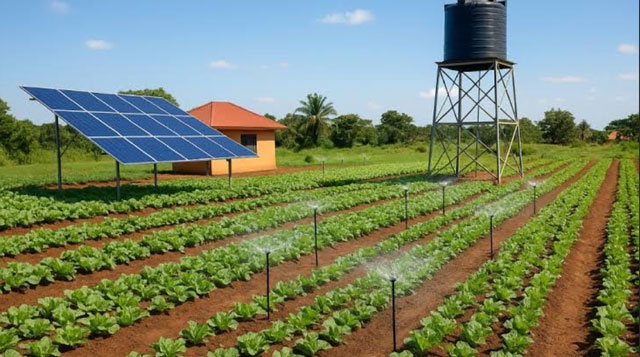
That control matters because agriculture is not only about whether rain falls but also when it falls. Water may be needed at planting, during germination, flowering or fruit development. A dry spell at a critical stage can cause damage even if rainfall returns later. Irrigation can help bridge some of those gaps and allow farmers to make decisions based on crop needs rather than relying solely on the weather.
The promise extends beyond irrigation. Solar energy can also power activities elsewhere along the agricultural value chain, including drying, processing, cooling and cold storage. Those uses matter because the losses farmers experience do not end when crops leave the field. Produce can lose value when it cannot be stored, processed or transported in time, while farmers may be forced to sell quickly into a weak market.
Khisa’s experience with cassava is a reminder that water alone cannot guarantee a profitable harvest. He was able to grow the crop, but low prices meant that the money he received could not cover the cost of bringing it to market. Irrigation could help make production more reliable, but it cannot by itself ensure that a buyer will pay a price that covers a farmer’s costs.
That is why the wider concept of “productive use of solar energy” has become important in discussions about Uganda’s agricultural sector. It means using solar power not only for household lighting or other basic energy needs, but for activities that generate income or improve productivity.
On Oct. 6, the Advocates Coalition for Development and Environment (ACODE), a Kampala-based public policy thinktank, called on the government to give productive solar energy a stronger place in its planning and budgeting for the 2027/28 financial year. Its proposals covered irrigation and water pumping, but also drying, processing, cold storage, cooling and value addition.
Dr Anthony Buyinza Mugeere (PhD), a research fellow at ACODE, described productive solar as the use of solar energy for income-generating activities that improve productivity or create economic value. The concept shifts attention from solar equipment as an end in itself to the economic and practical services it can provide.
A solar pump can support irrigation, but a solar dryer or cooling facility can address losses after harvest. A milling or processing system can help producers add value to their crops. Each intervention responds to a different problem, and each needs to be assessed according to whether it works for the people intended to use it, Dr. Mugeere said.
Onesmus Mugyenyi, ACODE’s Deputy Executive Director, argued that the potential of productive use of solar energy would not be realised unless the government prioritised it in public planning and budgets. The thinktank called for clearer targets and measurable indicators, bankable projects that could attract climate and development finance, and stronger systems for tracking expenditure and identifying who benefits.
The emphasis on public budgeting reflects a central challenge: even where the technology is available, the market may not deliver it to farmers who need it most. Solar pumps and their associated systems can be expensive to purchase upfront. Farmers may also lack access to credit, reliable technical support or information about the equipment best suited to their land and water source.
ACODE’s researchers identified poor-quality solar products, equipment costs and inadequate technical support as barriers to wider adoption. They also pointed to the need for subsidies that support quality equipment, as well as awareness and training through local governments.
Those challenges are particularly significant for smallholder farmers like Khisa, Washole and Sitati, who may have limited savings and little room to absorb the cost of a failed investment. A cheap pump that breaks down or is poorly matched to a farm’s needs may leave the farmer with debt and no dependable irrigation. A good-quality system may be more durable, but still remain out of reach if its upfront price is too high.
The question is therefore not simply how many solar pumps government can procure. It is how many farmers can use them reliably, whether the systems improve production and income, and whether support reaches the communities most exposed to weather shocks.
A pump without water is not irrigation
One of ACODE’s strongest cautions is that solar-powered irrigation cannot work in isolation from water infrastructure. Mugyenyi put the problem plainly: “You have a farmer who needs a pump to do irrigation but he also needs access to the water,” he said. He warned that if a pump is provided without the water needed to operate it, “this pump won’t be put to use.”
Mugyenyi’s point may sound obvious, but it has major implications for how irrigation programmes are designed. A solar pump needs a suitable and dependable water source. Depending on the location, that may mean a river, lake, valley or underground water source, but the availability, quality and seasonal reliability of the water must be assessed. There may also be a need for storage, conveyance channels, pipes, distribution networks or other infrastructure to get the water to the farm.
In some areas, a farmer may be able to draw water from a nearby source with a relatively small system. In others, the problem is more fundamental; water is scarce or distant, and individual pumps cannot overcome the absence of a reliable supply. Such places may require larger investments in water storage, bulk supply or other infrastructure before solar pumping can make a meaningful difference.
Paul Mwebaze, a research fellow at ACODE pointed to water-stressed areas such as Nakasongola and Luweero in central Uganda as areas where larger water infrastructure may be needed. Solar technology can help move water, but it cannot create a source where none exists.
This is a critical distinction for government planning. If support is directed only towards the purchase of pumps, the programme risks favouring places where water is already accessible and leaving out communities facing more severe constraints. Conversely, a programme that combines solar pumps with water-source development, storage and last-mile delivery could be more useful, but will also require careful planning, coordination and potentially greater investment.
There are environmental and management questions, too. Water sources must be used sustainably, and schemes need arrangements for maintenance, repair and fair access. Where several farmers rely on a shared source, decisions about when and how much water can be drawn may need to be agreed in advance. Without these arrangements, a technology intended to reduce vulnerability could create new disputes or become unreliable over time.
For farmers like Washole, who already has water in a valley but cannot easily transport it to his garden, a pump might address a clearly defined bottleneck. But his case should not be assumed to represent every farmer. The appropriate solution depends on local geography, water availability, the crops being grown, the area to be irrigated and the farmer’s capacity to manage the system.
Government’s irrigation ambitions—and the delivery question
The government has been pursuing solar-powered irrigation as part of a broader effort to expand irrigation and reduce agriculture’s dependence on rainfall. On June 10, this year, Parliament approved a loan of approximately €168.98 million (Approx. Shs 720bn) to finance Phase II of the Solar Powered Irrigation Project. The project was presented as covering 427 sites, with an expected reach of 4,768 acres and 2,562 households.
The loan approval followed a debate in the 11th Parliament about the scale and terms of borrowing, the scrutiny given to the proposal and the process through which it was approved. Those questions matter because large infrastructure projects must be judged not only by the needs they are intended to address, but also by the quality of their design, the transparency of their financing and the results they ultimately deliver.
The broader irrigation programme includes schemes such as Kabuyanda, Atari, Wadelai, Acomai, Namaitsu, Chembombai and Sipi. The government’s ambition is not limited to distributing individual pumps. Its plans include irrigation infrastructure and other water-for-production investments intended to support agricultural production and livelihoods.
On Oct. 6, Agriculture Minister, Frank Tumwebaze, said in a tweet that drought conditions and reports of poor germination and crop failure had prompted renewed attention to irrigation. He said Cabinet had discussed the matter and that President Yoweri Museveni had directed the conclusion of a plan for mass irrigation infrastructure to strengthen food and income security. The proposed approach includes support for food production, cash crops such as coffee and cocoa, animal feed and fish farming.
The following day, on Oct.7, the Ministry of Agriculture, Animal Industry and Fisheries began a two-day engagement with district local governments focused on agricultural transformation and the National Irrigation Development Project. Tumwebaze called for accurate, verified data from districts to inform planning.
The local leaders, who included both political and technical people, discussed last-mile conveyance where water sources already exist, the use of seasonal streams, rehabilitation of non-functional irrigation schemes and bulk water systems in water-stressed areas, alongside other water-for-production infrastructure. These are important elements because irrigation is not a single piece of equipment delivered to a farm; it is a system that must connect a water source to the land and keep functioning.
The emphasis on verified district data is also significant. Effective planning requires knowing which areas have reliable water sources, which are most exposed to dry spells, what farmers grow, how much land could realistically be irrigated and what infrastructure is already available. Without accurate information, government risks investing in systems that do not fit local conditions or overlooking places where irrigation could make the greatest difference.
Yet the distance between a plan and a working scheme can be considerable. Farmers need to know how the programmes will be implemented, who qualifies, what support will cost, when it will be available and where to seek help. Local authorities need the resources and technical capacity to support implementation. Equipment must be installed correctly and maintained. And the programme must be judged by outcomes rather than announcements.
Who will benefit?
For ACODE, the distribution of benefits is as important as the amount of money allocated. The coalition argued that climate-related and environmental spending can be difficult to trace through public budgets. It called for budget coding and clearer reporting so that the public can follow how much is spent, what it is spent on and which groups benefit.
Without such tracking, Mugyenyi warned, resources could end up going to farmers who are already better placed to access support, while smallholders and vulnerable communities are left behind. The danger is that a programme designed to help farmers adapt to climate variability may be easiest to access for those who already have money, land, information and connections.
That concern is especially relevant when equipment requires an upfront contribution or when farmers must navigate complex application processes. The researchers at ACODE also highlighted the difficulties farmers face in accessing finance, including collateral requirements and bureaucracy, and noted that women can encounter additional barriers.
A subsidy could help lower the initial cost of a pump, but subsidy design matters. If the process is cumbersome or requires farmers to meet conditions they cannot satisfy, the intended beneficiaries may still be excluded. If the subsidy supports low-quality equipment or fails to provide for installation and maintenance, the investment may not last. And if it covers equipment without addressing water access, it may not result in irrigation at all.
ACODE urged government to establish measurable targets and track whether investments improve production. That means asking more than how many pumps were bought or how much money was disbursed. It means asking how many farmers received functioning systems, how much land is actually irrigated, whether yields or cropping reliability improved, whether farmers’ incomes changed and whether benefits reached women and lower-income smallholders.
Mugyenyi also challenged the media to ask how many Ugandans or farmers have benefited from public irrigation programmes, how production has improved and what evidence supports continuing or expanding a project. Those questions are relevant to the solar irrigation programme, where the projected number of sites and households must eventually be compared with the actual number of systems operating and the results farmers experience.
Anna Amumpiire, a research fellow at ACODE said Uganda’s national roadmap for productive use of solar energy had not been fully operationalised and that the Ministry of Energy was developing guidelines.
She also pointed to existing initiatives, including the UGiFT (Uganda Intergovernmental Fiscal Transfers) programme and the GROW (Generating Growth Opportunities and Productivity for Women Enterprises ) project, while raising concerns about fragmented coordination between institutions.
“If different programmes operate in silos, farmers may struggle to understand what support is available or which agency is responsible, she said. She said, a farmer might need help with a water source, a pump, technical training and financing, yet those services may be sitting within different institutions, derailing implementing the entire initiative.
The limits of a solar solution
Yet, although solar energy has clear potential, it should not be presented as a complete answer to every problem facing Uganda’s smallholder farmers. Reliable irrigation can reduce exposure to some dry spells, but it does not remove all weather risks. Excessive rain, flooding, waterlogging, pests and crop diseases can still damage production. The government’s seasonal outlook itself warned of the possibility of extreme weather alongside the prospect of above-normal rainfall.
Nor does irrigation solve the market problems Khisa encountered with cassava. A farmer may produce more reliably and still struggle if prices collapse, transport costs are high or buyers are unavailable. For irrigation to improve livelihoods over the long term, it needs to be considered alongside access to markets, post-harvest handling, storage, processing, extension services and affordable finance.
This is why ACODE’s call for productive use of solar energy across the agricultural value chain is broader than a demand for pumps. Solar-powered drying, cooling, storage and processing may help farmers preserve quality, reduce waste and obtain better value from what they grow. But those investments, too, need to match local needs and market opportunities. Equipment that is not used, maintained or connected to a viable market will not deliver its promised economic return.
There is also a question of scale. A small pump may be appropriate for a farmer with a nearby water source and a limited plot. A larger community or commercial scheme may require shared infrastructure, engineering, water management and stronger institutional arrangements. Government needs to match the solution to the problem rather than assume that one model will work everywhere.
The benefits must also be measured over time. A successful installation is an important first step, but the real test is whether the system remains operational, farmers can afford to use it and the investment makes their livelihoods more secure. Transparent reporting should distinguish between planned coverage, completed installations, functioning systems and verified improvements in production or income.
Beyond the announcement
In Bugiri, the immediate concern for Khisa, Washole and Sitati is practical. They need a way to protect their crops from the next dry spell, and they need support that is affordable enough to use. Khisa has seen how one failed planting can leave him paying twice. Washole knows that water can be nearby and still be beyond his reach. Sitati says the absence of a harvest has left him with little to show for a year’s work.
Their experiences explain why solar-powered irrigation is attractive. It offers the possibility of giving farmers more control over water, reducing dependence on rainfall and making better use of land. But that promise will be realised only if the technology reaches the farmers who need it and is backed by the water infrastructure, finance, training and maintenance that make it useful.
The government has announced ambitious irrigation plans and secured financing for a major solar-powered irrigation programme. ACODE is urging policymakers to embed productive solar energy more firmly in the budget and to make public spending more transparent and measurable. The next stage is to show how those commitments translate into functioning systems and tangible benefits.
For farmers, the measure of success will not be the number of meetings held, the value of a loan approved or the number of pumps listed in a project document. It will be whether they can plant with greater confidence, keep crops alive when rainfall falters, harvest enough to feed their households and earn an income that covers their costs.
The post Pumps, promises and parched fields: Is Uganda ready for solar irrigation? appeared first on 1:.