

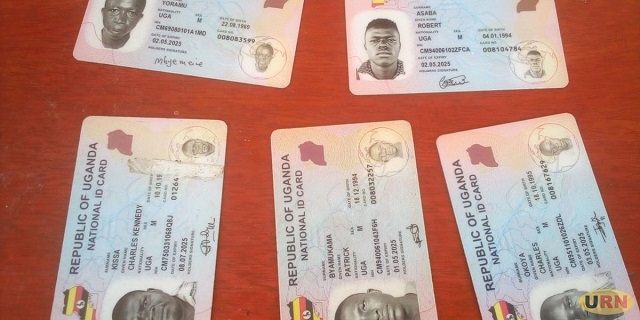
COMMENT | CLAIRE OLLAMA | Under the new National Security Information System, rolled out in May 2025, @NIRA_Ug strengthened electronic verification of personal information by requiring that customer information be only retrieved from the National Identification & Registration Authority (NIRA) database when a bank presents a National Identification Number and the customer’s fingerprint or iris. The ID document becomes secondary proof of your identity.

This was a significant departure from the existing way of verifying information, where verification depended only on information presented on reading the ID document.
This change in means of verification has resulted in a need for banks and telecoms to make significant upgrades to their existing technologies, a process that is progressing slower than anticipated but moving in a positive direction.
Therefore, as banks and telecoms continue to upgrade their existing systems, verification of information presented on the new cards will be possible.
NIRA introduced this safeguard after reports of stolen cards and instances in which photographs on genuine cards were altered and used to obtain loans in other people’s names.

This country!!
@NIRA_Ug told us to re-register to get new IDs.
When you go to Foreign Affairs get a passport and present the new ID , they send u back to @NIRA_Ug to get a confirmation letter that they indeed gave you the new ID.
Apparently I have heard that even in some places, registering anything with new ID is a whole mess because the new #NIN mbu doesn’t reflect.
Are you seeing these things?
What’s so heard in interlinking all this information in one place? What would it cost?
— Godfrey KUTEESA!! (@GODFREY_Kutesa) November 18, 2026
Biometric authentication enables a service provider (or third party) to check that the identity of the person seeking service (e.g., opening a bank account) is matched using a fingerprint or iris supplied at a service point against the fingerprint that NIRA collected during enrolment that is stored in the National Identification Register. After their identity is ascertained, their particulars are retrieved from the register in their presence with their consent.
Furthermore, in the age of AI, where non-existent persons can be generated by technology to near perfection, the risk of creating a KYC profile based on a synthetic person is mitigated by the supply of a fingerprint from a warm body.
In April 2026, NIRA shared integration guidance with all 107 partners using its third-party interface. As at 28 October 2026, NIRA reported that 10 partners had completed onboarding and were transacting on the new system. The Uganda Bankers’ Association reported that some member institutions were still testing their connections and that many were procuring or installing compatible biometric readers.
During the transition, NIRA has been assisting partner institutions to verify information through secure email at no cost to those institutions. NIRA also issues Confirmation of Information Letters for specified recipients and purposes. Where a customer’s card cannot be verified at the point of service, the customer should ask the institution whether it can verify their details through NIRA’s secure channel or accept a Confirmation of Information Letter for the transaction concerned.
Citizens who need assistance from NIRA may call its toll-free line on 0800 211 700
****
ADAPTED FROM TWITTER
 Ollama is a Public Relations Officer from NIRA