

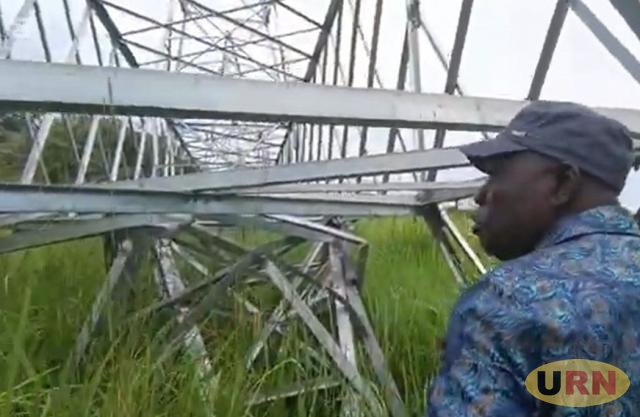
Pakwach, Uganda | URN | Kilak South Member of Parliament Gilbert Olanya has challenged the Ministry of Energy and Mineral Development over claims that vandalism caused the collapse of several electricity transmission towers along the Karuma–Olwiyo–Pakwach power line. The controversy follows statements by Energy Minister Ruth Nankabirwa Ssentamu and State Minister for Energy Sidronius Okaasai Opolot attributing the incident to widespread vandalism in Northern Uganda.
In a statement issued on May 3, 2026, the Uganda Electricity Transmission Company Limited (UETCL) said five towers along the Karuma–Olwiyo–Pakwach transmission line collapsed due to acts of vandalism. The company added that it was already in advanced stages of procuring a contractor to restore the affected infrastructure, warning that vandalism disrupts power supply and poses serious risks to human life.
However, Olanya dismissed the explanation, arguing that the towers collapsed because of poor-quality materials and weak engineering rather than sabotage by residents. “These towers were not vandalized by our people,” Olanya said in a video message addressed to his constituents and fellow legislators.

“They were destroyed by the wind because the materials purchased by the ministry were cheap and weak. We cannot blame the citizens for the failures of procurement and engineering.” He further questioned the reported cost of the towers, claiming that although the government allegedly spent about Shillings 800 million on each structure, the metals used appeared weak and substandard.
Olanya called for an independent investigation into the procurement and construction process, arguing that allegations of vandalism were being used to shield possible corruption and poor workmanship.

The MP’s remarks come amid an ongoing government campaign against vandalism of electricity infrastructure, which authorities describe as a major threat to the country’s power network. Minister Nankabirwa recently described vandalism as “economic sabotage” and “terrorism” following incidents involving attempts to steal parts from transmission pylons, including a case on the 132kV Owen Falls–Mukono North transmission line in November 2025.
The government has identified several areas, including Greater Kampala, Busoga, parts of the Albertine region, and Mbarara, as hotspots for scrap-metal dealers accused of targeting electricity infrastructure. Despite this, local leaders and some legislators have raised concerns that vandalism is increasingly being used as a blanket explanation for failures linked to substandard materials or compromised construction projects.
Olanya has since called on Members of Parliament, especially representatives from Northern Uganda, to conduct a physical inspection of the collapsed towers to establish the actual cause of the incident. The Uganda Electricity Distribution Company Limited (UEDCL) has previously estimated that the country loses about three billion shillings annually in replacing vandalized electricity infrastructure.
Neither UETCL nor the Ministry of Energy has publicly responded to concerns raised about the quality of transmission towers used across the country. Attempts to obtain comments from Ministers Nankabirwa and Okaasai were unsuccessful as they could not be reached by phone.