

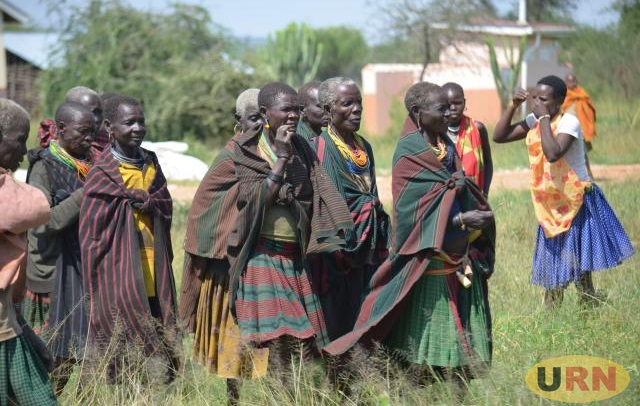
Napak, Uganda | URN | Leaders in Karamoja have warned that the Protection of Sovereignty law could cripple the region’s economy, disrupt peace building, and reverse development gains by redefining “foreign influence” and capping external funding.
In a position paper released this week, Karamoja leaders said the Bill, while aimed at safeguarding national sovereignty, fails to account for the sub-region’s heavy reliance on donor aid, cross-border trade, and foreign direct investment.
The paper notes that Karamoja receives an estimated USD 70–90 million annually in donor funding for education, health, food security, water, and peacebuilding.

Between 2022 and 2023, foreign funding to the sub-region exceeded USD 60 million, or 230 billion shillings .
Under the Karamoja Regional Development Plan 2025-2035, donors are expected to cover 20% of implementation costs, the private sector 24%, and the Government 55%.

They argue the Bill’s proposed cap requiring ministerial approval for funds above 400 million Shillings would jeopardize critical support.
“These are not peripheral activities; they are the foundation of resilience and survival,” the paper states.
The Bill redefines “foreigners” to include Ugandan citizens abroad and expands the definition of “foreign influence” to include individuals and institutions that receive external funding. Leaders say this misclassifies Karamoja’s cross-border pastoralist economy as a threat.
Karamoja shares borders with Kenya and South Sudan. In 2018, livestock trade between Kenya and Uganda alone was worth about USD 1 million.
In the Amudat district, roughly 70% of livestock sold goes to Kenya. The paper warns that restricting cross-border mobility and trade could push youth back into cattle raiding, undoing peace gains tied to the economic reintegration of former karachunas.
The sub-region is emerging as a tourism frontier with Kidepo Valley National Park, Pian Upe Wildlife Reserve, and Mount Morungole.
New roads and an international airport are planned. Private operators like Karatunga Tours and DNA have grown the sector, which employs women and youth.
The paper says the Bill could discourage investment and create uncertainty for tour operators by constraining cross-border mobility.
Cultural events like the Karamoja Cultural Festival, which draw Ateker communities from across borders, could also be hit.
On extractives, Karamoja is positioning itself as an industrial hub. Companies including Sand Belt, Yaobai Cement, Tororo Cement, and Savannah Cement have invested heavily.
Yaobai alone is a USD 300 million investment projected to produce 6,000 tonnes of clinker daily and employ thousands.
The paper notes Yaobai’s parent firm, West International Holding, is a subsidiary of China West Cement Limited, meaning staff could be categorized as “agents of foreigners” under the Bill.
New institutions, including Moroto University, KAPATU, and the International University of East Africa, are designed to attract international students, partnerships, and research funding.
Matany Hospital in the Napak district, key for health training, also relies on external support. The paper argues that the Bill risks deterring students, faculty, and donors by limiting mobility and funding.
While acknowledging legitimate concerns about foreign influence, Karamoja stakeholders said the Bill risks “misclassifying survival systems as external threats.”
“A balanced approach is needed, one that protects sovereignty while preserving the socio-economic and peace structures that sustain Uganda’s border regions,” the paper concludes.