

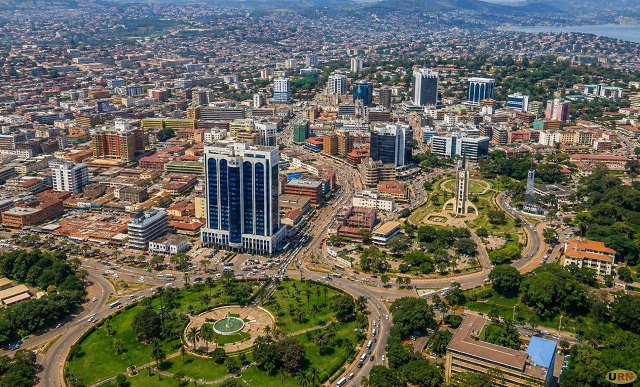
NEWS ANALYSIS | URN | The idea of moving Uganda’s capital from Kampala to Nakasongola has returned to the national conversation, reviving a debate that has periodically surfaced in Ugandan politics and physical-planning circles.
The latest discussion centres on whether government should gradually relocate political and administrative functions from Kampala to a purpose-built urban centre in Nakasongola, while allowing Kampala to retain its dominant commercial role.
But the proposal is not yet a settled government policy, and there is an important distinction between relocating government functions and formally changing Uganda’s capital city.

Under Article 5 of the Constitution, Kampala is the capital of Uganda, administered by the Central Government. The Kampala Capital City Act, 2011, similarly declares Kampala the country’s capital city.
That makes a formal transfer of the capital a constitutional matter, rather than simply an administrative decision to move ministries.

The idea of Nakasongola as an alternative political or administrative centre is not new. In December 2024, Members of Parliament discussing the draft Fourth National Development Plan with the National Planning Authority proposed decentralising some government functions to other parts of the country, including Nakasongola.
John Musila, the then Bubulo East MP, argued that Kampala should concentrate on its economic role while political and administrative functions could be established elsewhere. He specifically suggested moving Parliament to a new city such as Nakasongola. Other MPs supported the broader idea of developing a separate political and administrative centre.
The Nakasongola proposal also has a longer political history. In November 2010, presidential candidate Abed Bwanika pledged to move Uganda’s capital to Nakasongola if elected. He cited its location in the middle of the country and its accessibility from different parts of Uganda, while proposing that Kampala remain the country’s central business district.
More recently, calls for relocating some government functions have resurfaced amid concerns over Kampala’s congestion, infrastructure deficiencies and rapid urban growth. Contemporary reports in August 2026 have described a proposal for a phased relocation of ministries, departments and agencies to Nakasongola, potentially extending to 2040. However, the reports also indicate that the proposal remains under consideration rather than being an approved relocation programme.
The official planning record provides an important piece of context: Nakasongola is already identified in Uganda Vision 2040 as one of five strategic cities, alongside Hoima, Fort Portal, Moroto and Jinja. The five regional cities identified in the same framework are Kampala, Gulu, Mbale, Mbarara and Arua.
That designation, however, does not amount to a decision to make Nakasongola the national capital.
Wilson Awuzu, a physical planner and urban development specialist involved in the preparation of the Greater Kampala Metropolitan Area master plan, takes a different view of the need for relocation.
In an interview with URN, Awuzu said the proposal was still being considered by Cabinet and that the debate had recently returned to public attention after having been relatively dormant.
His central argument is that Kampala’s problems do not necessarily demonstrate that the city has reached its physical limits.
“I don’t think that there is reason and need either to begin another capital city immediately or to move, as it was said, to move Kampala from where it is right now and we take the capital to Nakasongola,” Awuzu said.
He argues that Kampala’s biggest challenges are not simply population size but the way land, transport, housing and services are organised.
“Kampala is one of the least developed, as far as land use is concerned, cities in Africa,” he said.
His solution is greater density rather than continued outward expansion.
Awuzu’s argument is consistent with a broader direction in Uganda’s physical-development policy.
Uganda’s Vision 2040 identifies uncontrolled urban sprawl as a problem and calls for integrated physical planning, development control and increased settlement densities, including through high-rise buildings.
The National Physical Development Plan similarly envisages a more polycentric settlement pattern, with stronger secondary urban centres helping to reduce excessive concentration in Greater Kampala. Its planning scenarios include Nakasongola as a future major regional urban centre rather than simply as a replacement capital.
The GKMA master plan takes a similar approach. Its future spatial structure is organised around four broad elements: landscape, housing, jobs and connectivity.
The plan’s study area covers Kampala Capital City together with Wakiso, Mukono and Mpigi districts- an area of about 5,148 square kilometres.
The master plan projects the population of GKMA from 5.584 million in 2020 to 8.046 million in 2030, 11.094 million in 2040 and 14.142 million in 2050. Kampala Capital City itself is projected to have about 2.234 million people by 2050, with the much larger increase occurring outside the city’s administrative boundaries.
Awuzu’s concern also extends beyond congestion.
He argues that outward urban expansion is consuming land that could otherwise support agriculture.
In the interview, he pointed to areas such as Mpigi and Mukono, where rural land has increasingly been converted to real estate development.
His argument is that Uganda should avoid solving Kampala’s housing and congestion problems by simply spreading development farther into the countryside.
Instead, he advocates concentrating more people in properly planned, higher-density urban developments.
This is broadly consistent with national physical-planning policy, which seeks to consolidate settlements, manage urban expansion and protect land and other natural resources. The Ministry of Lands says the National Physical Development Plan is intended to guide the allocation, use and management of Uganda’s land and physical resources.
Traffic congestion is one of the strongest arguments being advanced by supporters of decentralisation.
There is no question that congestion is a serious problem in Greater Kampala. The GKMA master plan contains extensive transport proposals, including road improvements, public transport interventions and a metropolitan approach to connectivity.
But Awuzu argues that traffic congestion is not, by itself, evidence that Kampala must cease being the capital. He attributes the problem partly to poor road behaviour and traffic management, but also to the concentration of services in the city.
He used Beijing as an example of a much larger city where traffic can be managed through better systems and behaviour.
His broader point is that moving government offices would not necessarily solve congestion if jobs, businesses, schools, markets and other services continued to be concentrated in Kampala.
The master plan therefore attempts to address the problem through a polycentric urban structure.
The GKMA plan proposes a hierarchy of urban centres around Kampala.
The technical plan identifies metropolitan centres including Kajjansi, Nsangi, Mukono, Wakiso, Matugga and Gayaza-Kasangati. It also identifies secondary urban centres, urban sub-centres, suburban centres and service centres.
The master plan sees metropolitan centres as intended to support jobs, education, health facilities and other urban functions. For example, its projections indicate that Nsangi, Mukono and Kajjansi will each need capacity to serve more than two million people with jobs and major services by 2050.
Awuzu sees this as the more immediate solution to Kampala’s congestion.
“If these strategies are followed, there is no need to move anywhere,” he said.
Awuzu argues that informal settlements such as Katanga are partly a consequence of the mismatch between where low-income workers can afford to live and where jobs are located.
His position is that poor households will continue seeking accommodation near employment because transport costs and commuting times make distant housing difficult to sustain.
The strongest argument for a new capital may be that Nakasongola would allow government to plan a city from the beginning rather than continually retrofit Kampala.
But that advantage comes with an enormous financial question.
A new administrative capital would require substantial investment in roads, water, electricity, telecommunications, public buildings, housing, schools, health facilities, public transport and other infrastructure.
Awuzu said in the interview that he had not calculated the cost of establishing a new capital and therefore did not want to speculate.
He did, however, cite an estimated requirement of about US$1 billion annually for 25 years for implementation of the broader Greater Kampala Metropolitan Area plan. He stressed that this was not a single-ministry budget, but a combined estimate covering infrastructure and services delivered by different government institutions across the metropolitan area.
Vision 2040 identifies Nakasongola as a strategic city. The National Physical Development Plan envisages it developing into a substantial urban centre, with the wider policy seeking to reduce excessive dependence on Kampala by strengthening other cities and growth poles.
The post How viable is moving Uganda’s Capital City from Kampala? appeared first on 1:.