

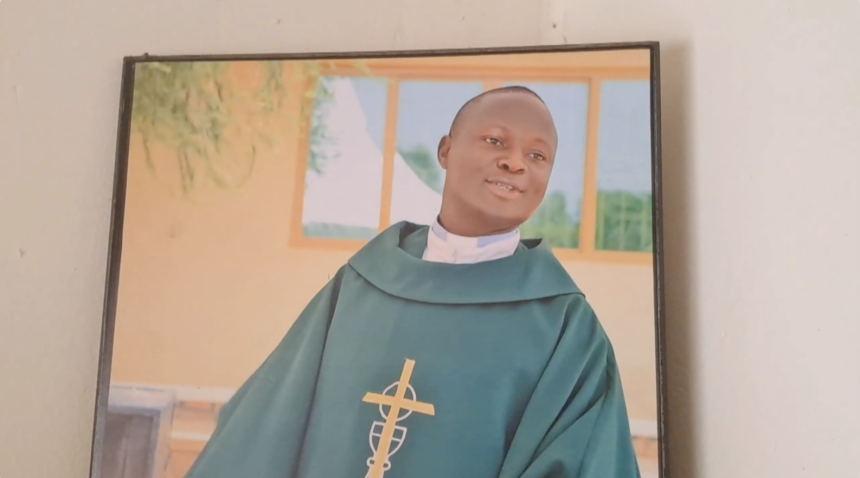
The Uganda People’s Defence Forces (UPDF) finally confirmed the detention of Masaka Catholic priest Rev. Fr. Deusdedit Ssekabira, who had been missing for over a week, claiming he is under investigation for “violent subversive activities against the state.”
While the military cites national security concerns, the circumstances of the arrest—including an alleged ‘abduction’ by men in army uniform and initial police denial—suggest a far more chilling motive: the government’s escalating effort to silence dissenting voices within the influential religious establishment.
Disappearance, Denial, and Delayed Confirmation
Fr. Ssekabira, a curate at Bumangi Parish, was reportedly seized on December 3, 2025, from his office in Masaka City.
Accounts from the Masaka Catholic Diocese, led by Bishop Severus Jjumba, describe the incident as a “grievous wound,” stating the priest was “kidnapped by men in Uganda Army uniform” using a van commonly known as a ‘drone’—a vehicle often associated with enforced disappearances.

For days, the whereabouts of the priest remained unknown, with the Uganda Police Force initially claiming ignorance of the matter, forcing the Diocese to pursue legal action, including filing for a writ of habeas corpus.

The UPDF’s subsequent statement on December 14, confirming the arrest, shattered the police’s narrative, creating a public crisis of confidence in the state’s security apparatus and adherence to the rule of law.
Undermining Due Process and Civil Liberties
The military’s prolonged detention of a civilian, Rev. Fr. Ssekabira, blatantly disregards the constitutional provision that an arrested person must be produced before a court of law within 48 hours.
This violation, coupled with the initial cover-up, has reignited long-standing public anxiety over arbitrary arrests, enforced disappearances, and the military’s encroachment on civilian law enforcement—a practice critics often link to pre-election intimidation tactics.
Opposition leader Robert Kyagulanyi (Bobi Wine) was quick to point out the anomaly, stating that the military has “no place detaining civilians.” The case now serves as a high-profile example of the government’s willingness to override due process when dealing with perceived critics.
A Message to the Clergy: Be Silent
The Catholic Church, along with other religious bodies, holds significant moral and social authority in Uganda. Historically, various bishops and priests have been vocal in critiquing corruption, human rights abuses, and deficiencies in governance. By targeting a Catholic priest with such serious, yet unspecified, charges as “violent subversive activities,” the government sends a powerful, intimidating message to the entire religious fraternity.
The swift, paramilitary-style operation and the subsequent attempt to obscure the priest’s location suggest an intent that goes beyond a standard criminal investigation. It appears designed to instill fear, forcing religious leaders to retreat from political and social commentary and limit their involvement solely to spiritual matters.
Bishop Jjumba’s immediate legal and spiritual response—ordering a Rosary Triduum and preparing for a court battle—demonstrates the Church’s resolve not to be cowed.
However, the use of state force against a man of God on vague charges of subversion is widely viewed as a deliberate and calculated effort to neutralize one of the few remaining independent voices capable of rallying public opinion.
The arrest of Fr. Ssekabira is not just a legal matter; it is a critical test of civil liberties and the independence of religious institutions in Uganda.
The government’s claim of lawful custody must now be scrutinized against the backdrop of its own constitutional violations and its history of silencing critics through military detention.