

Kyegegwa, Uganda | URN | When food and cash assistance stopped two years ago, Moise Kaulwa, a refugee from the Democratic Republic of Congo living in Kakoni Refugee Zone in Kyaka II Refugee Settlement in Kyegegwa district, had to find a new way to feed his family.
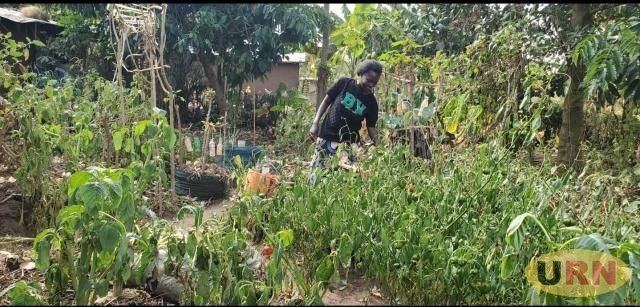
Like many other refugees in the settlement, Kaulwa turned the small plot surrounding his shelter into a productive garden, growing vegetables to supplement household meals and reduce dependence on humanitarian assistance.
According to Kaulwa, although refugee households are allocated 30-by-30-foot plots mainly for shelter, many families now reserve part of the land for gardens.

“We always leave some space where we plant vegetables to supplement the food we receive. Even if the space is small, it can still provide food for the family,” he says. Kaulwa adds that some refugees who can afford it hire land from members of the host community to grow cassava, beans, maize and soybeans.
Kaulwa’s experience reflects a growing trend across Kyaka II Refugee Settlement in Kyegegwa District, where refugees are turning the small plots surrounding their homes into productive gardens and adopting climate-smart farming practices to cope with declining humanitarian food assistance and the effects of climate change.

The shift comes after reductions in food and cash assistance from the World Food Programme (WFP), forcing many refugees to look beyond humanitarian aid and become more self-reliant. Due to funding shortages, the World Food Programme progressively reduced food rations for refugees in Uganda.
Under the current arrangement, new arrivals receive 60 percent of their full ration, the most vulnerable receive 40 percent, and moderately vulnerable households receive 22 percent. In May 2025, WFP also reduced the number of assisted refugees from 1.6 million to 662,000, phasing out support for those considered least vulnerable.
Jean Pierre Lounjiringa says refugees have received training in establishing keyhole vegetable gardens, enabling them to produce food even in limited spaces. He explains that the circular gardens have a compost pit at the centre where household organic waste is placed to decompose. As the manure breaks down, nutrients spread throughout the garden, improving soil fertility and increasing yields.
Lounjiringa says refugees are also planting fruit trees such as mangoes, jackfruit and avocados to improve household nutrition while conserving the environment.
For Zawadi Kulodina, backyard gardening has become an important source of food for her family. She says vegetables such as beetroot, cabbage, eggplants and dodo help her maintain a balanced diet and protect children from malnutrition. To ensure she harvests vegetables throughout the year, especially during the dry season, Kulodina uses plastic bottles as a simple irrigation method.”We make small holes in the bottles, fill them with water, and place them beside the vegetables. The water drips out slowly, helping to keep the vegetables from drying out,” she explains. Kulodina says she also sells some of the vegetables and saves the earnings through a village savings group.
For Elizabeti Estel, hiring farmland from members of the host community has improved both food security and relations with neighbouring communities. She says that after venturing into farming, her family now harvests enough food for consumption and sells the surplus to meet other household needs.
She adds that agriculture has strengthened peaceful coexistence between refugees and host communities. “When we hire land from nationals, we get close to them and even become friends. They no longer see us as a problem but as partners. We are now free with them,” she says.
According to Joseph Bakahera, a Field Officer with Joint Efforts to Save the Environment (JESSE), the organisation has worked to change refugees’ perception that successful farming requires large pieces of land.
“Most of them used to think that someone with a big piece of land is the one who could harvest a lot, but we are changing that mindset by teaching them how to maximize the small land they have.”
He says some refugee households with small plots are now harvesting more than farmers with much larger gardens because they have adopted climate-smart farming practices.
Among the technologies promoted are keyhole gardens with compost pits at the centre, which improve soil fertility using organic waste.
Refugees also use recycled plastic bottles to make simple drip irrigation systems that slowly release water onto crops during dry spells.
Alfred Okeng, a Project Officer at JESSE, says the initiative was designed to help refugee communities become more self-reliant as humanitarian assistance continues to decline.
“As donor funding reduces, refugees have to find sustainable ways of feeding themselves.
We are encouraging them to grow food on every available piece of land and use climate-smart farming methods to increase production,” Okeng says.
He says the organisation provides training and fast-maturing vegetable seedlings, enabling families to produce nutritious food close to home instead of buying it.
Okeng adds that refugees are further encouraged to protect the environment by avoiding cultivation in wetlands, reducing tree cutting and adopting conservation practices such as mulching, trenching and tree planting.
Kyaka II Refugee Settlement hosts more than 130,000 refugees, most of whom are from the Democratic Republic of Congo.
This version follows a stronger narrative flow: it opens with one refugee’s personal experience, broadens to show that his story reflects a wider trend in the settlement, explains the reduction in humanitarian assistance that prompted the shift, and then presents additional refugee experiences before ending with the perspectives of the implementing organization and the settlement’s broader context.
The post SMALL PLOTS, BIG HARVESTS: How climate-smart farming is helping refugees feed their families appeared first on 1:.