

Kampala, Uganda | URN | When Francis Mugwanya was a child, some neighbours questioned his parents’ determination to send him to school. Born healthy, he was later paralysed by polio. Without a wheelchair, getting to school was a struggle, and his parents faced criticism from those who believed he would never amount to much.
His father refused to listen. Instead, he bought a bicycle, and Mugwanya’s older brother helped transport him to school. The brothers fell off repeatedly, but each fall became another test of their determination to keep going. “Why are you taking him to school? He will be useless anyway. Just leave him at home,” Mugwanya recalled neighbours telling his parents.
The criticism did not deter his father. Eventually, a well-wisher gave Mugwanya a wheelchair, a gift that would shape the course of his life and inspire him to establish a ministry dedicated to helping others facing similar challenges. Today, Mugwanya is the executive director of Father’s Heart Mobility Ministry, an organisation that he says has distributed more than 25,000 wheelchairs across Uganda.

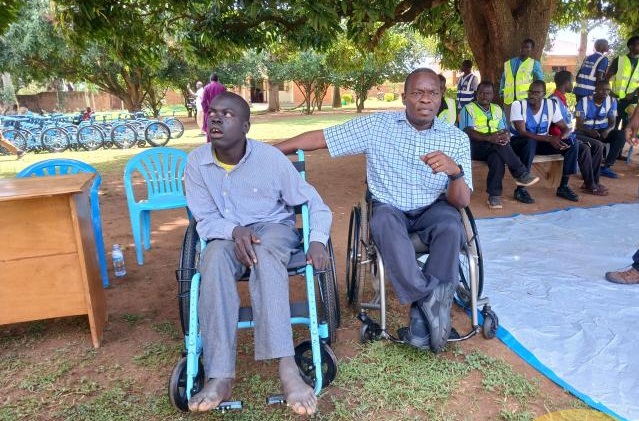
His journey has now brought him to Kitgum, where the ministry is working with the Diocese of Kitgum to distribute 295 wheelchairs to registered beneficiaries in a programme targeting Chua East, Chua West and Kitgum Municipality. For Mugwanya, the exercise is more than a distribution of mobility equipment. It is an opportunity to fulfil a promise he made after receiving the wheelchair that changed his life.
“I told God, when I grow up, I will give someone a wheelchair,” he said. That childhood promise has grown into a mission to restore mobility, dignity and opportunity to people whose lives are often constrained by disability, poverty and social exclusion.

Turning Personal Pain into Purpose
Mugwanya says his parents’ determination to educate him, despite the difficulties and pressure from the community, taught him that disability should never be a reason to deny a child the opportunity to develop.
His experience has also shaped his appeal to parents to resist negative attitudes towards children with disabilities, including beliefs that they are cursed, incapable of contributing to society or unworthy of education. “Those children are a gift from God,” he told persons with disabilities and their families during the Kitgum outreach, urging them to provide care, education and support.
He recalled that his father once paid for a wheelchair in Kampala, but the promised equipment never arrived. The family had to find another way to get him to school. The bicycle journeys with his brother were difficult, and their repeated falls attracted further ridicule. Some neighbours even warned that his brother might also become disabled because of the accidents.
But his father persisted. For Mugwanya, that decision illustrates the difference family support can make in the life of a child with a disability. His message to persons with disabilities is equally direct: they should not measure their worth by what they cannot do but should identify and use the abilities they possess.
“I tell people that for me, God gave me two gifts. Two things that I can do. I can talk, and I can give wheelchairs,” he said. He urged others to discover their talents rather than surrender to discouragement. “Use whatever God has given you,” he said.
Mugwanya also challenged leaders to share their resources with vulnerable people, arguing that meaningful service does not always depend on wealth. He said he began buying wheelchairs when he was earning a monthly salary of Shs90,000, demonstrating that even modest resources could be used to support someone in need. “Leaders, whatever you have, don’t eat alone. Share,” he said.
Mugwanya’s work carries a message that extends beyond the wheelchairs being distributed: children with disabilities deserve education, families need support, and persons with disabilities should be given opportunities to contribute to society.
A Church’s Mission of Compassion
The initiative in Kitgum has received the support of the Diocese of Kitgum, whose bishop, the Rev. Wilson Kitara, says caring for persons with disabilities is central to the church’s responsibility towards vulnerable communities. Kitara said the diocese had partnered with Father’s Heart Mobility Ministry after appealing for assistance to reach people who need wheelchairs.
For the bishop, the initiative is rooted in the example of Jesus Christ and the Christian obligation to care for people who are sick, poor and marginalised. Kitara invoked the biblical teaching that human beings are created in God’s image as a basis for respecting everyone, regardless of physical condition or social standing. “God has given us a gift. We have all been created and born and made in God’s image,” he said.
His message echoes Psalm 139:13–14, which describes human beings as formed by God in the womb and “fearfully and wonderfully made”. The passage provides a theological foundation for the bishop’s argument that disability should never diminish a person’s dignity or value.
Kitara also drew on Jesus’ ministry to the sick and vulnerable, saying the church must direct its attention towards people who are neglected and in need of support. He urged community members, civil society organisations and government leaders to work together to ease the challenges faced by persons with disabilities.
The post From Polio Survivor to Wheelchair Advocate: Francis Mugwanya’s mission of hope appeared first on 1:.