

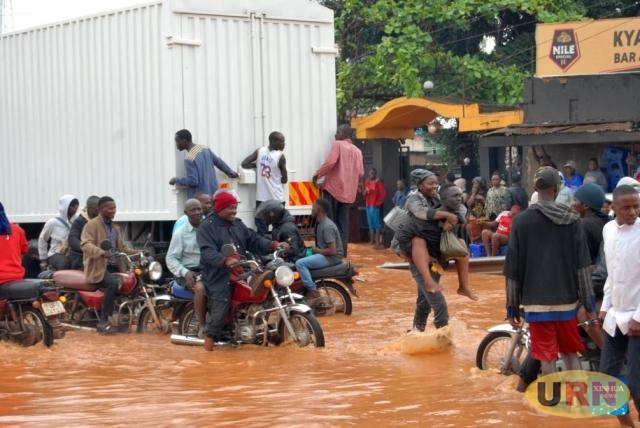
Kampala, Uganda | URN | The Office of the Prime Minister has developed a costed preparedness and response plan for the forecast El Niño rains, but the plan is yet to receive funding.
As a result, the government is left with insufficient resources to pre-position relief supplies and emergency equipment before the rains intensify.
According to the OPM, almost 80 percent of the country is expected to receive above-normal rainfall between September and December, increasing the risk of floods, landslides and damage to roads, bridges, schools and other infrastructure.

Rose Nakabugo, Assistant Commissioner for Disaster Management in the Office of the Prime Minister, said the government has identified the risks and prepared a costed contingency and response plan covering sectors including agriculture, food security, health, water and sanitation, education and disaster coordination. But the plan still has to go to Cabinet for approval and funding.
“A costed contingency and response plan has been developed, but in order for it to be funded, we need to present it to Cabinet to approve the required resources to support us in response,” Nakabugo told the IGAD Regional High-Level Forum on El Niño Preparedness for the Horn of Africa.

The event is taking place in Addis Ababa, Ethiopia, as countries in the region prepare for El Niño.
Nakabugo said the lack of resources is already affecting the government’s ability to prepare for predictable emergencies.
“We have a problem of insufficient resources for timely procurement and prepositioning of relief items, including emergency equipment,” she said.
The lack of or inadequate financing may affect operations in the event of major disasters in areas vulnerable to landslides, including the Elgon and Rwenzori regions, where the government needs equipment to clear roads and respond to landslide emergencies.
“We have those mountainous areas like the Elgon and Rwenzori. We are likely to experience landslides there, but we need equipment to support us in excavation, just in case. But these need to be prepositioned,” Nakabugo said.
The expected rainfall is likely to reverse the country’s recent weather challenge. The country has been experiencing a severe dry spell that has contributed to food shortages and deaths in some areas, particularly Karamoja.
The government now expects most parts of the country to move into a rainy period with enhanced rainfall.
Nakabugo said the anticipated rainfall could increase the risks of floods and landslides and cause damage to infrastructure.
“The expected rainfall could increase all the hazards that we expect to experience, include landslides, floods, damage to infrastructure, and other impacts,” she said.
Uganda’s challenge reflects a wider problem identified at the regional forum: governments and humanitarian agencies are increasingly developing anticipatory-action plans, but financing is not keeping pace with the plans.
A regional survey presented at the meeting found significant funding gaps among anticipatory-action plans, with only a minority of plans having full funding pre-arranged for activation.
Maureen Ambani, who coordinates anticipatory action for the World Food Programme’s regional office for Eastern and Southern Africa, said the region faces a major challenge in moving from plans to actual intervention without financing already in place.
“There’s a critical challenge for us to translate from plans to actual actions if we don’t have the relevant pre-arranged financing in place,” Ambani said.
She called for financing to be arranged before rainfall and flooding begin.
“A key plan for us to pre-arrange finance right now before the rainfall and flooding starts,” she said.
South Sudan’s experience highlighted the same problem. Charles Placido Wani Lako, Director for Emergency Preparedness and Response in South Sudan’s Ministry of Humanitarian Affairs and Disaster Management, said his country has developed an anticipatory-action roadmap and is working to involve government more directly in financing the approach.
He said the country had previously relied heavily on partners to drive anticipatory action, but government involvement is now being strengthened.
“Anticipatory action will not work without government taking the lead in finances,” Placido Wani Lako said.
Uganda, however, says it already has the legal and institutional framework needed to coordinate anticipatory action.
Nakabugo said Uganda’s Disaster Preparedness and Management Policy assigns the Office of the Prime Minister the responsibility of coordinating disaster-risk management.
She said the framework brings together government agencies, development partners and local governments to share forecasts, identify high-risk areas, determine available resources and agree on how to respond. “If there is a forecast, it is received, and it is shared across all stakeholders,” Nakabugo said.
She said joint planning allows government and partners to identify hotspots, determine where resources are needed most, and avoid duplication.
“When we plan together, we are able to identify the challenges together, the hotspots together, which regions or districts are going to be affected most, where should we focus our energies, where should we focus our resources, and that’s exactly what we do,” she said.
Uganda is also using early-warning messages through social media and local governments and translating the information into local languages.
According to Nakabugo advisory workshops have been conducted in high-risk areas including Karamoja, Elgon and Teso, while local governments have been asked to identify safer areas where communities at risk can be evacuated if rainfall intensifies.
The government is also working with the Uganda Red Cross Society to strengthen volunteer networks that can support monitoring, damage assessments, data collection, information relay and search-and-rescue operations.
Nakabugo said some high-risk local governments and urban areas have limited preparedness and response capacity, while critical infrastructure remains vulnerable. She also said some road sections located in wetlands require strengthening to withstand heavy rainfall, but this has not been fully done.
Another challenge is delayed receipt of real-time information about damage and losses from some locations, which can affect timely response.
Nakabugo said Uganda’s experience from previous El Niño conditions shows that acting before disasters occur is more effective and less costly. “Early action is more effective and less costly,” she said.
The regional meeting also highlighted the need for countries to harmonise the triggers used to determine when anticipatory action should be activated.
Participants said different countries and organisations are currently using different meteorological forecasts, hydrological information, river-level measurements and community observations to determine when to act.
They warned that without greater coordination, organisations could respond at different times and in different locations even when facing the same regional hazard.
The meeting also called for stronger cross-border information sharing, particularly for river systems whose flooding affects more than one country.
Somalia’s disaster-management officials said timely information from Ethiopia about water flows in the upstream areas of the Shabelle and Juba River systems could give downstream communities additional time to prepare.
Participants called on IGAD to help establish stronger mechanisms for sharing such information between countries.
The government knows the areas at risk, has identified the likely hazards and has a coordination system for bringing agencies and local governments together.
But the money required to fully activate the plan, including timely procurement and pre-positioning of emergency supplies and equipment, is still awaiting Cabinet approval and funding.