

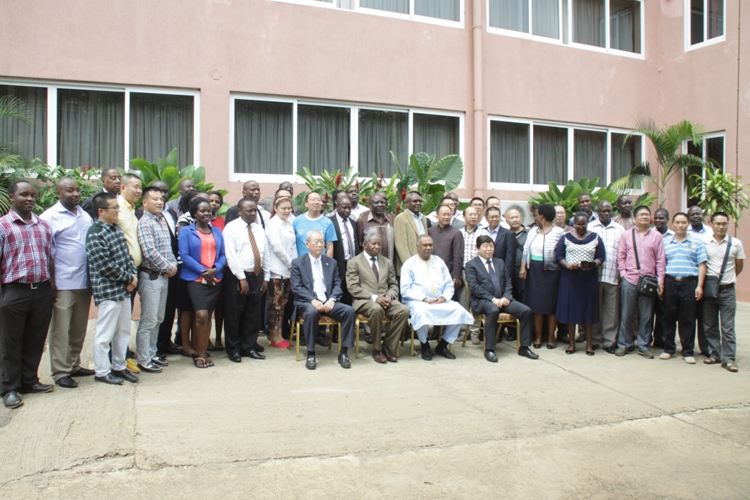
After successful implementation of the first phase of the South-South cooperation project which ran from October 2012 – October 2014, the Chinese government through the Food for Agricultural Organization (FAO) has embarked on Phase two of the Uganda China South – South Cooperation Project which will focus on three main areas; crops, Livestock and fish farming. The second phase of the SSCP which commenced last year in December will cover districts of Budaka, Kabale, Amuria and Mbarara. Because of it’s cool and low temperatures Kabale district will focus on growing horticultural products including apples, Mbarara will focus on livestock farming, Amuria (fish farming) while Budaka district will focus on growing cereals.
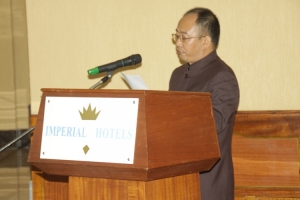
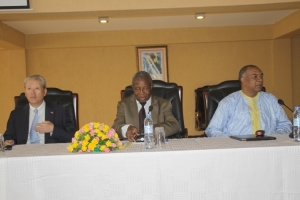
Speaking during the official launch of the Uganda- China South-South Cooperation Project that was held on Wednesday at the Imperial Golf View Hotel in Entebbe, Dr. James Tumwine the National Coordinator of the project revealed that the Chinese government has injected USD1.7m into the project while government of Uganda will inject USD800,000. The project which is expected to end in December 2017 will be implemented by Chinese experts who will work with Ugandan Agricultural experts.
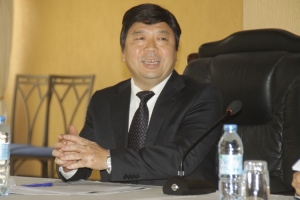
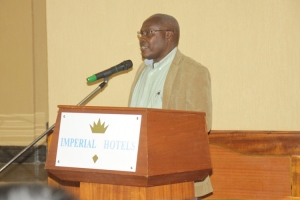
According to Dr. Tumwine the Chinese experts have set up an agro-industrial park in Luwero and will among others invest in renewable energy (bio-gas), irrigation, and agro-mechanization and value addition.

We (Ministry of Agriculture) are glad that the Chinese government through the Uganda-China South-South Cooperation Project has once again come onboard to support our efforts to improve the Agricultural sector in Uganda. This follows the successful first phase which run for two years (October 2012 –October 2014) and cost the Chinese government USD1.5m. Our aim is to ensure that local farmers benefit from the Chinese Agricultural expertise, Dr. Tumwine told entebbenews.
He added:

The Chinese government agreed to fund the second phase because the first phase which involved poultry cage farming, aquaculture, rice fish culture, herbal production, hybrid maize and rice was a success. Our biggest impediment is the inadequate funding for the project. This is a huge project which requires more funding from the local government and Ministry of Agriculture.
The Chinese Ambassador to Uganda H.E Zhao Yali expressed his satisfaction towards the first phase and said that the Chinese government is ready to work with the government of Uganda and FAO to ensure that the project is a success. Yali also appealed to all Chinese to come to Uganda and invest in the private sector.
Uganda is a very beautiful country and I would like to see more and more Chinese come to Uganda to invest in the private sector. The Chinese government pledges it’s total commitment towards the project because Agriculture is an important pillar in Uganda, Yali stated.
Agriculture Minister Tress Bucyanayandi lauded the Chinese government for their efforts to improve the Agricultural sector in Uganda and pledged his total commitment and support towards the project.
We (MAAIF) thank the Chinese government for partnering with government of Uganda in the second phase of the project and we pledge our total commitment because the project is part of government’s effort to improve house hold incomes across the country, Minister Bucyanayandi said.
Our task as (MAAIF) and the Chinese Agricultural experts is to put our heads together to ensure that we find solutions to the challenges in implementation of the project. We shall pay attention to the project because our aim is to have the MAAIF officers and local farmers gain the technical expertise from the Chinese, the Director Crop Production in the Ministry of Agriculture Okasai Opolot said.
All the achievements in the first phase need to be speeded up in the second phase. All the new technology demonstrations will be supported by trust funds from FAO and we hope to move fast within the limited 1 and half years. We hope to have more success and achievements in phase two, the project team leader Wuzhiping stated.
He added:
We shall try our level best to promote more cooperation between the Chinese government and the Ugandan government both at national and local government level to promote high quality agriculture investment through MOUs between investors and MAAIF.
Our aim will be to increase technological training and capacity development for the local farmers. After the project we hope that the local farmers will be able to manage and work on their own when the Chinese experts leave, Coordinator FAO and SSCP2 Liu Zhongui said.