

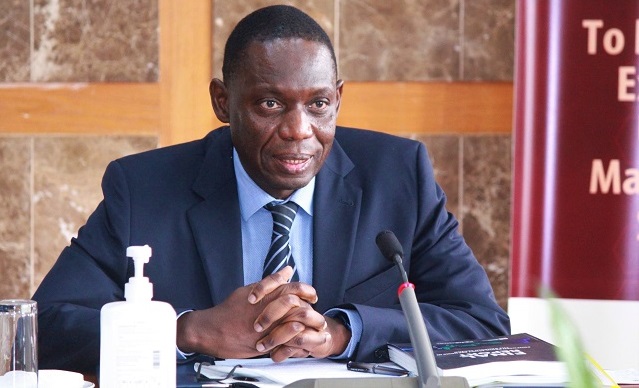
Kampala, Uganda | URN | Bank of Uganda Governor Michael Atingi-Ego has rejected suggestions that Uganda’s Sovereignty Bill may have contributed to the recent depreciation of the shilling, attributing the currency’s weakness primarily to a widening current account deficit and reduced portfolio investment flows.

The Protection of Sovereignty Act, 2026, which President Yoweri Museveni signed into law in May after Parliament revised some of its contested provisions, regulates the activities and foreign funding of people and organisations acting in the interests of foreign entities.
During Wednesday’s press conference, a participant raised concerns about reports that more than 200 million US dollars had flowed out of Uganda in the preceding two weeks, alongside other pressures on the shilling.

The law had earlier drawn concern from the Bank of Uganda over the potential impact of restrictions on foreign investment, remittances and other cross-border financial flows.
Atingi-Ego, however, attributed the currency’s depreciation primarily to the deterioration in the country’s current account balance and the moderation of portfolio investment flows.
Atingi-Ego made the remarks on Wednesday while responding to journalists following the central bank’s decision to raise the Central Bank Rate (CBR) by 2.25 percentage points, from 9.75% to 12%, in an effort to contain inflationary pressures and limit further depreciation of the currency.
The governor said Uganda’s external payments position had deteriorated, with the goods trade deficit widening to 2.8 billion US dollars from 2.4 billion dollars, while the services deficit increased to 3.3 billion dollars from 2.2 billion dollars in the 12 months to August 2026.
He attributed the deterioration in services partly to tourism losses associated with Ebola, while the primary income deficit, which reflects interest payments on government debt and other income payments to non-residents, increased to 1.7 billion dollars from 1.4 billion dollars.
Responding to a question on whether uncertainty surrounding the Sovereignty Bill and restrictions on civil society organisations could have discouraged foreign investors and development partners, Atingi-Ego said
“What I would want to say is that this does not in any way explain what the Sovereignty Bill did.
This explains the deterioration in the current account balance, explaining the depreciation in the currency,” he said.
The governor did not provide a direct response on whether such an amount of money has been moved from the economy.
He added that the moderation of portfolio investment flows had contributed to further pressure on the shilling.
The governor explained that secondary income, which includes remittances and other transfers, had increased to 3.1 billion dollars from 2.7 billion dollars, providing additional foreign exchange inflows.
He maintained that the depreciation was “purely a balance of payment matter.”
However, his response focused on the movements in the external accounts.
The figures cited do not, on their own, establish whether uncertainty surrounding the regulatory environment had any effect on investor decisions or capital inflows.
The governor acknowledged that the rate increase could raise borrowing costs and slow economic activity, but argued that allowing inflationary pressures to become entrenched would carry greater costs for the economy over the medium and long term.
Dr Adam Mugume, the Bank of Uganda’s Executive Director for Research and Policy, said the central bank expected core inflation to rise towards 5.5% to 6%, creating a risk that higher prices would spread across the wider basket of goods and services.
He said the policy decision involved a trade-off between controlling inflation and supporting economic growth.
Mugume warned that tighter monetary conditions could reduce private-sector credit, push interest rates higher and lower economic growth by at least half a percentage point.
He, however, argued that higher interest rates could reduce demand for imports and make Ugandan financial assets more attractive to investors, helping ease pressure on the exchange rate.
“The benefits outweigh the costs that will come in terms of slightly lower economic growth,” Mugume said.
Atingi-Ego said the central bank could not afford to wait until inflation and exchange-rate expectations became firmly established among businesses and consumers.
“It might result into reduced growth, higher loan repayments, particularly if your loan is on a variable rate. But it is better to rein in these variables before they become entrenched, so as to preserve the medium- and long-term stability of the economy,” he said.
Some have stated that the decision presents a difficult choice for businesses and households already facing higher import costs and a weakening shilling.
While tighter monetary policy is intended to curb price increases, borrowers could face more expensive credit as commercial banks adjust lending rates.
Atingi-Ego also sought to reassure the public about Uganda’s rising public debt and the implications of the shilling’s depreciation for debt servicing.
Responding to a question about whether the increasing cost of servicing public debt was putting pressure on the government’s ability to finance development and essential services, he said the latest debt sustainability analysis incorporating the most recent currency movements had not yet been completed.
He explained that debt sustainability assessments consider different scenarios, including exchange-rate shocks, and examine whether these would push debt indicators beyond established thresholds.
“While we have not yet done the most recent analysis based on this currency, I would want to assure you that the indicators suggest that Uganda’s debt is sustainable,” he said.
He added that, as of August, there had been no indication that Uganda’s debt was unsustainable.
Normally, a weaker shilling increases the domestic-currency cost of servicing external debt denominated in dollars and other foreign currencies.
The full effect of the recent depreciation will depend on the currency composition of the debt, the timing of payments and the results of the updated assessment.
The governor also defended the decision to tighten monetary policy despite concerns that the current inflationary pressures originate largely from supply-side shocks, including rising international oil prices and higher food costs.
Responding to a question about whether higher interest rates could undermine the government’s Tenfold Growth Strategy, Atingi-Ego referred to the experience of 2022, when Russia’s invasion of Ukraine and subsequent sanctions disrupted international energy and grain markets.
He said the Bank of Uganda initially observed the effects of higher fuel prices before tightening monetary policy as the increases began spreading across the wider consumer price basket. He argued that a central bank should not ignore a supply shock once it begins generating broader and sustained increases in prices.
“So, you’re right, it’s supply-side, but we act when it begins to feed into the broader CPI,” he said.
Higher interest rates cannot directly lower international oil prices, shipping costs or the price of imported food.
The central bank’s intervention is instead intended to limit the extent to which those initial increases spread through transport, production, distribution and other domestic costs.
The government’s growth ambitions depend on investment and expanding production, while tighter credit conditions could raise the cost of financing those activities.
The central bank maintains that containing inflation and limiting exchange-rate volatility are necessary to preserve the conditions for sustained growth.
The post BoU Governor: Sovereignty Law is innocent appeared first on 1:.