

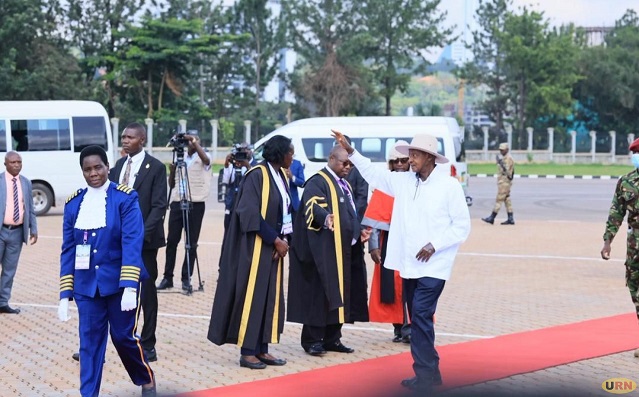
Kampala, Uganda | URN | As President Yoweri Kaguta Museveni prepares to deliver the State of the Nation Address (SONA) at Kololo Ceremonial Grounds this afternoon, attention is increasingly shifting from government achievements to a growing list of unresolved national concerns that have dominated public discourse over the past year.
In his 2025 SONA address, Museveni highlighted economic growth, industrialisation, export diversification, peace and security, infrastructure development, wealth creation programmes, and preparations for Uganda’s oil and gas sector. He described Uganda’s socio-economic transformation as “unstoppable,” pointing to expanding manufacturing, increasing exports, and sustained economic growth.
However, as the President returns to fulfil his constitutional obligation of reporting on the state of the nation, many Ugandans will be listening for answers on issues that remain largely unresolved despite repeated government commitments. At the forefront is corruption, which continues to rank among the country’s biggest public concerns. Despite government declarations of a zero-tolerance approach, scandals involving misuse of public funds, procurement irregularities, and abuse of office continue to emerge across public institutions.

Critics have also questioned the government’s commitment to accountability, citing instances where suspects implicated in high-profile corruption cases have benefited from discontinued prosecutions or presidential pardons. While addressing Parliament last year, Museveni acknowledged the challenge posed by individuals within government structures who pursue personal enrichment rather than national service. Yet public concern remains high over the recovery of stolen funds and the effectiveness of anti-corruption agencies.
The issue has gained renewed prominence in recent weeks, with several newly appointed ministers using their parliamentary vetting sessions to pledge a crackdown on corruption within their respective sectors. The health sector is another area expected to feature prominently in today’s address, particularly against the backdrop of the recent Ebola outbreak that forced authorities to restrict attendance at several national events, including this year’s SONA.

Despite significant investments in health infrastructure, concerns persist over shortages of medicines, inadequate staffing, limited equipment in public health facilities, and delays in implementing the National Health Insurance Scheme. Museveni’s address also comes amid controversy over proposals to withdraw medical internship allowances, a move that has drawn criticism from health professionals who argue that interns play a critical role in supporting service delivery in public health facilities.
Health experts and civil society organisations have repeatedly argued that infrastructure improvements have not always translated into better access to quality healthcare, particularly in rural areas. In the education sector, government officials continue to cite the achievements of Universal Primary Education (UPE) and Universal Secondary Education (USE) in expanding access to learning. However, concerns remain over declining learning outcomes, overcrowded classrooms, teacher absenteeism, and the continued financial burden on parents despite the government’s free education policy.
Analysts argue that improving the quality of education, rather than merely increasing enrolment, remains one of Uganda’s most pressing challenges. Youth unemployment is another issue that continues to test government policy interventions. Successive State of the Nation addresses have highlighted programmes such as the Parish Development Model (PDM), Emyooga, and other government-backed credit schemes as vehicles for wealth creation and economic empowerment. The President frequently uses public engagements to showcase beneficiaries of initiatives such as the four-acre model and PDM, presenting them as evidence that government programmes are transforming livelihoods.
However, critics argue that unemployment and underemployment remain widespread among Uganda’s youthful population. Questions continue to be raised about access to financing, market opportunities, and the long-term sustainability of government wealth-creation initiatives. The government has consistently highlighted macroeconomic stability and economic growth as major achievements. In last year’s address, Museveni reported continued economic expansion and projected stronger growth in the years ahead.
Yet public debate has increasingly focused on Uganda’s growing public debt, the rising cost of living, taxation, and whether economic growth is translating into improved living standards for ordinary citizens. Economists have repeatedly cautioned that positive growth figures alone do not necessarily reflect the realities faced by many households struggling with high commodity prices and limited incomes.
Governance, political freedoms, and civic space are also expected to remain part of the national conversation. The recently enacted Protection of Sovereignty law has generated intense debate among civil society organisations, opposition politicians, and international observers. Supporters argue that the legislation is necessary to protect Uganda from undue foreign influence, while critics contend that it could restrict civic engagement and political dissent.
Similarly, discussions surrounding electoral reforms, political competition, freedom of expression, and human rights continue to attract attention both locally and internationally, particularly as the country moves closer to the 2026 general elections. Security, traditionally one of Museveni’s strongest talking points, is also expected to feature prominently in the address. Last year, the President cited Uganda’s relative peace and stability despite regional conflicts and threats from terrorist groups.
While Uganda remains comparatively stable within the region, concerns persist over cross-border insecurity, urban crime, and the balance between security operations and civil liberties. Meanwhile, the government continues to present oil production and industrialisation as key pillars of Uganda’s transformation agenda. Officials report significant progress on major oil infrastructure projects and remain optimistic about the country’s journey towards first oil.
Yet many Ugandans continue to ask when the promised benefits, including jobs, increased government revenues, and opportunities for local businesses, will begin to have a noticeable impact on their daily lives.
Today’s address also comes just a day after Parliament’s Appointments Committee concluded the vetting of 81 ministerial appointees recently nominated by the President. The exercise was overshadowed by public debate over allegations of dual citizenship involving some nominees, a matter that has largely played out on social media and in public commentary.
The post Unfinished business ahead of Museveni’s State of the Nation Address appeared first on 1:.