

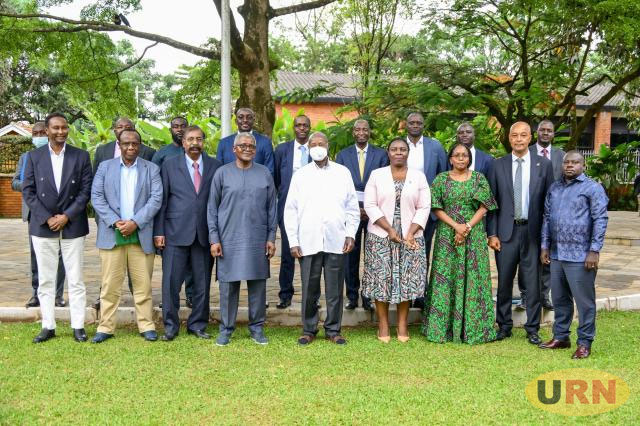
Kampala, Uganda | URN | President Yoweri Kaguta Museveni has endorsed a proposed multi-billion-dollar regional oil refinery initiative championed by Nigerian industrialist Aliko Dangote, while firmly reiterating that Uganda’s own 60,000 barrels-per-day refinery in Hoima will proceed as planned.
The position emerged following high-level discussions between President Museveni and Dangote at State Lodge Nakasero on Sunday, where the two leaders explored deeper energy cooperation, regional industrialization, and East Africa’s long-term petroleum security strategy. At the heart of the talks was a proposed regional refinery estimated to cost between $15 billion and $17 billion, with a projected processing capacity of 650,000 barrels of crude oil per day. The facility is expected to serve Uganda, Kenya, Tanzania, Ethiopia, South Sudan, the Democratic Republic of Congo, and other regional markets.
However, amid speculation that the regional initiative could overshadow Uganda’s long-delayed domestic refinery project, Museveni made it clear that Hoima refinery remains fully on track. “We have no problem supporting a broader regional refinery that can guarantee energy security for the region while Uganda also develops its own refinery,” Museveni said. “The Hoima refinery will continue as planned because value addition remains critical for Uganda’s economic transformation.”

Uganda’s refinery project, planned for Kabaale in Hoima District, is expected to process 60,000 barrels of crude oil per day during its first phase and forms a cornerstone of the country’s National Oil and Gas Policy. The policy emphasizes value addition, industrial growth, job creation, and energy security rather than reliance on raw crude exports alone.“We have always been against the export of unprocessed raw materials,” Museveni said. “That is why Uganda insisted on having a refinery as part of our oil development strategy.”
The President noted that Uganda’s oil development timeline may have appeared slower compared to some petroleum-producing countries because the government prioritized infrastructure, local processing capacity, and long-term national benefit arrangements before commercial production began. Uganda expects first oil production from the Albertine Graben fields in the near term, supported by major infrastructure investments, including the East African Crude Oil Pipeline (EACOP), which will transport crude oil from Hoima to Tanzania’s Tanga Port for export.

Dangote, Africa’s richest businessman and founder of the massive Dangote Refinery in Nigeria, said the East African proposal seeks to address growing regional fuel demand while reducing dependence on imported petroleum products. “This is a continuation of discussions we held with regional leaders in Nairobi,” Dangote said. “We want to establish a refinery that can support East Africa’s growing energy needs.” The proposed refinery would potentially process crude from multiple regional sources, including Uganda, South Sudan and Kenya, while supplying refined products across Eastern and Central Africa.
Dangote revealed that his team is currently assessing possible host locations, including Tanga in Tanzania, Mombasa and Lamu in Kenya, as consultations continue with governments across the region. The proposal gained momentum during the Africa We Build Summit 2026 held in Nairobi, where regional leaders reportedly explored joint industrial projects aimed at strengthening intra-African trade and manufacturing.
For years, East African states have struggled with fragmented infrastructure investments, dependence on imported fuel, and limited regional industrial coordination despite growing energy demand. Museveni argued that shared infrastructure projects could improve commercial viability and create wider economic benefits for member states. “If East Africa works together, these projects become more viable and beneficial to all our people,” he said.
Eng. Irene Bateebe, Permanent Secretary at the Ministry of Energy and Mineral Development, notes that a national refinery offers advantages beyond fuel production, including petrochemical development, fertilizer manufacturing, aviation fuel supply, and industrial feedstock generation. She reaffirmed that Uganda’s refinery project remains commercially viable despite ongoing regional discussions.
“Uganda will continue engaging stakeholders and partners on both the national refinery project and wider regional energy cooperation initiatives,” Bateebe said. Her remarks appear aimed at calming concerns among investors and policymakers that the regional proposal could dilute attention from Uganda’s refinery ambitions. Uganda’s refinery project has faced multiple delays over financing structures, investor negotiations, and infrastructure planning, but officials insist preparatory work remains ongoing.
Dangote also emphasized the employment and skills-transfer potential of the proposed regional refinery, promising that East Africans would benefit from jobs and technical opportunities. “Jobs will not be a problem,” he said. “In our refinery in Nigeria, we employ people from many nationalities, and East Africans will also benefit from this project.”