

Beyond Applause: Why Africa’s Service Institutions Must Mature

Kampala, Uganda | NEWS CORRESPONDENT | Rotary leaders across Africa have been being urged to rethink expansion not as a celebration but as a structural responsibility in a rapidly shifting continental landscape.
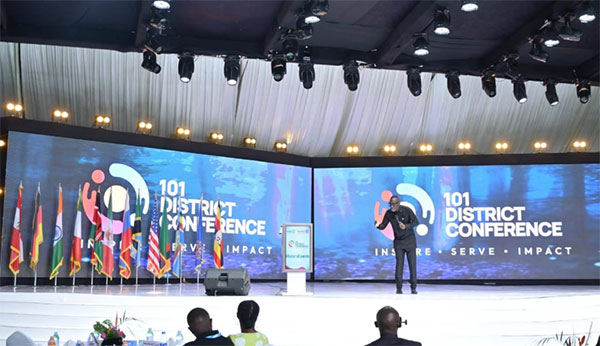
This was one of several pointed messages delivered by Pastor Robert Burale during his keynote address at the Rotary DISCON 101 conference that ended on Saturday at Munyonyo Commonwealth Resort.
The event, graced by Uganda’s Vice President Rt Maj. Jessica Alupo, convened Rotarians from across Africa at a time when the continent is navigating unprecedented demographic acceleration, rising civic expectations and an evolving leadership architecture across both public and private institutions.

Burale, whose voice has increasingly featured within continental conversations on legacy, governance and institutional maturity, noted that projections indicating Rotary Africa could reach 70,000 members by 2028 must not be reduced to symbolic celebration. Instead, he framed the milestone as a structural examination.
“Looking ahead, we are confident that by 2028, we will reach an impressive milestone of 70,000 Rotarians across Africa,” he said.
“This vision is within our grasp, and we will achieve it through strategic initiatives such as rezoning. By reevaluating our regions and supporting units more effectively, we aim to ensure that the resources and leadership needed to foster further growth are in place.”
He emphasised that expansion without recalibration risks operational strain — particularly in a continent where civic institutions are increasingly called upon to complement state systems in education, healthcare, youth development and ethical leadership.
“This collective effort will not only enhance the effectiveness of our units,” he said, “but also ensure that we are fully equipped to meet the growing demands of a rapidly evolving Rotary network in Africa.”
Africa remains the youngest continent globally, with urbanisation accelerating and governance models undergoing recalibration.
Rather than focusing solely on membership metrics, Burale redirected attention to internal architecture.
“Legacy is felt when you are gone, but built while alive,” he stated.

According to Burale, sustainable legacy-building begins with what he described as a “divine disturbance” an internal moral agitation that refuses complacency.
“There has to be a disturbance within,” he said. “An inner drive, an inner voice that tells you that you must make things right in society.”
He further urged Rotarians to shift from operational management to vantage-point leadership.
“Stop looking and start seeing. Go to the mountain top,” he said, calling for long-term institutional design rather than short-term administrative execution.
Burale emphasised alignment as central to durable scaling.
Burale’s address, delivered with disciplined clarity and structural foresight, positioned Rotary Africa at a decisive crossroads — pursue numerical expansion, or build governance architecture capable of sustaining continental relevance.
The distinction, he implied, will determine whether 70,000 becomes a symbolic statistic — or a defining legacy.
The post BURALE: Rotary in Africa can reach new heights appeared first on 1:.