

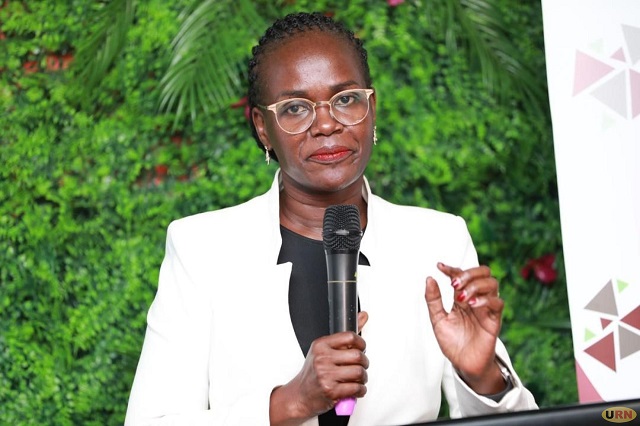
Kampala, Uganda | URN | Uganda Development Bank’s Managing Director, Patricia Adongo Ojangole, says institutional collapse rarely happens suddenly, suggesting that institutions weaken gradually, through ignored risks, broken controls, compromised governance, and small ethical decisions that accumulate over time.
She used this analogy to warn and urge newly qualified internal auditors to identify risks, protect integrity and build systems that outlive their leaders.
Dr. Ojangole cited her nearly two decades of experience examining institutions as an internal auditor before eventually becoming responsible for leading one.

Ojangole says she learnt early in her career as an internal auditor, long before she became Managing Director of Uganda Development Bank.
Speaking to 28 newly graduated internal auditors, Ojangole returned to the profession that shaped her understanding of how organisations work, how they fail and what it takes to rebuild them.

“Internal Audit taught me early that institutions do not fail suddenly; they fail gradually. One ignorant risk at a time, one broken control at a time, one broken governance process at a time, one compromise of ethics, one unaccountable decision at a time,” she narrated.
Her career has taken her from examining the systems of large financial institutions to becoming responsible for one of Uganda’s most important development-finance institutions. That journey, she says, changed the questions she had to ask.
“As an auditor, I examined systems. As a leader, I have to build and strengthen systems. As an auditor, I assessed controls. But as a leader, I have to create a culture where controls are respected without suffocating innovation. As an auditor, I identified risks. But as a leader, I have to take responsible risks in pursuit of growth and impact,” she said.
At UDB, she says, change was not achieved through one major intervention but through a succession of policies, controls, and management decisions.
“The transformation that has been talked about did not happen all of a sudden. It was gradual. One thing at a time, one policy at a time, until all those were put in place. One control at a time, until all those are… starting to build a culture,” she added.
Many testify that the scale of Uganda Development Bank today is markedly different from the institution she joined.
She repeatedly shares how starting as an internal auditor sits at the centre of her understanding of leadership, explaining that an auditor is trained to identify weaknesses.
Ojangole says the transition required her to move from diagnosing institutional problems to taking responsibility for solving them.
“That transition required or requires me to keep asking, ‘ What went wrong? to asking, ‘ What must we build?. From asking Where is the weakness or gaps? To asking, ‘ Where is the opportunity? From asking What control fails? To asking, ‘ What culture must we create so that people choose to do the right thing?”
Her professional journey began in audit and risk management, including senior roles within Standard Bank Group.
She says one of the most valuable aspects of working in internal audit was the opportunity to see an institution from almost every angle. She audited different departments and, at times, the work of senior executives, including the group’s then chief executive, Philip Odera.
For an auditor, she says, “You get to see every part of the organisation. You see the processes. You see the strategy. You see the outcomes. You see where things are working and where things are not working. You can ask the questions that perhaps even the executives are not asking.”
That experience convinced her that audit is much more than checking financial records or compliance.
“The beauty of being out starting as an internal auditor. And that’s why I believe that the audit profession is one of the finest schools of leadership,” she said.
“It teaches you to be independent but not isolated, sceptical but not cynical, courageous but not reckless, detailed but not narrow, principled but still practical.”
“It teaches you that leadership is not about occupying a large office, but it’s about carrying the deepest responsibility.”
The auditor, she says, develops a way of looking at institutions that remains valuable even after moving into management.
“It gives you the ability to see systems, to connect causes and consequences, to distinguish symptoms from root causes, and to understand risk before it becomes a crisis.”
“It helps you to ask whether an organisation is not only doing things right, but doing the right things.”
It was that experience that Ojangole took to Uganda Development Bank. When she became involved in the bank’s management, she says she encountered serious institutional weaknesses.
As chief internal auditor, she says she identified problems within the institution, including weaknesses in its loan portfolio and controls.
She says her audit work contributed to the removal of the old management.
Her own transition from auditor to chief executive was, however, not straightforward. Following the removal of the previous management, staff were encouraged to apply for positions in a new management structure.
Ojangole, who was serving in an acting executive capacity, applied for the position of managing director and was subsequently appointed.
Her appointment was later challenged in the Anti-Corruption Court.
The Inspectorate of Government alleged that Ojangole had participated in processes leading to her appointment while she was acting chief executive and had failed to disclose an interest in the recruitment process.
Ojangole denied the allegations while appearing before the court presided over by Justice Lawrence Gidudu.
She told the court that rather than improperly influencing her appointment, she had exposed serious problems at the bank and was being persecuted by former employees who wanted her removed. Justice Lawrence Gidudu eventually acquitted her.
He found that the prosecution had not produced sufficient evidence to convict her.
The court also heard testimony from former UDB board chairperson Dr Samuel Ssejjaka that the board had encouraged staff to apply for the available positions and knew Ojangole would apply.
The two court assessors, Annet Kasendwa and Fred Kiggundu, also advised that she be acquitted. The Inspectorate of Government said it was dissatisfied with the judgment and intended to appeal.
For Ojangole, the experience became part of a lesson about professional courage and reputation.
Years later, speaking to the new auditors, she referred to her own experience when warning them that there would be moments in their careers when telling the truth would be uncomfortable. “There will be moments in your career when speaking the truth may be uncomfortable. Those of you who know my story know that I’m a living example of this,” she said.
For her, the audit career was not simply about auditors identifying wrongdoing; it is about understanding what happens after the finding.
At UDB, she says, institutional transformation did not happen through one dramatic intervention.
“The transformation that has been talked about did not happen all of a sudden. It was gradual. One thing at a time, one policy at a time, until all those were put in place. One control at a time, until all those are… starting to build a culture.”
The scale of UDB has changed considerably since Ojangole took over in 2013.
The bank’s balance sheet, which was about 130 billion shillings or less at the time, had grown to about 2.6 trillion shillings by 2025.
Ojangole said she hoped the balance sheet would reach about 3 trillion shillings by the end of 2026.
The bank’s shareholders have also increased its capitalisation, with authorised capital now standing at 5 trillion shillings, compared with about 100 billion shillings when she assumed leadership, which was not fully paid up.
She, however, does not describe development banking simply as expanding the amount of money a bank lends.
“Development finance is about more than lending money. It’s about allocating patient capital where it can unlock production, create jobs, defend value chains, support enterprise growth, and contribute to national transformation,” she stated.
That approach requires accepting some risks while ensuring that those risks are understood.
This is another point at which her audit training continues to influence her management style.
An auditor is trained to ask where a risk originates, where it ends, and what could happen if it is ignored.
As a managing director, Ojangole says she still asks those questions, but now she must make the decision.
“To ask and say, where is this coming from? Where is it ending? Is this the right decision for the organisation?” Her colleagues, she says, sometimes describe her as having a strong “sixth sense” because she can anticipate consequences before they become obvious.
Ojangole attributes that ability largely to years of examining systems and patterns. She says there are times when she has told colleagues: “We are not going to do this, because if we do it, this is where we’re gonna end.”
She recalls colleagues later telling her: “If we had done this MD, we would be finished by now.”
For her, however, that is not instinct divorced from evidence. It is the accumulated effect of years spent understanding how institutional decisions produce consequences.
That is also why she places such emphasis on objectivity. “Objectivity helps a leader to rise above favoritism, emotion, pressure, and short-term popularity,” she said.
She urged the graduates to keep asking questions that can sometimes be uncomfortable.
“What is evidence? What evidence do we have? What is the risk? What is the opportunity? Who will be affected? What are the long-term consequences? What does the institution’s mandate require?” She insisted that evidence and integrity are inseparable.
“Integrity is the currency of leadership. You may have technical brilliance, networks, experience and ambition, but if people cannot trust your judgment, your word, and your motives, your leadership will not endure.”
She said she has developed a personal test for difficult decisions, particularly those involving public institutions and public resources.
“One of the tests I usually give myself, even when I’m making decisions, is if today I have to stand before the public, before Ugandans, are they going to see value in the decision that I’ve made? Are they going to defend it? Will it be justified?”
She said professional judgment also requires thinking beyond what is explicitly prohibited by a written rule.
“Some of the things may not be written down. But it’s very important to look at the decisions that you’re making and be able to subject yourself to that and say, if today I have to sign before a public court, will the public justify me? Will common sense defend me?”
For any auditor, she says, evidence should never be treated as an obstacle.
“Evidence is not the enemy of leadership. It is the friend of responsible leadership.”
The same principle applies to information. Internal auditors are often given access to sensitive institutional information, including weaknesses in systems and failures by individuals.
Ojangole says the way that information is handled can determine whether an auditor strengthens or damages an institution.
“People will trust you with facts; people will trust you with weaknesses. People will trust you with their problems; people will trust you with their challenges, sometimes even their failures,” she noted
“But get that trust and use that information to support colleagues to improve institutions. Not to use it in any way against people or against your own institution. But use the knowledge to strengthen governance, not to build personal power.”
She also cautioned the graduates against confusing independence with confrontation.
“Courage is not noise. Courage is a calm determination to do what is right, even when it is unpopular. And constructiveness is the wisdom to help the organisation improve rather than merely exposing its weaknesses. Independence does not mean hostility,” she cautioned.
For her, the manner in which an auditor communicates a finding can determine whether management accepts it or resists it.
“The way you communicate your findings can determine whether they are resisted or you are embraced,” She added.
She says that when she became managing director, she already had significant training in accounting, auditing, banking and management.
But moving from commercial banking into development finance made her realise that she needed a deeper understanding of the field she was now responsible for leading.
She pursued an MPhil in Development Finance at Stellenbosch Business School and later a PhD in Development Finance.
According to her, “The auditor who stops learning becomes obsolete, and the leader who stops learning becomes dangerous.”
She advised the new auditors to regard professional qualifications as a beginning rather than an endpoint.
“Treat your CIA qualification and any others that you have not as the end of your professional journey, but as a passport to higher responsibility. Let it open doors, but let your discipline, humility, performance and character keep those doors open.”
She also wants them to resist the idea that internal audit is a narrow career.
“Audit can take you into assurance, risk management, governance, finance, operations, strategy, board service, entrepreneurship, regulation, public service, even executive leadership.”
“The analytical discipline that you have as an internal auditor is portable. The ethical foundation you have acquired is timeless.”
She said that she moved from examining systems to becoming responsible for designing them, from identifying institutional risks to making decisions about which risks an organisation should take, and from asking what went wrong to asking what must be built. But she warns that ambition without character can make professional success dangerous.
“Ambition without values can become dangerous. Expertise without humility can become arrogance. Access to information without ethics can become abuse. Leadership without accountability can become power without purpose.”
“And therefore, let your professional growth be matched by moral growth. Your credibility is your most valuable professional asset. Protect your reputation, because a reputation built over decades can be lost in a moment,” arguing that reputation is another form of professional capital.
“Your name will travel ahead of you in rooms you have not yet entered. Let it be associated with excellence, reliability, fairness, diligence, humility and integrity. Opportunities often follow reputation before they follow application.”
The internal auditor’s work is fundamentally about helping an institution understand where it is vulnerable.
“The auditor asks: what went wrong? The leader must ask: what must we build? The auditor identifies the weakness. The leader must create an institution strong enough to withstand it. And ultimately, the auditor and the leader are pursuing the same objective: an institution that can be trusted,” she said.
“We must build institutions that outlive us. One of the greatest responsibilities of leadership is to build institutions that are stronger than the individuals who lead them.”
Ojangole told the graduates. “Tomorrow the real journey begins. Step forward with confidence, lead with courage. Serve with integrity. Continue learning. And never underestimate the difference that you can make.”
The post Why institutions fail appeared first on 1:.