

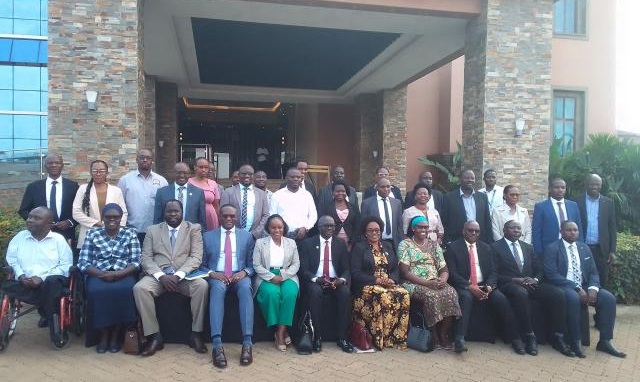
NEWS ANALYSIS | URN | The Assistant Commissioner for Planning from the Ministry of Agriculture Industry Animal Industry and Fisheries(MAAIF) Colins Amanya has described as an affirmative action programme the injection of 60 billion shillings into the expansion of coffee growing in the Northern region.
Amanya told the ongoing negotiations sitting of the central government and local governments on financing and grants for the agricultural and agro-industrialisation sector that the funds are being used to supply coffee seedlings and support the expansion of coffee production in the region, which has traditionally not been a major coffee-growing area.
He said between 23 and 25 million coffee seedlings have already been supplied and planted, with government also considering irrigation and other agricultural inputs to support farmers, adding that the programme intends to help Uganda achieve its coffee production targets under NDP4, including the long-term ambition of producing more than 20 million 60-kilogramme bags annually by 2030.

During the negotiations for funding of the Agro Industrialization program under (MAAIF) Amanya noted that there is need for increased funding for agricultural extension services and irrigation to improve farm productivity and strengthen Uganda’s agro-industrialisation drive.
Amanya noted that extension services remains a major challenges affecting agricultural production at the local government level adding that local governments need more resources to recruit and facilitate extension workers, conduct soil testing and provide farmers with technical advice.

He said effective implementation of agricultural programmes depends largely on local governments because they are closest to farmers.
“We must work together with local governments because that’s where the work happens and where implementation takes place,” Amanya said.
Amanya also called for increased investment in irrigation, citing the effects of prolonged dry spells on farmers. He said government is pursuing small-scale irrigation and bulk water supply projects but acknowledged that the cost of accessing irrigation services remains high.
According to Amanya, the government is considering reducing the cost of co-funding required from farmers, although farmers will still be expected to make a contribution to ensure sustainability.
Frederick Kisakye, a District Production Officer from Mubende and member of the Local Government Negotiation and Advocacy Team, said Coffee is a major area requiring additional government support. Kisakye said coffee is Uganda’s major agricultural export, and the country has an opportunity to significantly increase its supply because of strong international demand.
He said Uganda currently exports about 8.6 million 60-kilogramme bags annually, against a potential market estimated at about 20 million to 60 million bag, and called for government support through a subsidy programme targeting coffee seedlings, agricultural inputs and irrigation.
According to Kisakye, subsidised seedlings would help open up new high-potential coffee-growing areas, particularly in Northern Uganda, where large tracts of land are suitable for coffee production.
He said farmers should also be supported to access fertilisers and pesticides at reduced prices, rather than receiving the inputs for free.
Kisakye said that currently a coffee seedling costs between 2,000 and 3,000 shillings which is high for farmers, suggesting 800 shillings instead so that several farmers can afford the coffee seedlings.
Additionally, during the negotiations Kisakye noted that local governments are seeking a revision of the current grant allocation formula to cater for districts facing unique geographical challenges.
He said island districts require additional resources to deliver extension services because officers need boats, and personal protective equipment to reach farmers.
Kisakye also cited highly mountainous and hard-to-reach areas, saying they require special consideration when government allocates resources. According to Kisakye, the Local Government Finance Commission will hire a consultant to review the allocation formula across government grants.
He called for climate adaptation grants for all districts currently implementing government projects.
This year’s negotiations span eight government programme areas of agro-industrialisation, tourism development, private sector development, manufacturing, human capital development, sustainable urbanisation and housing, natural resources and environment, and transport infrastructure.
The post Why gov’t injected Shs60 billion to promote coffee growing in northern Uganda appeared first on 1:.