

As Uganda pursues a US$500bn economy, policymakers face a difficult question: how much revenue can the country afford to sacrifice in the pursuit of growth?

Kampala, Uganda | JULIUS BUSINGE | Uganda’s tax policy is facing an increasingly important test: whether the revenue government gives up through exemptions, tax holidays and other incentives is generating enough economic and social value to justify the cost.
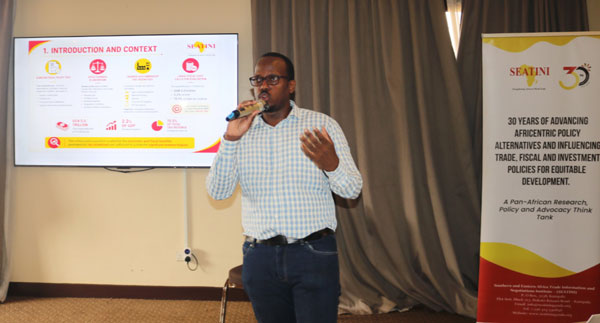
The question came into sharper focus on September 25, 2026, when the Southern and Eastern Africa Trade Information and Negotiations Institute (SEATINI-Uganda), in partnership with the Uganda Revenue Authority (URA) and with support from the Embassy of Ireland through the Sustaining Tax and Revenue Improvement for Development (STRIDe) project, convened stakeholders in Kampala to discuss the findings of a new cost-benefit analysis of tax expenditures in Uganda.
The study estimates that Uganda’s tax expenditure reached Shs5.01 trillion in FY2024/25, equivalent to about 2.2% of GDP and 15.5% of total tax collections. That represents a substantial amount of revenue that did not enter the Treasury because government deliberately departed from the normal tax system through exemptions, preferential rates, deductions, holidays and other reliefs.
The timing matters. Uganda is simultaneously pursuing an ambitious economic transformation programme under the Tenfold Growth Strategy, which seeks to expand the economy from roughly US$50 billion to US$500 billion by 2040. Government says the strategy depends partly on increasing the share of the formal economy and creating a larger domestic revenue base. That creates an obvious policy tension.
Tax incentives can be used to attract investment, create employment, encourage exports and accelerate industrialisation. But every exemption also means government collects less from a particular activity, company, household or sector.

The policy challenge is therefore moving from asking simply how much revenue Uganda is foregoing to asking what Uganda is receiving in return.
The revenue gap
The latest study shows that tax expenditure is not a marginal feature of Uganda’s tax system. Solomon Rukundo, a tax specialist at the Ministry of Finance, Planning and Economic Development, told stakeholders that tax expenditures were costing the country about Shs5 trillion in FY2024/25.
“Tax expenditures are currently costing Shs5 trillion, about 2.2% of GDP and 15.5% of the tax collected,” Rukundo said. The amount was distributed across several tax heads. VAT accounted for about Shs2 trillion, personal income tax roughly Shs1 trillion, excise duty Shs853 billion, customs duty Shs708 billion and corporate income tax Shs431 billion.
This matters because the debate over tax incentives is often framed almost entirely around investors. The evidence suggests the issue is considerably broader.
Tax expenditure also arises from reliefs benefiting individuals, public institutions and households. Under personal income tax, for example, security personnel, retirement fund contributions and Members of Parliament were among the major beneficiaries during the period examined.
Under VAT, mining, oil and gas and government projects accounted for a substantial share of the relief. This means tax expenditure is not merely an investment-promotion instrument. It is also a central component of fiscal policy, social policy and income distribution.
Growth versus revenue
Uganda’s government has a clear reason for wanting to maintain an investment-friendly tax regime. The Tenfold Growth Strategy is designed to push the economy towards double-digit growth and ultimately increase GDP to US$500 billion by 2040. Government identifies agro-industrialisation, tourism, mineral development including oil and gas, and science, technology and innovation as key anchors.

Tax incentives can therefore be viewed as one instrument for achieving structural transformation. But incentives only make economic sense if the investment and other benefits they generate are sufficiently large, additional and sustainable.
The new study provides evidence on both sides. Investment-related incentives have expanded considerably. The number of firms benefiting from the strategic investor tax holiday increased from two in 2018 to 123 in 2025.
The beneficiary firms recorded increases in investment, turnover, profits, wages and purchases after receiving incentives. Yet another finding complicates the picture: imports grew more strongly than local purchases, while the share of local sourcing declined.
That distinction is important for the Tenfold Growth Strategy. Attracting a company is one objective. Building an economy in which that company purchases more from Ugandan suppliers, employs Ugandans, develops local skills, adds value and creates export capacity is another.
For a country seeking structural transformation, the second outcome is arguably the more consequential policy question, experts say.
Measuring returns
The emerging policy direction is therefore towards greater scrutiny of incentives rather than necessarily eliminating them. SEATINI’s Jane Nalunga captured the public-interest dimension of the debate during the September dialogue.
“We are not tax experts. But we are taxpayers. This is our money,” she said.
Her argument points to a basic fiscal principle: tax expenditure is public money even when it does not appear as a conventional budget allocation.
When government spends Shs1 trillion on a programme, the expenditure is visible in the budget. When government chooses not to collect Shs1 trillion through tax relief, the economic cost can be less visible.
Yet both decisions affect the resources available for roads, health, education, infrastructure and other public priorities. This makes monitoring particularly important.
The study notes that Uganda has made progress through annual Tax Expenditure Reports, a benchmark tax system, a tax expenditure repository and a Fiscal Governance Framework.
But gaps remain in beneficiary reporting, monitoring, evaluation and data availability. Some tax expenditures are also not yet fully costed.
Ronald Nyenje Makumbi of URA highlighted another practical problem: some beneficiaries do not file returns, while in other cases returns do not contain sufficient information to determine whether the intended benefits of incentives have actually been delivered.
That creates a fundamental weakness in tax policy. Government cannot reliably assess whether an incentive works if it cannot reliably observe what happens after the incentive is granted.
Incentives need conditions
The policy implication is not necessarily that Uganda should abandon tax incentives. Rather, incentives could increasingly be treated as performance-based fiscal instruments.
An incentive intended to create jobs should have measurable employment targets. One intended to increase exports should have export-related indicators. A manufacturing incentive should be assessed partly on local sourcing, domestic value addition and supplier development.
This would also help address the question of additionality: whether the investment or economic activity would have happened without the tax incentive.
That question is crucial because an incentive cannot be judged solely by whether a beneficiary firm grew after receiving it. Policymakers also need to establish whether the tax relief caused additional investment that would otherwise not have occurred.
The Ministry of Finance has already recognised the need for cost-benefit analysis as part of tax-expenditure management. Earlier ministry policy commentary said such analysis should help government rationalise tax expenditures and improve revenue outcomes.
The new study gives that policy ambition more evidence to work with.
The poverty question
Tax policy, however, cannot be judged only by revenue mobilisation. The study’s findings on VAT demonstrate why some exemptions may have wider social consequences.
According to the analysis, removing current VAT exemptions would increase national poverty from 16.08% to 21.54%, a rise of 5.46 percentage points.
The increase would be even more pronounced among households with children and female-headed households. This complicates any argument that Uganda should simply eliminate exemptions to increase tax collections.
Some exemptions have a redistributive or social-protection function, even where they reduce government revenue. The more appropriate policy question is therefore which exemptions produce meaningful social benefits and whether they are the most efficient way of achieving those objectives.
A tax exemption that reduces poverty may have a different policy justification from one that simply increases the profitability of an already competitive business.
Both are tax expenditures, but their policy purposes are fundamentally different.
The debate comes as government is seeking a much larger domestic revenue base. Finance Minister Henry Musasizi has set a target of increasing Uganda’s revenue-to-GDP ratio to at least 20%, from around 14%, as part of a broader domestic revenue mobilisation effort.
“We shall implement the second domestic revenue mobilization strategy to push our revenue to GDP ratio to at least 20%, cutting external dependency,” Musasizi says.
At a URA post-budget dialogue in July, Musasizi said government projected domestic revenue of Shs45.96 trillion in FY2026/27, including Shs40.16 trillion in tax revenue. He said the resources would finance investments required to sustain Uganda’s transformation while maintaining fiscal sustainability.
This is where tax expenditure becomes a strategic issue. If Uganda wants to increase revenue collection from 14% to 20% of GDP while simultaneously giving up an amount equivalent to 2.2% of GDP through tax expenditures, policymakers will increasingly need to distinguish between incentives that support growth and those that simply narrow the tax base.
The two objectives are not necessarily contradictory. A successful incentive can expand the economy and eventually broaden the tax base. But an incentive that produces little additional economic activity can weaken revenue mobilisation without materially advancing development.