

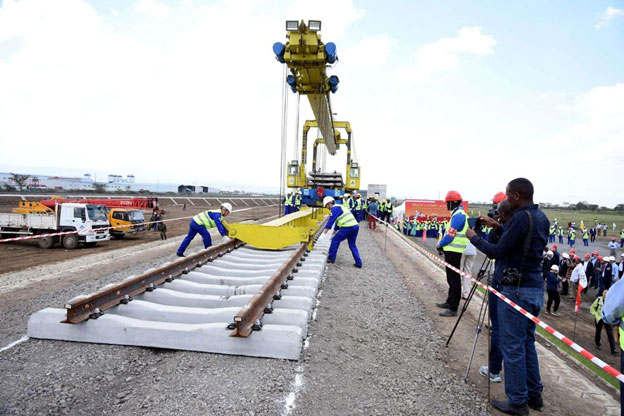
The Uganda government is courting global lenders to revive the €2.7 billion stalled project

COVER STORY | IAN KATUSIIME | Uganda’s long-delayed Standard Gauge Railway (SGR) project is facing another major financing test, with questions over whether the government can secure the €2.7 billion (Shs13.31 trillion) needed to move the project forward by next month.
The government is seeking funding from a combination of Western state-backed lenders, Islamic finance institutions and sovereign funds linked to OPEC member countries.
The Islamic Development Bank approved €650.75 million (Shs3.21 trillion) for the project in June this year, while the OPEC Fund is considering a further €150 million (Shs739.3 billion) loan. A decision is expected by the end of November.

The financial-close timetable (the point when money is released) has, meanwhile, slipped towards next year, according to recent reporting.
The stakes extend beyond the release of money. The government must establish that the financing structure is complete, the project’s contractual arrangements are secure and outstanding implementation conditions can be met before the railway moves from preparatory works to full construction.
After a grueling decade of parliamentary deadlocks, canceled contracts, and inflated pricing scandals, Uganda’s highly anticipated SGR project now faces another set of financing and implementation risks.
A specialised technical appraisal team from the OPEC Fund for International Development is in the country for an exhaustive on-site audit for the Kampala-Malaba corridor of the SGR.
The audit team will visit the Iganga sleeper factory; a specialized industrial plant built on-site to manufacture hundreds of thousands of heavy concrete railway sleepers. It will also inspect early work construction camps, and audit compensation payouts to project-affected persons (PAPs) along the Right-of-Way to ensure no legacy legal disputes or land rights bottlenecks disrupt construction.
The mission of the OPEC audit is a strict compliance gateway: to verify that the €75 million (Shs361.6bn) in domestic cash spent during the early preparatory phase was deployed transparently.
The requirement for Uganda to front the €75 million (Shs361.6bn) came down from the collective mandate of the international lender syndicate (the consortium of lenders arranged by Citibank, which includes Germany’s KfW IPEX-Bank, the Islamic Development Bank, and the OPEC Fund).
By forcing the GoU to independently fund early physical works—such as the Iganga sleeper factory and grading works—using its own money first, the lenders effectively insulated their capital until Uganda proved its local skin in the game.
Any unresolved land compensation issues or concerns over the use of public funds could complicate the lenders’ assessment of Uganda’s SGR project, with scrutiny of the financing arrangements potentially extending to discussions among financial institutions in Germany during Euro Finance Week, scheduled for November 16–20.
The event is in Frankfurt, Germany’s financial capital, and brings together senior figures from banks, financial institutions, asset managers, industry and public policy.
The financing matrix
Both KfW and Citibank feature in the event’s programme, raising the possibility that discussions could touch on overseas financing projects such as Uganda’s SGR. The findings of the OPEC Fund’s field assessment in Uganda could prove significant in determining whether the project meets key conditions in the financing package.
Reuters reported in April that Uganda had hired Citibank to help mobilise the €2.7 billion required for the project. The appointment followed years of difficulty securing financing after the earlier Chinese-backed arrangement fell apart.
A lead arranger and financing coordinator is not necessarily the institution lending the largest amount of money according to experts on capital markets. Its job is to help assemble the funding structure, coordinate potential lenders and organise the financing process.
To insulate their boards from macroeconomic risk, the lenders reportedly engineered an unconventional structural marriage. KfW will act as the “first mover,” wiring an initial $300 million drawdown tranche to fund raw, early-stage earthworks and concrete sleeper manufacturing.
When The Independent contacted Germany’s development bank for an update on its financing for Uganda’s SGR, it referred us to Citibank, which had not responded to our queries by press time.
The financing package of the Islamic Development Bank’s (IsDB) is €650.75 million but its release is contingent on the disbursement of funds for the foundational corridor by KfW. The IsDB package is ring-fenced for some of the project’s most complex engineering works, including the 2.12-kilometre Kampala tunnel and the 553-metre Jinja Nile Bridge.
The Ministry of Finance announced the funding by IsDB on June 23 after the bank’s Board of Governors meeting held in Baku, the capital of Azerbaijan. It is the largest amount of money ever approved by IsDB for a single project in Uganda.
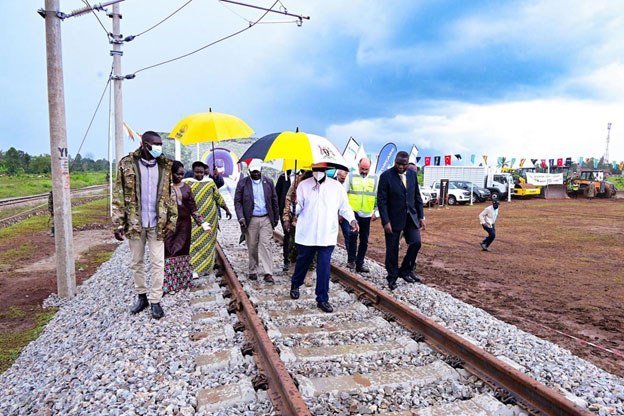
Uganda’s Permanent Secretary and Secretary to the Treasury Ramathan Ggoobi, who led the delegation, reaffirmed the government’s commitment to securing financial closure for the SGR project by November. However, with key financing arrangements still being finalised, meeting the deadline now appears increasingly unlikely.
Uganda is pursuing a highly diversified financing pool for the SGR that also includes the African Development Bank. In May, the Ministry of Finance reported that the AfDB had tentatively allocated approximately $650 million to the SGR. The ministry said final financing arrangements would follow further appraisal.
To address lenders’ concerns over land acquisition and project implementation risks, Uganda entered into a Limited Notice to Proceed (LNTP) agreement with Turkish contractor Yapı Merkezi, allowing preliminary works to proceed ahead of full financial closure.
The arrangement was complicated in June when Chief of Defence Forces Gen. Muhoozi Kainerugaba publicly announced that the contractor’s deal had been cancelled. However, the contract appears to remain in place, raising questions about the status of the agreement and its implications for the project’s financing.
In October this year, the SGR’s official X account said activities under the LNTP were due to end that month. It reported that a sleeper factory, labour camps and a materials laboratory had been established, although The Independent could not independently verify those claims. The account also put land acquisition at about 70%, with compensation still ongoing in Mukono and Kampala.
The announcement by Gen. Muhoozi has also drawn attention to the potential implications of the contract’s status for lenders, export credit agencies, insurers and guarantors. However, the extent to which it has affected financing negotiations remains unclear.
Kenya link
Meanwhile, in March this year, Kenya revived its long-delayed SGR extension from Naivasha through Kisumu to Malaba, marking a significant step towards connecting the port of Mombasa to Uganda’s border by modern rail. President Yoweri Museveni joined his Kenyan counterpart, William Ruto, in Kisumu for the launch of the cross-border section, underscoring the project’s regional significance.
The extension comprises a 264-kilometre Naivasha–Kisumu section and a further 107-kilometre stretch from Kisumu to Malaba, bringing the railway closer to Uganda and the wider East African hinterland.
Construction works began in July, following years of delays after the earlier China-backed expansion stalled over financing difficulties. Once completed, the line is expected to strengthen the Northern Corridor, reduce reliance on road freight and improve the movement of goods between Mombasa and landlocked markets, including Uganda.
Museveni said the railway would improve regional connectivity and make trade and transport more efficient across East Africa. For Uganda, however, the benefits will depend on completing its own SGR link from Malaba to Kampala, as well as ensuring that the two countries’ railway systems operate as an integrated freight corridor.
SGR project coordinator Eng. Perez Wamburu said the railway is expected to halve freight costs from $0.14 to $0.07 per tonne-kilometre and reduce transit time from 8.5 days to one day.
Proponents also project that the railway could cut manufacturers’ overall production costs by about 30%, making Ugandan goods more competitive in regional and international markets. These gains, however, will depend on actual freight volumes, rail tariffs and the cost of moving cargo between factories, railway terminals and final destinations.
The railway is also expected to close a critical gap in the Northern Corridor, strengthening Uganda’s links to the port of Mombasa and its access to regional markets in the Democratic Republic of Congo, Rwanda and South Sudan. If integrated with Kenya’s SGR network, it could bolster Uganda’s ambitions to become a regional logistics hub.
The Northern Corridor Transit and Transport Coordination Authority (NCTTCA) reported in its 2021 transport observatory report that Uganda accounted for about 76% of transit traffic through Mombasa, with more than 90% of that traffic moving by road. The figures underline the importance of reducing the cost and time required to move cargo between the coast and Uganda’s inland markets.
Kenya’s existing SGR offers a glimpse of both the opportunity and the operational challenges. According to the NCTTCA, the Mombasa–Nairobi railway has a designed capacity of 22 million tonnes of cargo annually, while the extension to Naivasha provides an inland connection for freight moving beyond the capital. But completing the railway to Malaba—and connecting it to Uganda’s proposed line—will be essential to extending those benefits across the border.
The regional transport authority’s monitoring reports also show why a railway alone cannot guarantee lower logistics costs. Infrastructure experts say freight rates are influenced by road conditions, border procedures, handling charges and other administrative barriers, while the corridor’s performance depends on the coordination of road, rail, port and inland logistics infrastructure.
The SGR’s projected savings will therefore depend not only on completing the tracks, but also on competitive rail tariffs, reliable freight services and efficient transfers between the railway and its final destinations.
Debt trap
The project has also drawn criticism over its cost, debt implications and the economic model underpinning it. Engineer Apollo Buregeya argued in a post on X in May 2025 that the SGR risks reproducing colonial-era infrastructure patterns rather than transforming Africa’s economies.
“It is a well-polished iron chain extending a colonial infrastructure vision, not disrupting it,” he said, describing the railway as “a debt trap disguised as development.”
Buregeya argued that, despite the modern technology, the railway could reinforce an export-oriented model that prioritises moving goods cheaply and accelerating imports over strengthening domestic production. “Move goods cheaply, push imports faster, deepen dependence,” he said.
He contends that infrastructure investment should first protect citizens and connect domestic production zones to markets within Africa before prioritising links to the global economy.
“The Standard Gauge Railway jumps to the last stage, ignoring the first two,” he said.
In Uganda, there is intense debate on whether the railway will do more than move imports from Mombasa faster. Some trade experts say the project’s longer-term economic value will also depend on whether manufacturers and agricultural producers can use it to ship exports competitively, and whether reliable connections to domestic production centres and neighbouring markets can be established.
The €2.7 billion financing matrix has become the critical bottleneck in Uganda’s most ambitious transport infrastructure project. With the Islamic Development Bank, KfW IPEX-Bank, the African Development Bank and the OPEC Fund at different stages of consideration, and Citibank coordinating the fundraising, the tall order is aligning their approvals, conditions and disbursement timelines into a single, executable financing package.
Until that happens, the government’s ambition to connect Kampala to the Kenyan border by rail remains constrained by the gap between financing commitments and funds available for construction.
The OPEC Fund’s appraisal visit and the November financial meetings in Frankfurt could prove important in closing that gap, but the decisive test will be whether the negotiations translate into signed agreements and actual disbursements.
The post Uganda’s SGR faces new funding test appeared first on 1:.