

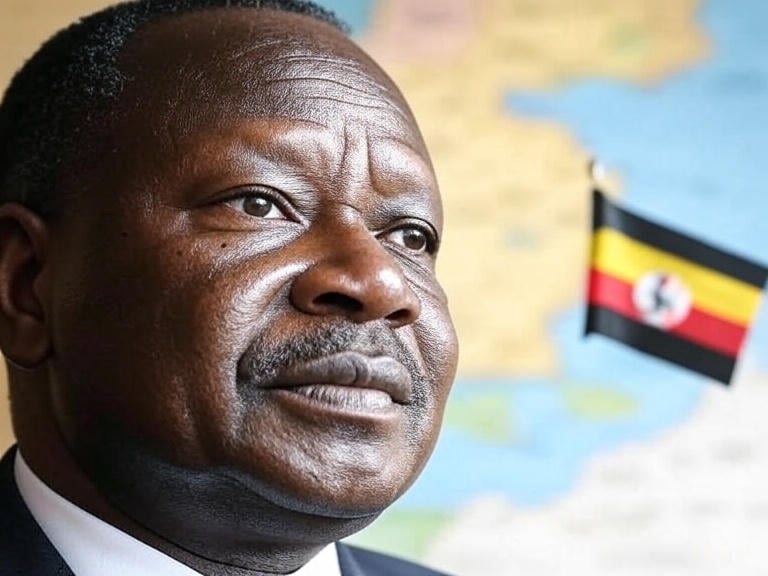
There is a man seated behind a heavy mahogany desk. The cameras flash, the nation sees power, but his soul knows otherwise.
His back aches, his blood is thin, and his breath comes heavy. He is tired—so tired. Yet he cannot leave. He cannot say, “My mission is complete.” Because outside that office lies a storm waiting to devour him.
The banks are circling like vultures. They remember the loans that were signed with reckless confidence when the fuel was free, when every journey was on the taxpayer’s back, when every handshake was a deal. The moment he loses that title, the calls will begin: “Sir, your loan is overdue.”
The enemies sharpen their knives. He remembers the villages where he stole land, the contracts he awarded to cronies, the opponents he humiliated in broad daylight. He remembers the protests silenced with bullets. He knows those ghosts are patient. They are waiting for the day he is naked, no longer Honorable, no longer Excellency, just a man with no address.

Even the pleasures will mock him. The endless foreign trips, the envelopes passed under the table, the women who offered themselves because power made him irresistible—all vanish the day his convoy stops moving. When the sirens go silent, so do the phone calls.

He knows it. And so he stays. Not because he wants to, but because he cannot afford not to. He sits in office like a man clinging to a coffin floating on flood waters. The coffin is heavy, but it is the only thing keeping him from drowning.
This is Uganda’s tragedy. We are ruled not by men of vision, but by men of survival. They extend their terms not because they believe in tomorrow, but because they are terrified of today. They smile at us on television, but behind those eyes is pure fear. Fear of creditors. Fear of revenge. Fear of obscurity. Fear of losing the only shield they have against the consequences of their own choices.
That is why corruption is not just a vice in Uganda—it is oxygen. Without office, the free fuel stops, and they must pay for every litre. Without office, the bank closes its vault. Without office, the girlfriends find new “honorables.” Without office, the once-mighty are reduced to weak men standing in endless queues like the very people they once mocked.
And so, they hold on. Their bodies cry, “We are finished.” Their souls whisper, “We are guilty.” But their fears scream louder: “Stay. Stay until the last breath.”
Uganda is thus governed by the weary, the haunted, the indebted. Men and women who should have retired to silence long ago, but who continue to sit in seats that have become their prisons. They cannot leave—not because they are strong, but because they are too weak to face life outside power.
And this is why the nation suffers. Decisions are no longer about building schools or hospitals. They are about extending lifelines. Budgets are not crafted for citizens; they are crafted for survival. Every law passed is not about justice—it is about insurance. Every deal signed is not about progress—it is about escape.
The office, which should have been a platform of service, has become a bunker of fear. A coffin where the living dead pretend to rule, when in truth they are only hiding from the ghosts outside.
Uganda deserves better. A leader should step into office with courage, and step out with dignity. But here, office is not service—it is asylum. And the man in the chair is not a ruler—he is a fugitive of his own past.
By Isaac Christopher Lubogo