

Kampala, Uganda | ENTEBBENEWS.NET | On Tuesday evening, Amina Namuwaya arrived at Immaculate Heart Primary School as she had done countless times before. She expected to walk straight to her children’s classrooms, collect them, and head home. Instead, school authorities restricted her at the gate.
“Last week I wasn’t the one who picked them up,” she said. “Returning this week, I found new instructions that we can no longer enter the school but rather stop at the gate where you are verified and a teacher or security person calls the child.”
What was once a simple, familiar routine has become a security checkpoint. And Amina’s experience is no longer the exception—it is quickly becoming the new normal across schools in Kampala and Wakiso districts.

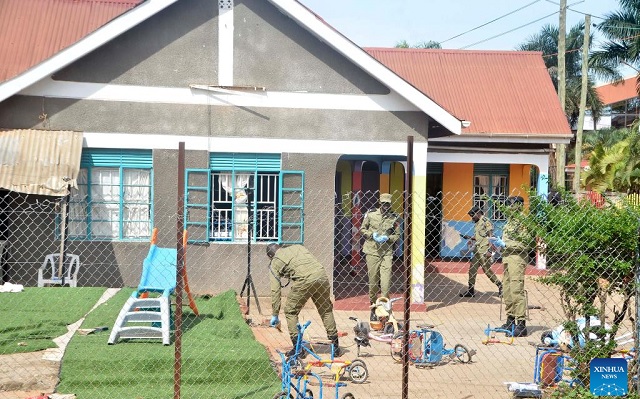
The trigger was a nightmare that unfolded just over a week earlier at the Ggaba Early Childhood Development Programme (ECD) in Makindye Division, Kampala. On April 2, 2026, a 39-year-old man named Christopher Okello Onyum gained entry to the nursery by posing as a concerned parent. He had visited the centre days earlier, inquired about enrolling a child, and even paid admission fees.
Once inside, he reportedly locked the gate behind him and brutally stabbed four toddlers, aged between one and three years, to death. The victims were identified as Ryan Odeke (1.5 years), Judeon Eteko (2.5 years), Keisha Alungat (2 years), and Egnious Sseruyange (2 years). Police arrested Onyum at the scene after a security guard from a nearby church intervened; angry residents had tried to lynch him.

The suspect has since been charged with four counts of murder and remanded in custody. The Ministry of Education and Sports immediately closed the Ggaba ECD centre and two sister schools (Maranatha Primary and High Schools) run by the same church management, ordering parents to collect their children while investigations continued.
The killings sent shockwaves through Uganda’s education community. For parents who have long treated schools as extensions of the home, dropping off and picking up children freely, chatting with teachers, and even entering classrooms, the attack exposed a terrifying vulnerability: anyone could pose as a parent and walk straight in.
In response, many institutions have moved swiftly to restrict access. At schools like Lohana in Kampala, parents interviewed for this story report being issued identification cards for verification. Drop-offs and pickups are tightly controlled; entry beyond the gate is limited to authorised staff only.
Similar protocols have appeared at other private and public schools in Wakiso and Kampala, where parents wait outside while teachers or security summon children by name or class. Perimeter checks, visitor logs, and gate-only policies are being enforced more rigorously than ever.
Derrick Lwanga, a director at Tinygaint School in Namalele, Wakiso District, says the changes follow heightened safety concerns after the Ggaba incident, which exposed gaps in school security, alarming both parents and administrators.
Lwanga accepts that his school, like many others, previously allowed parents to move freely within the compound, including access to classrooms and other sections. That approach has since been scrapped. Access is now controlled, with parents restricted to designated areas and required to follow stricter entry procedures. Lwanga notes that the new measures aim to protect learners and staff, even if they reduce the openness that schools once maintained.
Paul Nsereko of Kisakyamuka PS in Namungoona echoes the shift, as they are tightening enforcement of visitor protocols in response to the same concerns.
Nsereko adds that entry into the school is now strictly regulated. Anyone without a visitor’s card is turned away at the gate. Those who are cleared must wear identification and are only allowed to move within the school under the guidance of a teacher or designated staff member.
Nsereko stresses that the tighter controls are necessary to prevent unauthorized access and to strengthen child protection within school environments.
Hasadu Kirabira, the director of City Schools who is also the chairperson of the National Private Education Institutions Association, said that the Ggaba incident exposed weak points in school security. He also admited that before the incident, some schools had relaxed their vigilance hence the attack has since served as a wake-up call across the sector.
“Schools must enforce basic safety measures.” Kirabira said. “These include screening everyone who enters the premises and checking for dangerous items. Such steps form the first line of protection for learners and staff and schools must step up vigilance at all levels to match the evolving threats.”
Kirabira also raised concern over the quality of security personnel in many schools. He said that some institutions rely on guards who lack formal training and serve mainly as gatekeepers.
“This gap weakens overall security and calls for proper training and professional standards,” he added.
The strengthening of security measures at schools in wake of the Ggaba attack aligns with long-standing but often loosely followed government guidelines issued over the year after a series of school fires and security scares.
The rules call for controlled access points, secure perimeter fencing, guards at entrances, restricted movement inside school compounds especially around dormitories, kitchens and play areas. Police and education official kep urging implementation; the Ggaba tragedy has turned the advisories into urgent action.