

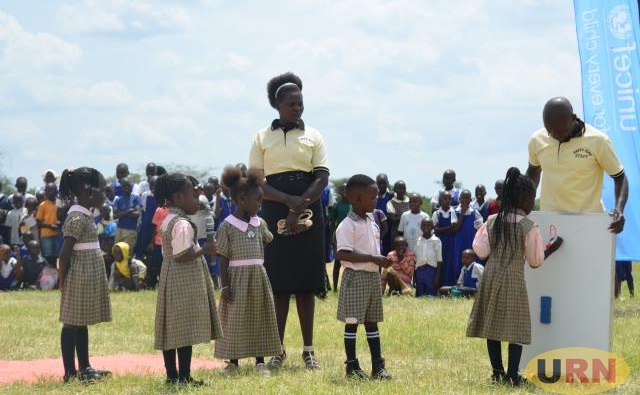
Moroto, Uganda | URN | Indigenous communities in the Karamoja sub-region are asking the government to train and recruit native teachers to teach children in lower primary schools, saying the shortage of teachers who speak local languages is undermining learning.
Karamoja is home to 11 minority ethnic groups, including the Pokot in Amudat, Tepeth in Moroto, Kadam in Nakapiripirit, Ethur in Abim, Ik in Kaabong, Tuni in Napak, Ikuliok in Kotido, Nyangiya and Napore in Karenga.
However, communities such as the Pokot, Ik and Kadam say they have struggled to secure native teachers and are instead relying on teachers from other ethnic groups to teach children in their mother tongue, despite some not being native speakers of the languages.

Rev. Canon Jane Chorey, a cultural leader of the Pokot community, said the community has failed to attract enough Pokot teachers and is forced to rely on Sabiny teachers because they speak a language similar to Pokot.
Chorey said the curriculum requires children in lower primary to be taught in their mother tongue, but pupils in Pokot areas are struggling because there are not enough teachers who can effectively communicate in the local language.

“At some point we trained our own Senior Four leavers to become primary teachers, and they were doing a good job. But the government did not put them on the payroll because they lacked formal qualifications, and parents could not afford to pay them,” Chorey said.
She said some of the trainees eventually dropped out, while others returned to school to pursue formal teaching qualifications but could not afford to complete their studies.
Amudat District has long struggled with poor education outcomes, which Chorey attributed partly to weaknesses in the early years of learning.
“Children go to school and meet very new things. The struggle to learn English takes them longer, forcing them to repeat classes,” she said.
Chorey said the Pokot community already has teaching materials translated into the local language but lacks teachers to use them effectively in Primary One, Two and Three.
“Because there are no native teachers, pupils sometimes go home without understanding anything taught in school. Both teachers and pupils are gambling in communication,” she said.
She appealed to the government to establish a special programme to train and recruit native teachers from indigenous communities to teach lower primary classes.
In the Tepeth, Ik and Kadam communities, district local governments have also resorted to recruiting a small number of Karamojong and Iteso teachers because of the shortage of native teachers.
Samuel Baker Abukong, chairperson of the Karamoja Indigenous Minority Groups, said minority communities face major gaps in service delivery, particularly in education, healthcare and road infrastructure.
“Services like education, health, and road networks are the most affected. Schools and roads are in a very poor state and receive little attention, while health facilities are far from the communities,” Abukong said.
He said indigenous leaders are working with local governments to improve road networks in minority areas to ease access to schools and health facilities.
Abukong challenged the government to prioritise the needs of minority communities, saying poor access to essential services continues to deepen their marginalisation.
The indigenous leaders argue that training and recruiting native teachers would improve literacy, reduce school dropouts and help preserve the languages and cultural identity of minority communities in Karamoja.
The post Karamoja indigenous communities call for gov’t to train native teachers appeared first on 1:.