

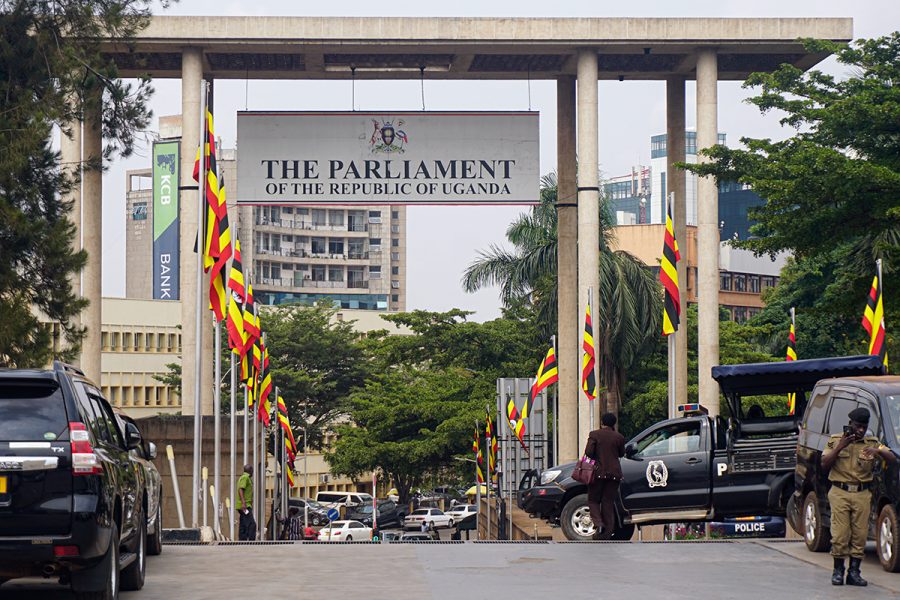
Parliament of Uganda will spend a staggering Shs 39bn on the upgrade of the existing security system and installation of another network in the new chamber under construction.
According to highly confidential documents seen by ChimpReports, Parliament has earmarked Shs 4bn to upgrade the existing Shs 30bn security system procured for the old Parliament structure in 2015.
The cost of the security upgrade includes Shs 281m for video surveillance equipment; Shs 1.6bn for the entrance security detection system; Shs 714m for vehicle management system; Shs 496m for pedestrian gate system; Shs 580m for under vehicle scanner; Shs 41m for network equipment and Shs 246m for “tools.”
Additionally, Shs 35bn has been set aside for the “supply and installation” of an “integrated system” for the new chamber.

The new block contracted to Roko Construction Company has 8 floors, chambers, an archive center, press gallery, a spacious members’ lounge, offices for the Speaker and Deputy Speaker, a library, dining hall, and committee rooms.
At this new structure, video surveillance will cost Shs 7.7bn; Shs 17bn for access control system; Shs 2.9bn; and Shs 802bn for the command and control centre.

The main data centre will cost Shs 4.9bn; Shs 2.7bn is earmarked for the disaster recovery centre; while network and security will go for Shs 3.7bn.


The implementation, project management, training and I year maintenance will cost a staggering Shs 3.6bn.
This is in addition to Shs179 billion which Parliament is spending on the construction of the new chamber.
In total, since 2015, the taxpayer will have paid Shs 248bn for the construction of the new Parliament chamber and security systems to keep the MPs safe.
Parliament speaks out
The cost of the new security systems at Parliament has caused unease with insiders saying the figure is high and others questioning the soundness of the procurement process.
Acting Parliament spokesperson Hellen Kaweesa said the price of the security system was determined by a committee comprising police and Parliament officials.
“There was a team composed of Uganda Police Force and the user department (Parliament),” Kaweesa told ChimpReports by telephone.
“Police took the lead in developing the specifications which provided indicative prices of the system,” she added.
Controversy
According to insiders who preferred anonymity to speak freely, the existing security system was procured by Parliament through police’s classified method in 2014.
Police has been maintaining the system since then.
In 2018, on request by Parliament, police’s technical team conducted surveys, technical designing, bill of quantities for the new chamber’s integrated system as an update and integration to the current systems.
On August 24, 2020, the Director of ICT Department at Parliament, Fred Baale requested for approval of procurement of the integrated security system with the amount of Shs 39bn under reference number POU/SUPLS/01B/00130.
However, in a legal opinion dated Sept 8, 2020, Parliament’s Director of Litigation and Compliance noted that: “It is recommended that Police should take on all aspects of security for a seamless integration since they are in charge of surveillance of Parliament buildings and had ever handled similar works for the same institution.”
On September 2020, Julian Kaganzi on behalf of Clerk to Parliament, Jane Kibirige wrote to police to secure their green light to go ahead and procure the integrated system.
According to whistleblowers, the law enforcement body rejected the request.
Officials said despite these recommendations, Parliament’s ICT and Procurement departments went ahead to procure the system “which is beyond their mandate.”
Parliament spokesperson Kaweesa said “Police was involved in the entire procurement process – from development of the specifications of the security system up to the evaluation stage of the best bidder.”
Pressed to identify police officials on the committee, Kaweesa said, “We had representation from Police’s ICT department.”
Asked why Parliament chose the restrictive bidding process, Kaweesa said the “components of system are on open market and there are a few firms in Uganda with capacity and expertise to put them together into an integrated system. This requires specific firms with necessary expertise to integrate them into one system.”
She further said Parliament was keen on avoiding exposing specifics of the security system requirements in public domain.
The project is currently under the stage of best bidder notice with four companies now being invited.
These include Technology Associates Ltd, Emerald Telecom (U) Ltd and Infinity Computer and Company Ltd.
Cost
In 2018, Speaker Rebecca Kadaga said the new chambers would improve the sitting capacity for Members of Parliament, and create more space for the growing number of legislators.
“When we conceived the project, we considered that Parliament would grow overtime and reach 500 members in another 20 years,” said Kadaga in 2018.
“But when handing over the site, we had already hit the 400 mark. We hope you will make adjustments to create more space for MPs,” she added.
The new Parliament will host a chamber with the capacity to sit 600 MPs as opposed to the current one of 100 members.
Other facilities include a museum, state of art archiving facility, gallery and increased space for offices.
The building was initially expected to be completed in July 2020 but the deadline was extended due to slow works as a result of COVID-19.
Uganda, with a GDP per capita of $794, elected 529 MPs in the 2021 general elections. Yet, Australia, the 13th largest economy in the world with a GDP of $1.40 trillion and GDP per capita of $55,060, has only 151 members of the House of Representatives.
src: ChimpReports