

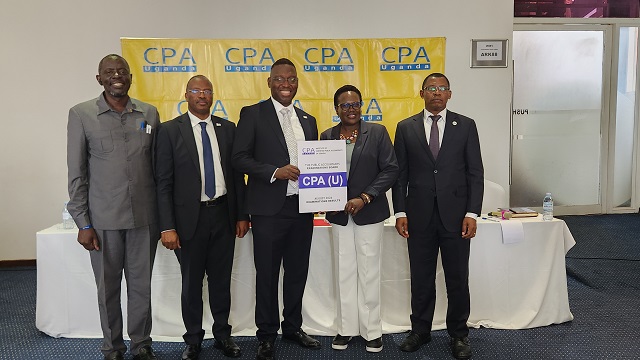
Kampala, Uganda | JULIUS BUSINGE | Uganda’s CPA examination pass rate fell to 34% in the August 2026 sitting, down from 36.4% a year earlier, even as the number of candidates increased by more than 10%, according to results released by the Public Accountants Examinations Board (PAEB) on Sept.14.
The August examinations attracted 4,675 candidates, an increase of 426 from the 4,249 candidates who sat in August 2025. However, of the 6,711 examination scripts presented this year, only 2,281 registered passes, bringing the average pass rate down by 2.4 percentage points.

The results were released by the Public Accountants Examinations Board of the Institute of Certified Public Accountants of Uganda (ICPAU).
The decline comes despite interventions by PAEB and ICPAU aimed at improving candidates’ preparation, including free virtual student engagements, examination briefing sessions and increased collaboration with tuition providers.
PAEB said examiners continued to identify inadequate preparation, weaknesses in applying technical knowledge, examination technique and interpretation of examination questions as some of the major challenges affecting candidates.

Performance varied significantly across the four levels of the CPA course.
Level I recorded the strongest improvement, with its average pass rate rising to 49.9% from 41.6% in August 2025. Level IV also registered a substantial improvement, with the pass rate for Integration of Knowledge rising to 52.1% from 33.5%.
However, Level II recorded the sharpest deterioration, with its average pass rate falling to 34.7% from 44.1%. Level III remained almost unchanged at 22.2%, compared with 22.5% in the previous year’s sitting.
Individual subject performance also revealed significant differences.
Quantitative Techniques at Level I recorded a notable improvement, with the pass rate rising to 38.9% from 19.8%. Cost and Management Accounting also improved from 41.5% to 49.1%.
At Level II, however, Financial Reporting fell to 41% from 52.8%, while Management Decision and Control dropped to 38.2% from 50.1%. Taxation declined to 41.7% from 56.3%.
Level III remained particularly challenging. Advanced Financial Reporting recorded a 13% pass rate, while Advanced Financial Management registered 13.2%. Public Financial Management recorded 27.7%, while Audit Practice and Assurance improved substantially from 12.8% to 31%.
The results show that while some parts of the CPA programme are producing better outcomes, advanced-level papers continue to pose a considerable challenge to candidates.
PAEB Chairperson Nancy Amuge Owino said the board had intensified interventions intended to address performance challenges.
The board has been conducting free virtual student engagement sessions, with the first phase held in March. More activities are scheduled to begin in October ahead of the December examinations.
Briefing sessions were also held on August 20 and 21, immediately before the August examination diet.
PAEB said it had observed improved performance among students who participated in the engagements and urged candidates preparing for the December examinations to take advantage of the sessions.
The board also held a specialised virtual workshop with 70 tuition providers on August 7, focusing on audit-related papers that have consistently recorded poor performance.
The engagement was also used to share research findings on factors affecting performance in CPA core subjects, with PAEB saying similar interventions would be extended to other subjects showing persistent weaknesses.
The August examination itself was not without challenges.
PAEB acknowledged an incident involving Paper 18, Integration of Knowledge, which delayed the start of the examination at a designated centre on August 26 from 9am to 11am.
The board apologised to affected candidates and said it was working on lasting solutions to prevent similar incidents in future.
Despite the overall decline in the pass rate, 130 students completed the CPA course during the August sitting, up from 97 in August 2025.
Women accounted for 69, or 53.1%, of the 130 finalists, while men accounted for 61, or 46.9%.
The cumulative number of students who have completed the CPA course now stands at 5,806.
Samali Favour Nawankambo emerged as the overall top student and also the best-performing female candidate in the August examinations.
Of the 21 top positions across the subjects, male candidates occupied 11 positions, representing 52.4%, while female candidates took 10, or 47.6%.
Candidates aged between 25 and 29 years accounted for the largest share of passes, with 927 passes, equivalent to 41%. They were followed by those aged 30 to 34, who recorded 653 passes, or 29%. Candidates aged 35 to 39 accounted for 14%, while those aged 18 to 24 and 40 years and above accounted for 9% and 7%, respectively.
Only 732 of the 2,281 successful candidates, equivalent to 32.1%, were sitting their papers for the first time, highlighting the difficulty many candidates face in progressing through the professional accountancy qualification.
The Institute’s President, David Timothy Ediomu, congratulated successful candidates and urged those who completed the course to proceed with membership enrolment.
He said candidates who have not yet attained the three years of practical experience required for full membership can enrol for free Associate Membership while they work towards meeting the requirement.
For candidates who did not achieve the desired results, Ediomu said another opportunity would come with the December 2026 examination diet.
The December sitting will be the third and final CPA examination diet for 2026, with results scheduled for release in January 2027.