

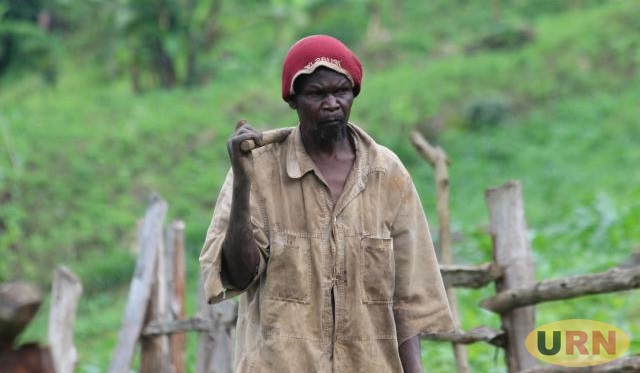
Bududa, Uganda | URN | When Peter Kibeti returned to Nametsi village in Bududa District after years in government resettlement in Kiryandongo, he knew exactly what he was returning to.
He was returning to the same steep mountain slopes that buried homes and claimed hundreds of lives during the devastating March 2010 landslide.
He was returning to a community that still lives with the fear that another disaster could strike with the next heavy rains.

Yet he was also returning to fertile soils, dependable rainfall and the only livelihood he believed could sustain his family.
His decision captures a dilemma that is becoming increasingly familiar across Uganda

.As climate change alters rainfall patterns, intensifies floods and landslides, and prolongs droughts, growing numbers of Ugandans are making difficult decisions about whether to stay, move or begin again elsewhere.
For decades, climate change was largely viewed as an environmental challenge.
Today, policymakers increasingly recognise that it is also reshaping where people live, how cities grow, how governments plan infrastructure and how countries invest in development.
The question is no longer simply how to respond after disasters strike. It is whether Uganda is preparing for a future in which climate increasingly determines where people can safely build their lives.
Uganda has long experienced floods, landslides and droughts. Communities along major rivers and around Lake Victoria endure recurring floods, while settlements on the slopes of Mount Elgon remain vulnerable to deadly landslides.
Across Karamoja and the cattle corridor, prolonged drought has steadily undermined farming, livestock keeping and household incomes.
These disasters often dominate headlines only when lives are lost. Yet experts argue that the more profound story unfolds long after the emergency has passed: the gradual movement of people seeking safer places to live and more reliable livelihoods.
Speaking during a regional dialogue on migration, environment and climate change, Ugandan climate policy specialist Bob Natifu said environmental change has always influenced migration across Africa, but climate change is making those movements more frequent, more complex and increasingly permanent.
Floods, landslides, drought, declining agricultural productivity and environmental degradation are combining to erode livelihoods that have sustained communities for generations.
Migration is therefore becoming an adaptation strategy for many households rather than simply an emergency response. Sometimes movement is temporary. Sometimes it becomes permanent. And sometimes, as happened in Bududa, families relocate only to discover that the places intended to keep them safe cannot provide the livelihoods they left behind.
That reality challenges traditional disaster management. For decades, governments have largely measured success by how quickly relief reaches affected communities or how efficiently families are relocated after disasters.
Increasingly, however, researchers argue that success should instead be measured by whether displaced families are able to rebuild sustainable lives. Recognising these emerging challenges, Uganda has taken a leading role in regional discussions on climate mobility.
The Kampala Ministerial Declaration on Migration, Environment and Climate Change calls on African governments to recognise climate change not only as an environmental crisis but also as a driver of human mobility.
It urges countries to integrate migration into climate adaptation planning, strengthen disaster preparedness, improve climate mobility data and invest in long-term resilience instead of relying solely on humanitarian response.
For Natifu, one of the declaration’s most important messages is that governments must address the conditions forcing people to move rather than simply managing displacement after it occurs.
Planning for climate migration requires answering difficult questions. Which communities are becoming increasingly vulnerable?
Where are displaced families likely to relocate? Which towns will absorb growing populations? And are local governments prepared for these demographic changes?
Those questions place evidence at the centre of climate policy. Across East Africa, regional institutions are increasingly attempting to forecast not only climate hazards but also the human movements they trigger.
The Intergovernmental Authority on Development’s Climate Prediction and Applications Centre (ICPAC), traditionally known for producing seasonal weather forecasts, is expanding its work to understand how droughts, floods and other climate shocks translate into population movement.
“We need facts and evidence,” Natifu said during one of the regional policy dialogues.
“We need data we can rely on to assess the situation and ensure that the relationship between migration, disasters and climate change becomes much clearer.”
Regional Programme Manager Dr Ahmed Abdehud says governments need to understand not only how many people are displaced, but also where they originate, where they move, how long they stay away and whether they eventually return.
ICPAC has therefore begun integrating displacement information into regional hazard-monitoring systems so that future early warning systems can identify not only where disasters may occur but also where they are likely to trigger migration.
Such information could enable governments to prepare schools before enrolment increases, expand health services in receiving communities, identify land for temporary settlements and pre-position humanitarian assistance before families are displaced.
In short, climate migration could become something governments anticipate rather than merely endure.
Uganda has made progress in strengthening meteorological monitoring and disaster response, but systematic information linking climate hazards to internal migration remains limited.
Government agencies record disaster impacts. Humanitarian organisations monitor emergency displacement. National censuses capture migration over time.
What remains largely absent is an integrated system that connects climate events with patterns of population movement. Without that evidence, policymakers struggle to answer fundamental questions. Which districts are consistently losing population because of climate stress? Which urban centres are receiving increasing numbers of migrants? Why do some resettlement programmes succeed while others fail?
Research by Makerere University’s Cities of Youth project has already begun documenting how young migrants displaced by climate pressures are reshaping Uganda’s secondary towns and cities.
The findings suggest that climate mobility is no longer confined to disaster camps or rural resettlement schemes. It is increasingly becoming part of everyday urbanisation, placing new pressure on housing, employment, education and public services.
The Kampala Ministerial Declaration recognises these knowledge gaps and calls for stronger data systems capable of informing national planning. Yet even the strongest national policies ultimately succeed or fail at the local level.
District governments remain the first institutions to respond when rivers overflow, hillsides collapse or prolonged drought destroys crops.
Many, however, continue to operate with limited financial resources, technical capacity and competing development priorities.
Bududa illustrates both the strengths and limitations of current approaches. Authorities successfully coordinated emergency evacuations and organised resettlement after major landslides.
Yet many relocated families eventually returned, citing infertile land, unfamiliar climatic conditions and limited economic opportunities.
Their experience demonstrates that relocation cannot be measured simply by the number of households moved. Success depends on whether families are able to rebuild livelihoods, educate their children, access healthcare and remain economically secure. Planning for climate mobility therefore extends well beyond disaster management.
It requires coordinated investments in agriculture, infrastructure, education, health, roads, housing and local government.
Communities vulnerable to floods need improved drainage and flood protection. Landslide-prone areas require slope stabilisation and better land-use planning.
Drought-prone regions need irrigation, climate-smart agriculture and diversified livelihoods. Growing towns require schools, housing, water systems and transport infrastructure capable of accommodating expanding populations.
Many of these priorities already appear in Uganda’s National Adaptation Plan.
The challenge is turning policy into implementation. Climate finance remains limited, while local governments continue to rely heavily on constrained national budgets and donor-funded projects.
Natifu argues that stronger partnerships between governments, research institutions, regional organisations and development partners will be essential if countries are to mobilise the investment required.
For Peter Kibeti, however, climate migration is not about declarations, adaptation frameworks or regional policy.
It is about deciding whether to remain on a dangerous mountainside or abandon the only land his family has ever known. Across Uganda, thousands of households are making similar calculations.
Whether those decisions become recurring humanitarian emergencies or opportunities for planned adaptation may ultimately depend on whether the government begins preparing for climate mobility before the next disaster forces people to move.
The post Climate-induced migration: Is Uganda ready? appeared first on 1:.