

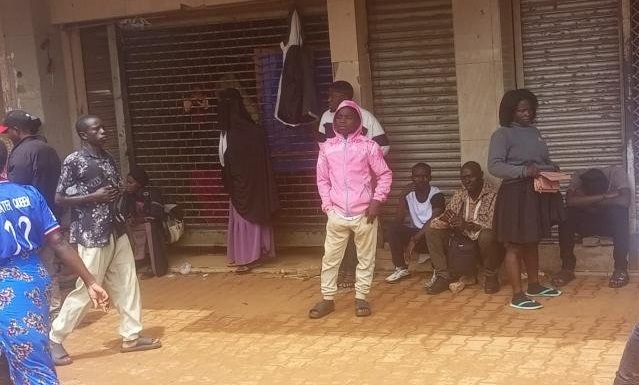
Kampala, Uganda | URN | Traders in downtown Kampala have closed their shops in protest against what they describe as excessive taxes imposed by the Uganda Revenue Authority (URA) and harsh enforcement methods, demanding urgent government intervention to address the rising cost of doing business.
Several arcades and commercial buildings across the city remained closed throughout the day as traders staged what they described as a peaceful shutdown. Some workers sat outside locked shops chatting, while others slept as they waited for the next course of action.
URN reporters who moved around downtown Kampala found several shops closed, particularly in Skylight, Dembe, Bypass, Nabukera and Pentagon arcades, as well as Shopping Centre and Qualicel Bus Terminal Shopping Centre, among others. Most of the traders who participated in the shutdown are members of the Kampala City Traders Association (KACITA), which has been demanding a meeting with URA to discuss a range of tax and business-related concerns.

Security was heightened across the city, with traffic police deployed along major roads and reinforced by military police. Kampala Capital City Authority (KCCA) enforcement teams were also seen patrolling the city centre amid fears that some traders could attempt to force those who had opened their shops to join the shutdown, as has happened during previous protests.
Yusuf Kalungi, the chairperson of the Kikubo business hub, said traders had opted for a peaceful protest by simply closing their shops. He said no trader had taken to the streets with placards or attacked anyone, adding that the closure would continue until the government listens to their concerns.

Kalungi said the shutdown was a last resort after several written requests by traders’ leaders seeking a meeting with URA to discuss what they consider excessive tax charges and enforcement measures. He said traders want the government to review tax policies, enforcement practices and the overall cost of doing business in the country.
Kalungi also argued that previous protests had achieved little because traders lacked direct representation in Parliament, where laws and policies affecting businesses are made. He said one of their demands was to secure representation in Parliament, similar to arrangements for special interest groups such as the youth and older persons.
Robert Kagwa Matovu, a trader at Skylight Arcade, said the cost of doing business had become unbearable due to high taxes and rental charges, which he said were no longer sustainable. He said traders were struggling to keep their businesses afloat and wanted the government to intervene before more businesses collapsed. Mathias Bwanika, another trader at Mini Price, said many traders worked throughout the year without making profits because almost all their earnings went towards rent and taxes.
John Bosco Ahimbisibwe, a clothes trader at Qualicel Shopping Centre, questioned why the government had ignored traders despite their contribution to public revenue through taxes. He said traders were particularly frustrated by what he described as the government’s unwillingness to sit down with them and listen to their concerns. Ahimbisibwe also criticised tax holidays reportedly extended to some foreign nationals operating businesses in Uganda, saying the arrangement was unfair to local traders struggling to survive.
//Cue in: Tax holiday nga …
Cue out: … Chinese wano.//
Issa Ssekito, the KACITA chairperson, expressed disappointment with traders who defied the shutdown and opened their shops, saying disorganisation was weakening their collective voice in engagements with government. The traders want URA to address several issues, including the taxation of textiles in Kenya before they are transported to Uganda, alleged smuggling of textiles, and the new cargo clearance process for buses, particularly those transporting textiles.
They are also concerned about delays in customs clearance, enforcement of the Electronic Fiscal Receipting and Invoicing Solution (EFRIS), especially among city landlords, and alleged revenue leakages during container loading, among other issues. The shutdown follows last week’s failed meeting between traders and URA officials in Nakawa, which ended prematurely after disagreements between the two sides.
URA accused the traders’ leaders of hiring disruptive individuals to cause chaos during the meeting, an allegation the traders denied. The traders, on the other hand, said the meeting collapsed after URA security officials insisted that all participants leave their mobile phones at the registration desk before entering the meeting venue, a condition they rejected.By press time, traders remained divided over the shutdown. While some kept their shops open, arguing that a strike would not resolve the standoff, particularly with the festive season approaching and rent payments due, others maintained the closure was necessary to compel URA and the government to address their concerns. They warned that the protest could continue if their demands for dialogue were ignored.