

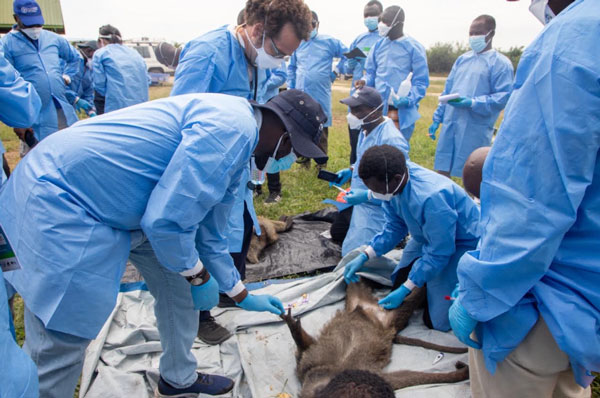
Kasese, Uganda | ENTEBBENEWS.NET | For five days, wildlife health workers at Queen Elizabeth National Park did work most people never see: setting rat traps, catching mosquitoes and learning to sample monkeys without harming them or themselves.
The regional training ran from November 2 to 6, 2026, and was organised by the Food and Agriculture Organisation of the United Nations (FAO) with Gorilla Doctors. The aim was to help Uganda’s frontline wildlife teams spot diseases in animals before they reach people and livestock.

The mosquito sessions covered malaria, dengue, yellow fever and Rift Valley fever. The rodent sessions covered Lassa fever, plague and leptospirosis. With non-human primates, the focus was mpox, Ebola, influenza and tuberculosis.
Participants learned to restrain, handle and dart primates. They collected blood, oral, nasal and rectal swabs, ticks and body-surface samples using sponge swabbing. They also learned to monitor an animal’s temperature, heart rate and oxygen levels throughout, to protect the animal and the people working with it.
Abebe Wolde, the Regional Pandemic Fund Coordinator at the FAO Regional Office for Africa, said: “The main problem identified is limited capacity in the wildlife sector, especially in wildlife veterinary surveillance.”

He said past capacity-building has focused heavily on animal health, while wildlife surveillance remains underdeveloped. He named Kasese as an example of where the work is now being done.
“The training combines theory with hands-on practical sessions,” Wolde said.
Participants learn “animal capture, sample collection, and sample processing under biosafety and biosecurity conditions.” The course also emphasises “collecting the information needed for veterinary authorities to make informed decisions.”
He said diseases and wildlife “do not respect borders,” pointing to Ebola.
“Regional coordination and collaboration are essential for detection, prevention, response, and investigation,” he said, and partners need consensus and collaboration “to help avert future pandemics.”
Maria Flavia Nakanjako, a senior veterinary officer in charge of wildlife and aquatic health at the Ministry of Agriculture, Animal Industry and Fisheries (MAAIF), said: “There are several challenges in identifying diseases in the wild.”
One of the biggest, she said, is safely immobilising an animal before taking samples. The training covered several techniques. It also equipped participants with skills to respond to epidemics and pandemics.
Her main message was about containment.
“The key takeaway is the ability to contain disease at the wildlife source,” she said, so it never escalates to nearby park communities. Livestock are also at risk, she added.


Dr. Bernard Sebidde the country head vet for Gorilla Doctors in Uganda and project coordinator for the pandemic fund project run by the Greater Virunga Landscape. He said detection is the first problem to solve.
“The key is to do surveillance so you know what is existing where,” he said. Teams need “the capacity to detect when something wrong happens.” Treatment and therapeutics, he said, are a later challenge.
Gorilla Doctors worked with FAO to design the programme. It brings together epidemiologists, veterinarians and wildlife surveillance officers. It is meant “to equip the frontline animal health workers for doing continued surveillance,” Sebidde said. Participants get “training materials and kits” and are expected to build the capacity “to detect and report.”
The course follows a training-of-trainers model, so participants can expand the programme back home. Sebidde urged them not to keep it to themselves. “Scale it up and train others,” he said.
Dr. Ricky Okwir Okello, a veterinarian working with gorillas in Bwindi Impenetrable National Park and Mgahinga Gorilla National Park, said the training shows how wildlife disease surveillance is done in Uganda, so participants can adapt similar approaches in their own countries. It also works as a networking platform for future collaboration.
His biggest lesson from the field exercises was the value of “a well-equipped laboratory located inside or very close to the park.” Queen Elizabeth has an elaborate one, he said, so samples collected in the field can be investigated “within hours or within a day.”
He also passed on a lesson that costs nothing. “Wildlife work requires patience,” Okello said. It means “taking time rather than rushing.
Dr. Mercy Chagara, one of the trainees, plans to apply her new skills in the Queen Elizabeth Conservation Area. She described it as “a hotspot for many zoonotic infections,” including anthrax and Rift Valley fever.
She said she was taught to trap rats and collect samples from them and from mosquitoes. “Particular emphasis is placed on conducting a risk assessment before establishing wildlife disease surveillance,” she said.
Chagara noted that the area is a Man and Biosphere Reserve, “making surveillance complex but also essential.” She cited figures that 70% of infections originate from animals, and 60% of those come from wildlife. Her answer was “the One Health approach,” which links human, animal and environmental health. She also called for direct funding for wildlife health programmes and for advanced testing of monitored diseases.