

Kampala, Uganda | URN | TotalEnergies expects global oil demand to peak between 2035 and 2040, even as it maintains that petroleum production will remain necessary for decades.
This outlook that raises questions about the long-term commercial prospects of Uganda’s multibillion-dollar oil investments.
The French energy company, which operates Uganda’s Tilenga oil project and is a major shareholder in the East African Crude Oil Pipeline (EACOP), says petroleum products demand will increase before reaching a plateau during the 2030s and gradually decline thereafter.

The projection is contained in the eighth edition of the company’s Energy Outlook, published on November 2, 2026, which examines possible developments in the global energy system up to 2060 under three scenarios: Trends, Momentum and Rupture.
In its Trends scenario (documents available at this link), which reflects the continuation of current government policies, technological developments and consumer behaviour, TotalEnergies projects that global demand for petroleum products will rise and plateau during the 2030s before beginning a slow decline.

Natural gas demand, meanwhile, is expected to continue growing before stabilising in the 2040s.
The company’s Chief Sustainability Officer, Aurélien Hamelle, told journalists that global oil demand could peak between 2035 and 2040, with the possibility of an earlier decline if electric vehicle sales continue expanding.
The outlook comes as Uganda approaches the commencement of commercial petroleum production, nearly two decades after commercially viable oil deposits were discovered in the Albertine Graben.
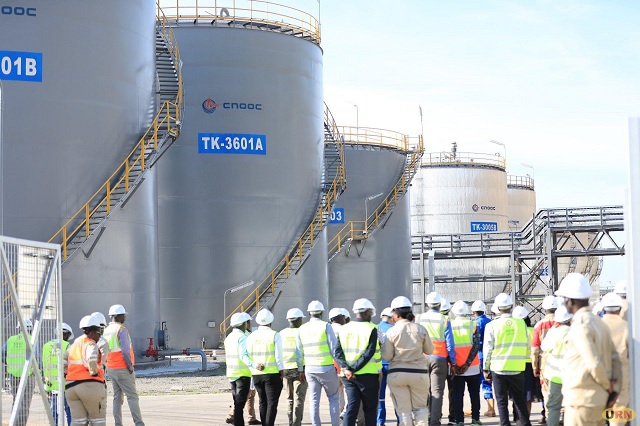
Uganda’s two major oil developments, Tilenga, operated by TotalEnergies EP Uganda, and Kingfisher, operated by China’s CNOOC, are designed to produce a combined 230,000 barrels of crude oil per day at peak production.
The crude will be transported through the 1,443-kilometre The projects, together with the pipeline, represent billions of dollars in investment. Uganda is targeting first oil before the end of the 2026/2027 financial year, which closes in June 2027, after missing an earlier July 2026 production target.
The revised timetable follows delays in the delivery of specialised equipment required to complete the petroleum facilities and pipeline infrastructure.
For Uganda, the timing of commercial production is particularly significant because the country is entering the international oil market at a time when the world’s largest energy companies are increasingly examining how electrification, renewable energy and climate policies could reshape future petroleum demand.
TotalEnergies’ outlook does not predict an immediate end to fossil fuels. Instead, it presents three possible pathways based on different levels of government ambition, international cooperation and investment in low-carbon technologies.
The Trends scenario, which the company describes as the continuation of current trajectories, anticipates global warming of between 2.6 and 2.8 degrees Celsius by 2100.
Under this scenario, the penetration of solar and wind energy, electric vehicles and heat pumps continues, but infrastructure limitations, particularly inadequate electricity grids, geopolitical tensions and the cost of new technologies constrain the speed of the transition.
The Momentum scenario assumes a more ambitious transition, with developed economies approaching carbon neutrality by 2050 and China by 2060.
It envisages greater electrification, a near phase-out of coal in OECD countries and increased use of natural gas in electricity generation and industry.
Even under this pathway, fossil fuels are expected to account for half of the growth in energy demand in India and the rest of the world because of inadequate investment in low-carbon alternatives.
The scenario produces an estimated global temperature increase of between 2.3 and 2.4 degrees Celsius by 2100.
The most ambitious pathway, Rupture, works backwards from a 2050 target intended to limit global warming to below two degrees Celsius, consistent with the Paris Agreement.
It requires significantly stronger international cooperation, faster electrification and a much sharper reduction in coal consumption.
Natural gas would retain a broadly stable share of the energy mix, while low-carbon electricity generation would expand substantially.
However, TotalEnergies acknowledges that achieving this scenario currently appears out of reach because of geopolitical rivalries and inadequate international cooperation.
It estimates that this pathway would result in global warming of between 1.8 and 1.9 degrees Celsius by 2100.
The differences between the three scenarios are important for countries such as Uganda, which are developing new petroleum resources while also committing to reducing greenhouse gas emissions and expanding renewable energy.
Despite the anticipated changes in global energy consumption, TotalEnergies maintains that petroleum and natural gas will remain important components of the global energy system.
In the Momentum scenario, the company specifically identifies natural gas as a transition energy for electricity generation and industrial production.
It also anticipates increased deployment of low-carbon hydrogen and sustainable fuels in sectors such as aviation and shipping, where direct electrification is difficult.
The company argues that energy security, affordability and sustainability must be considered together when governments make decisions about their energy systems.
Its outlook states that demand for all energy sources is still growing, including coal, oil, natural gas and electricity, particularly electricity generated from renewable sources.
The company observes that the growth rate of fossil fuels and their associated greenhouse gas emissions is slowing even as global economic growth continues above three per cent.
It describes this as evidence of an energy system that has begun transitioning towards lower energy consumption and emissions for every unit of wealth created.
TotalEnergies says investment in low-carbon energy, including the electrification of energy consumption, almost doubled from US$1.2 trillion in 2015 to US$2.1 trillion in 2025.
China is identified as the leading player in this transformation, accounting for approximately 60 per cent of additions in solar panels, 70 per cent of wind turbines and 60 per cent of electric vehicle sales.
The report also observes that electricity’s share of global final energy demand has increased by an average of 1.3 per cent annually since 2000. In 2025, it says, the increase in global electricity demand was met entirely by new low-carbon sources.
TotalEnergies’ President for Strategy and Sustainability, Aurélien Hamelle, says geopolitical developments are also reshaping governments’ energy priorities.
“The global energy system continues to walk a fine line, between resilience and sovereignty challenges, once again highlighted by the crisis in the Middle East, and an ongoing transition,” Hamelle said.
He added that recent developments had demonstrated the importance of developing domestic energy sources while securing supplies of fossil fuels.
“Developments since the Strait of Hormuz crisis underline the importance for governments to promote domestic energies, through power generation, notably from renewables, the electrification of demand, and biofuels, while investing in securing the fossil energy system through the diversification of supply sources and investment in storage and transport infrastructure,” he said.
Hamelle further observed that the developments in 2026 support the energy transition initiated under the Paris Agreement but do not indicate an acceleration sufficient to achieve the objective of limiting global warming to below two degrees. For Uganda, the projections present a complicated picture.
The country has invested heavily in developing its petroleum industry, with Tilenga and Kingfisher expected to produce up to 230,000 barrels of crude oil daily at peak production.
Tilenga, operated by TotalEnergies, has a designed peak production capacity of 190,000 barrels per day, while Kingfisher, operated by CNOOC, is expected to produce 40,000 barrels daily.
The projects feed into EACOP, which will transport the crude to Tanzania’s Indian Ocean coast for international markets.
According to Uganda National Oil Company, the government holds a 15 per cent participating interest in both the Tilenga and Kingfisher projects. TotalEnergies holds 56.67 per cent in each, while CNOOC holds the remaining 28.33 per cent.
The scale of the investments makes the future of international petroleum markets particularly important to Uganda.
One concern is whether the country can generate sufficient economic returns from its petroleum resources within the period when international demand remains strong.
A gradual decline in demand does not necessarily mean Uganda will fail to find buyers for its crude.
However, it introduces questions about future oil prices, competition among producers and the ability of new projects to recover their development and operating costs.
The economics of EACOP are also tied to the volume of crude transported through the pipeline and the tariff charged for using the infrastructure.
Appearing before Parliament’s Public Accounts Committee in March 2026, Petroleum Authority of Uganda officials disclosed that the pipeline’s investment costs would be recovered through transportation charges.
The Authority indicated that the applicable tariff was US$12.77 per barrel transported through the pipeline.
This means that the commercial performance of the export infrastructure will depend partly on sustained production and sufficient volumes of crude moving through the system.
The government has also justified its petroleum investments on the prospect of using oil revenues to finance development, reduce dependence on imported petroleum products and support industrialisation.
The government is pursuing a domestic refinery at Kabaale in Hoima District, with a planned processing capacity of 60,000 barrels per day.
The two oil developments are also expected to generate gas for power production and liquefied petroleum gas for domestic use.
According to the Ministry of Energy and Mineral Development, the processing facilities at Tilenga and Kingfisher will separate gas from crude oil for electricity generation, with excess power from Tilenga expected to be supplied to the national electricity grid.
This provides an additional dimension to the energy debate: whether Uganda can use its petroleum resources to strengthen domestic energy supply and industrial development rather than relying predominantly on crude exports.
TotalEnergies’ outlook also highlights the growing importance of renewable energy and electricity storage, areas that present opportunities for Uganda and other East African countries.
The company identifies inadequate electricity infrastructure as one of the major constraints to the energy transition.
This is relevant to the country, where expanding electricity access, strengthening transmission infrastructure and ensuring reliable power supplies remain important development priorities.
The outlook argues that the transition will require substantial investment in electricity networks, renewable energy generation, storage systems and technologies that allow industries and transport systems to use electricity instead of fossil fuels.
The company also acknowledges that energy transitions will differ between countries depending on their resources, economic circumstances and development priorities.
Hamelle said fossil fuel-producing countries would continue using their domestic resources, citing the United States’ continued reliance on oil and natural gas and China’s use of coal.
“We anticipate increasingly differentiated energy trajectories by region: fossil energy-producing countries will continue to use their domestic resources, oil and gas for the United States, coal for China, India and other Asian countries,” he said.
This raises the question of how Uganda can pursue petroleum development while preparing for an energy system increasingly shaped by renewable energy and electrification.
There is also a climate dimension. Uganda’s petroleum developments are taking place alongside its commitments under the Paris Agreement and its national climate policies.
The challenge will be to ensure that anticipated petroleum revenues contribute to economic development while investments in renewable energy, electricity infrastructure and climate resilience are not neglected.
Although TotalEnergies’ report examines developments across several major energy markets, it does not provide a dedicated long-term energy-demand forecast for Uganda or East Africa.
The outlook gives detailed attention to the United States, China and the European Union, whose energy trajectories are shaped by their respective economic structures, domestic resources and climate policies.
Africa features in the broader discussion of energy access and investment, but the report does not offer a comparable country-level assessment of the region’s future petroleum markets.
This leaves important questions unanswered for Uganda, Kenya and Tanzania, which are pursuing different energy development pathways while facing common challenges of expanding electricity access, industrialisation and climate adaptation.
In the case of Uganda, the absence of a country-specific forecast means the global projections cannot be used on their own to establish the future commercial viability of its oil investments.
The report, however, provides an important context for examining the risks and opportunities facing a country preparing to enter the international petroleum market.
TotalEnergies cautions that its outlook is based on assumptions about economic developments, technology, government policies and market conditions.
The scenarios should therefore be understood as possible futures rather than firm predictions.
Uganda’s task will be to establish commercial production and translate petroleum investments into economic benefits while preparing for a global energy market that could look substantially different over the next three decades