

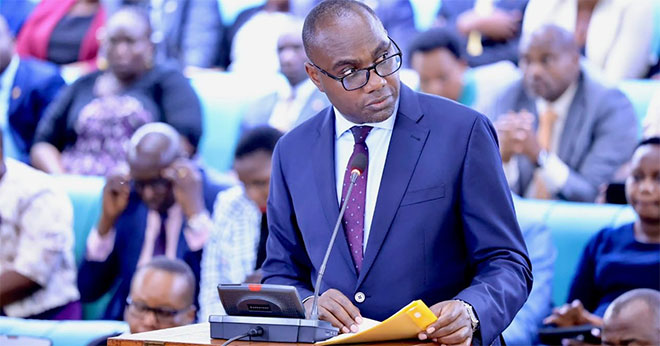
Finance State Minister Henry Musasizi tells Parliament the currency’s fall reflects a dollar supply-demand imbalance, announces expenditure cuts and defends Bank of Uganda’s tightening

Kampala, Uganda | ENTEBBENEWS.NET | The Uganda shilling has weakened sharply against the US dollar, sliding from approximately Shs 3,604 in March 2026 to around Shs 4,500 by late October, prompting the Government to appeal for calm and announce a raft of fiscal and monetary measures to stabilise the currency.
Delivering a statement to Parliament on the State of Uganda’s Economy on Tuesday afternoon, Finance State Minister Henry Musasizi attributed the depreciation to an imbalance between demand for and supply of foreign exchange, particularly US dollars.
“When demand for dollars to finance imports and meet other external obligations exceeds the supply generated by exports, investment and other foreign-exchange inflows, the price of the dollar rises,” Musasizi told lawmakers.

The minister pointed to higher international petroleum costs, heightened geopolitical tensions in the Middle East and increased foreign-exchange demand across other sectors of the economy. He also cited international financial conditions and market expectations as contributing factors.
On the supply side, Musasizi said declining global prices for key agricultural exports, particularly coffee and cocoa, alongside reduced tourism receipts, had temporarily constrained Uganda’s foreign-exchange inflows.
The minister’s remarks come amid growing anxiety in trading circles, with the shilling’s slide stoking concerns over imported inflation and the cost of servicing external obligations.
In response, the Bank of Uganda has moved aggressively to tighten monetary conditions, raising the Central Bank Rate from 9.75 percent to 12 percent and lifting the commercial banks’ cash reserve requirement from 11 percent to 13.5 percent.
“These measures are intended to moderate excessive demand, contain inflationary pressures and support confidence in the shilling,” Musasizi said, adding that the central bank will continue to manage liquidity and intervene in the foreign-exchange market where necessary to address excessive volatility, consistent with its mandate.

He reaffirmed Uganda’s commitment to a market-determined exchange rate, saying it allows the economy to adjust to changes in external conditions, and described the country’s international reserves as an important buffer against external shocks.
He urged Ugandans to avoid panic buying of foreign currency and speculative transactions driven by rumours, warning that such behaviour can amplify short-term pressure on the shilling. “Remain calm, avoid panic-driven decisions,” he said.
He pledged that Government and the Bank of Uganda will continue to provide timely, factual communication to support informed decisions and confidence in the economy, insisting that despite current pressures, “the fundamentals of our economy remain strong,” with growth supported by increased production, investment and exports.
On the fiscal front, Musasizi announced that Government will rationalise non-essential expenditure—including foreign and domestic travel, workshops, meetings and other administrative costs—while protecting critical public services and priority development investments.
He also called on households to prioritise essential expenditure, conserve fuel and energy, and make informed purchasing decisions, and urged businesses to eliminate waste, improve operational efficiency, source inputs locally where commercially viable, and expand production for export markets.
Here is his list of actions:
1️⃣Let us avoid panic buying of foreign currency, speculative transactions driven by rumours and other behaviour that can amplify short-term pressure on the shilling. Remain calm, avoid panic-driven decisions.
2️⃣Government and the Bank of Uganda will continue to provide timely, factual communication to support informed decisions and confidence in the economy.
3️⃣Despite the current economic pressures, the fundamentals of our economy remain strong. Uganda’s economy continues to grow, supported by increased production, investment and exports.
4️⃣Government and the Bank of Uganda are responding through prudent fiscal management and appropriate monetary policy.
5️⃣Government will rationalise non-essential expenditure, including foreign and domestic travel, workshops, meetings and other administrative costs, while protecting critical public services and priority development investments.
6️⃣Households should prioritise essential expenditure, conserve fuel and energy, and make informed purchasing decisions.
7️⃣Businesses should eliminate waste, improve operational efficiency, source inputs locally where commercially viable, and expand production for export markets.
The post ‘Do not panic’, Minister appeals as shilling races past 4,500 appeared first on 1:.