

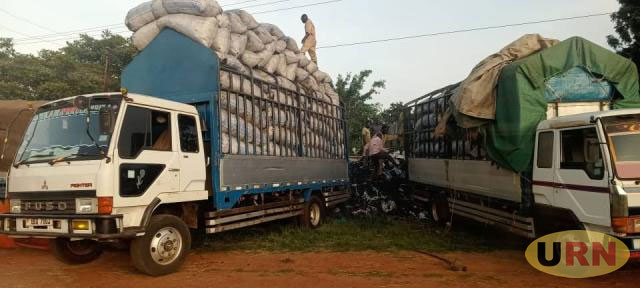
Kampala, Uganda | ENTEBBENEWS.NET | Uganda Police has warned charcoal dealers, transporters and even domestic users that the ban on charcoal burning and trade in northern Uganda remains in full force, declaring that carrying even a single bag will not be spared.
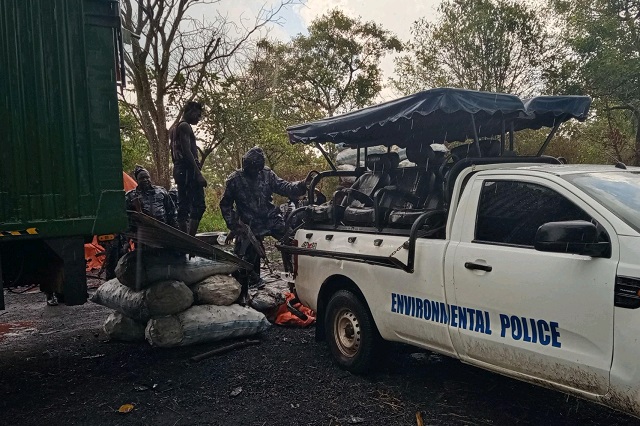
The warning came as inter-agency enforcement of Executive Order No. 3 of 2023 yielded 275 bags of charcoal and two arrests in Amuru and Pakwach districts over the past week.

In Amuru District, an operation conducted on 6 October 2026 covered Pabbo Town Council, Opara Sub-county and Atiak Town Council. In Pabbo, officers impounded a motor vehicle registration number UAX 307D, carrying 26 bags of charcoal. The driver, Joseph Ssentambula, and the conductor, Wassa Kiziti, were arrested.
A further 234 bags were impounded in Opara Sub-county and Atiak Town Council, bringing the total recovered in Amuru to 260 bags. In a separate operation on 10 October 2026 along the Pakwach–Nebbi road in Alwi Sub-county, Pakwach District, officers impounded 15 bags.

The police statement was unusually specific in its warning to motorists returning to Kampala. “We discourage motorists returning to Kampala from carrying charcoal in their vehicles, including even a single bag on a pickup,” it read.
Police spokesperson Rusoke Kituuma dismissed any assumption that small quantities fall outside enforcement. He cited a case in which a pastor had called seeking clarification about transporting a single bag for domestic use. “Whether you are carrying a single bag on your pick-up as an individual, we will not spare you in this operation,” Kituuma said.
The enforcement is also targeting roadside vendors displaying charcoal along highways, a shift from previous operations that focused primarily on transporters intercepted at checkpoints.
The current operations follow a sustained pattern of enforcement over the past year. In July 2026, the Environmental Protection Police Unit, working with UPDF and the National Forestry Authority, arrested eight suspects and impounded 72 bags in Madi Okollo District, West Nile.
In August 2026, at least 40 charcoal dealers were detained in Gulu after a meeting with the Commander of the 4th Infantry Division, Major General Felix Busizoori. The dealers had sought permission to continue trading, arguing their charcoal was imported from South Sudan under permits they believed were legitimate. Their request was denied.
That same month, security agencies intercepted a truck carrying 500 bags along the Kora Abiri-Layibi route and distributed the confiscated consignment to local residents. More than 800 bags were distributed to residents in Nwoya District after being impounded from dealers.
The crackdown has created an energy crisis for households in urban centres. A bag of charcoal that cost between 30,000 and 40,000 shillings in Gulu previously now sells for 60,000 to 80,000 shillings, according to residents.
“How can an old woman like me afford a gas cylinder for home use because the army doesn’t want charcoal?” asked Esther Agnes Okongo, a 60-year-old businesswoman in Gulu City. “We have been using charcoal for a long time for domestic use and that shouldn’t be taken away from us without a cheaper alternative source of energy.”
Local leaders in Acholi have called for the restrictions to be relaxed for domestic use. Atkinson Ojara, the Lamogi Sub-County Chairperson, said the crackdown should focus on large-scale commercial production rather than intercepting every bag in transit.
The government’s concern is not without basis. Maj Gen Keith Katungi, Commander of the 5th Infantry Division, stated during a charcoal distribution exercise in Lira that Uganda has lost more than 60 per cent of its forest cover since 1960 due to uncontrolled charcoal trade and deforestation.
According to the Uganda Bureau of Statistics, 21 per cent of Ugandans still depend on charcoal for cooking, while 73 per cent use firewood, making wood fuel the most relied-upon energy source for cooking in the country.
Research published in Environmental Research Letters suggests that while the charcoal ban may have had a localized effect in reducing deforestation, it likely displaced the activity elsewhere, resulting in no additional carbon conservation and possibly an increase in regional emissions.
The seized charcoal has in several cases been distributed to local communities. In Lira City, the 5th Infantry Division distributed confiscated charcoal to vulnerable households, with the Division Commander stating the operation aimed to reverse forest loss. Similar distributions have occurred in Gulu and Nwoya districts.
Kituuma said investigations would guide further arrests and prosecution. The public has been urged to report suspected illegal charcoal dealing to the nearest police station.
For now, the executive order stands. The question for thousands of households across the north is what they will cook with instead.
The post Uganda Police declares another war on charcoal appeared first on 1:.