

Kampala, Uganda | NEWS CORRESPONDENT | Kampala Metropolitan Police spokesperson SP Rachael Kawala recently announced what investigators described as a breakthrough in the fight against motorcycle theft in Kampala.
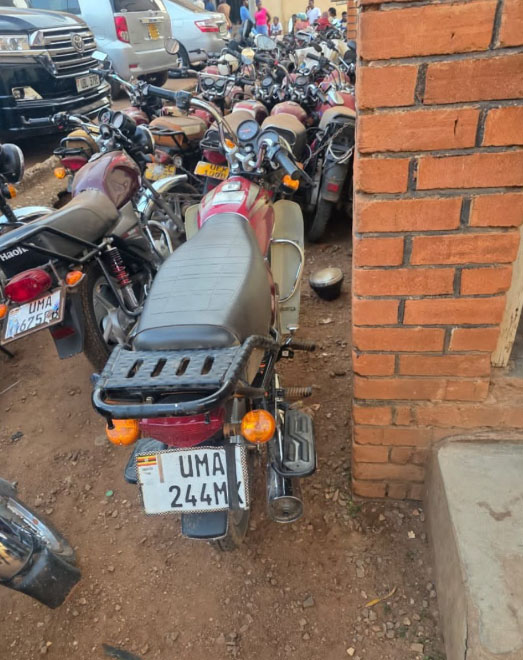
“Police in the Kampala Metropolitan Area have made a breakthrough in investigations into motorcycle robberies,” Kawala said August 27, 2026, announcing the arrest of five suspects and recovery of 12 suspected stolen motorcycles following an intelligence-led operation in Ndeeba.

The trail began with motorcycle registration number UMA 330NR, reported stolen at Nabweru Police Station. Investigators followed its movements to Busabala in Katwe Division, where two suspects, Mugisha Ivan, 28, and Kabanda David, 25, were arrested.
Police said the two had allegedly stolen the motorcycle and concealed it while waiting to remove its tracking device.
From there, the investigation widened.

The suspects allegedly led police to Ndeeba, where investigators found 12 suspected stolen motorcycles and arrested three more suspects. Police said the group targeted relatively new motorcycles, took them to Ndeeba and removed trackers before selling them for about Shs1.7 million each.
Investigators also linked some of the suspects to cases reported at Old Kampala, Nateete, Jinja Road and Nabweru police stations.
The operation offers a glimpse into how digital tracking is changing the hunt for stolen vehicles.
At the Police Monitoring Centre, the Intelligent Transport Monitoring System (ITMS) allows officers to identify, track and verify vehicles using digital number plates, records and real-time tracing.
The technology provides the lead. Police officers still have to follow it.
Information generated by the system can be shared with police stations and investigative teams, while the Police Multimedia Unit, video analysis teams and Uganda Revenue Authority help verify vehicle records and movements.
The numbers show the scale of the operation
Between January and July 2026, Police recovered 203 stolen motor vehicles and 95 motorcycles. In July alone, 43 of 49 stolen cars reported were recovered, an 88% recovery rate.
For victims, however, the technology matters only when a digital trail ends in a physical recovery. Moses Kitimbo, a boda boda rider in Jinja, discovered that after his motorcycle was stolen from Bugembe while he was watching a televised football match.
He reported the theft to Police. Ten days later, his motorcycle was back. “Upon reporting to police, the motorcycle was traced through its digital number plate and recovered in 10 days,” Kitimbo said. “I couldn’t believe it!”
His experience captures the changing nature of vehicle theft investigations. A stolen motorcycle no longer has to be found first by an officer on the road. Its movements can leave a digital trail that investigators can follow.
But criminals are adapting too
In the Ndeeba investigation, Police said suspects allegedly dismantled motorcycles for parts or altered them to make them appear older.
That has turned vehicle theft into a race between criminals trying to erase a motorcycle’s identity and investigators trying to preserve and follow its digital trail.
Luke Owoyesigyire, Deputy Kampala Metropolitan Police spokesperson, urged the public to report stolen vehicles and motorcycles promptly and provide proof of ownership to support investigations.
Police spokesperson Kituuma Rusoke has similarly urged victims to report thefts without delay.
“When people report in time, it enables police to respond to scenes of crime quickly, increasing the likelihood of finding and apprehending suspects and averting offences,” he said at a recent press conference.
“That speed of response also enhances tools such as the Intelligent Transport Monitoring System, which uses tracking technology to support interception and recovery of stolen vehicles.”