

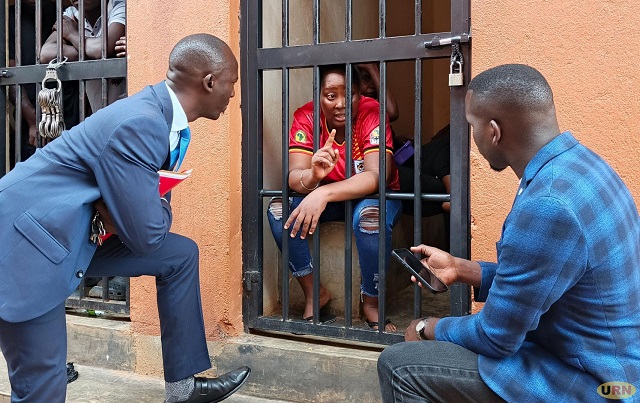
Kampala, Uganda | URN | The courtroom is often full during the first appearance of a political detainee in Uganda. Supporters squeeze onto benches.
Security personnel line corridors. Journalists carry heavy cameras to the courtroom, lawyers turn up in large numbers, sometimes more than twenty at a time, all holding briefs for the accused and united in a public show of solidarity.
But according to lawyers handling politically sensitive cases, that solidarity slowly fades as the hearings drag on.

“Every time there is an arrest of either high-profile political personnel or politically related charges, the first time we are appearing in court, you will have more lawyers than even the public that has come to attend court,” lawyer Alex Luganda said during a recent Uganda Law Society discussion on political prisoners and the rule of law.
“But by the time we are having the third, fourth, and fifth hearing, the group of lawyers that was about 25 on record, you’re remaining five. Or three. And that tells you a lot. One, about our consistency and resilience as members of the profession fighting for the rule of law. Or about our ability to withstand the trials, tribulations, and the challenges that are embedded within the practice around this area of political prisoners.” Explained Luganda.

For Luganda and other lawyers involved in defending opposition politicians, activists, and government critics, the struggle extends far beyond legal arguments inside the courtroom.
Luganda said there is a growing pressure on defense lawyers and an increasingly hostile environment surrounding political litigation in Uganda.
“In criminal proceedings, the lawyer is accused number two. Now, when it comes to prosecution of politically related offenses or litigation, we as the lawyers involved in this are accused number two or sometimes co-accused,” he said.
“At times, we do not come out to the public to speak about what pressures we are going through in engaging in these prosecutions. Be it at your law firm, you have the URA coming with some kind of noxious assessment. You have blackmail. They manipulate clients at times to come and put you in fixes. There are issues of bribes. When bribes fail, they go to the stick. If you refuse to eat the carrot, they will bring the stick and intimidate you here and there.”
Luganda argued that Uganda’s justice system has increasingly shifted from prosecution to persecution in politically charged cases.
“The concept of political prisoners is in line with persecution or what is sometimes called prosecution in line with what you believe in or do not believe in,” he said.
“Over the last 20 years, we’ve had very spirited struggles by the state to secure a conviction on most of the political cases or on the political persecutions and prosecutions that have been engineered without any success. But the script appears to be changing.”
“It’s like currently, if we are to examine what is going on, the state is determined to get a conviction at all costs, including vulgarizing all known legal processes, precedent, and procedures, and this has been done and is likely to be achieved with the total cohabitation and cohesion of some elements within the judiciary.”
He warned that many Ugandans who feel insulated from the justice system today may one day face the same realities.
“I just want to make this prophecy available to you,” Luganda said. “Everybody in this country will have a test of the breakdown of the rule of law. The only question is, when will it reach your door?”
“So we’re only saying be patient. You will test it. And when you test it, and when it comes to your door, then what the Uganda Law Society has been making noise about, what civil society organizations and morally cautious members of society have been fighting for, will make sense to you,” he warned.
Luganda said lawyers who have spoken and demanded legitimacy and protection of rights have been labeled anti-government.
“And that is the dilemma we even find in the Uganda Law Society. Because for it to perform its statutory role as a rule of law watchdog, some members are labelling the Uganda Law Society a political institution.”
Much of the discussion centered on bail, prolonged detention, and what the lawyers described as the selective application of constitutional protections.
Luganda criticized the handling of mandatory bail provisions, arguing that constitutional guarantees are increasingly being overridden in political cases.
“We have others in seven years right now,” he said while discussing suspects held on remand for prolonged periods.
“And now, when we are in courts, even where these political prisoners have been remanded beyond the mandatory period without commencement of trial, beyond one year, beyond four years, the courts are hiding under the bail guidelines to violate the constitutional provisions. And to us, this is very, very absurd.”
He went further, accusing sections of the judiciary of serving political interests. “The judiciary has been weaponized by the state,” Luganda said.
“There is consistency. The cases that involve political prisoners are usually taken to the same courts. The investigating officers are usually the same. The magistrates, the judicial officers, and the judges before whom they are allocated are the same. The prosecutors are usually the same. And the results of those processes, of the trials, of the bail applications are also usually the same.”
Bayern Turinawe, another lawyer representing opposition politician Dr. Kizza Besigye and his aide Obeid Lutale, echoed similar concerns while describing what it means to defend political prisoners. Besigye and Lutale have been in jail for 558 days without being granted bail.
“When the matter is even more political, all the tools of the state focus on that specific accused person,” Turinawe said.
“And the last bridge or the last shield of that specific accused person becomes the defense counsel.”
Turinawe traced the concept of the rule of law through political philosophy and constitutionalism before turning to Uganda’s current legal climate.
“Universally, if we are to examine the concept of the rule of law, it means that rules that govern the country and individuals should be universally predictable, but should also be written to safeguard against arbitrary use of rules and tyranny by the state,” he said.
“We look at the supremacy of the law, where no person is above the law, including the president of the country. We look at equality before the law. We look at fairness and transparency.”
But according to him, Uganda is drifting away from those principles. “How the parliament disregarded the Supreme Court decision, disregarded public consultation, and re-enacted that law is enough to show that the government has become an abuser of the law,” Turinawe said while discussing the controversial military trial of civilians.
He also pointed to cases of enforced disappearances and prolonged detention.
“We agree that in Uganda, enforced disappearances have become normal,” he said.
“We have individuals that we don’t know where they are, we don’t know whether they still exist, and no one is coming to answer questions that are being asked.”
Turinawe described remand as increasingly being used as punishment before conviction. “Remand has now become conviction,” he said.
“Remand is being used to punish more than even if you’re convicted.” He cited a case where suspects accused of nuisance, an offense carrying a maximum sentence of one year, spent nine months on remand before conviction.
“So now suspects come because they know that if they plea bargain, they get out of prison easier than if they try to prove a case that they did not commit,” he said.
Turinawe also criticized recent bail decisions involving opposition politician Dr. Kizza Besigye.
“In 2005, Dr. Kizza Besigye was a beneficiary of something not even in our statute books, called interim bail,” he said.
“But a judicial officer tells you that in 2026, a person who benefited from interim bail cannot benefit from mandatory bail, which is a constitutional command. How sudden, how fast this country has moved in the 21st century.”
Throughout the discussion, the lawyers repeatedly returned to the same concern: that political cases are increasingly testing the strength, independence, and credibility of Uganda’s justice system. For the lawyers who continue handling such cases, however, withdrawing is not an option.
“The last shield of that accused person becomes the defense counsel,” Turinawe said. “And therefore, we continue pushing for the rights of political prisoners because they are really under threat.”