

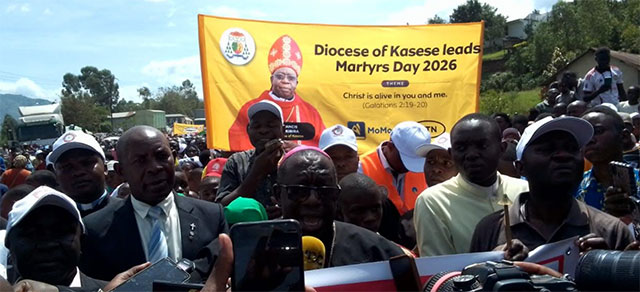
How new Ebola outbreak in eastern Congo forced Uganda to halt its biggest religious gathering

Kampala, Uganda | RONALD MUSOKE | For weeks, Christian Congolese pilgrims had been walking. From the crowded trading centres in eastern Democratic Republic of Congo, from villages shadowed by militia violence and chronic displacement, the pilgrims comprising men, women and children had already begun the long annual trek to Uganda for the June 3 Martyrs’ Day celebrations at Namugongo Martyrs Shrines.
Some crossed through official border points. Others slipped through the countless informal crossings that stitch together eastern Congo and western Uganda in a frontier where commerce, faith, family ties and survival routinely defy the authority of the two states.
Many were headed toward the Namugongo Catholic and Anglican shrines outside Kampala, where every year hundreds of thousands of pilgrims from across Africa gather to commemorate the Uganda Martyrs, the 45 Christian converts executed between 1885 and 1887 under Kabaka Mwanga II of Buganda Kingdom.

Then came the announcement. Late in the night, on May 17, the Ugandan government postponed this year’s Martyrs Day celebrations following a rapidly escalating Ebola outbreak linked to eastern DRC, a decision President Yoweri Museveni framed not merely as a domestic health precaution but as an urgent attempt to avert what could become a regional, or even a global, public health catastrophe.
“After consultations with the national epidemic response taskforce and religious leaders, we have decided to postpone the Martyrs’ Day to a later date,” Museveni said in a statement issued by State House via social media channels.
Uganda, he noted, receives thousands of pilgrims annually from eastern DR Congo, now at the epicentre of an Ebola outbreak caused by the rare Bundibugyo strain, a form of the virus for which there is currently no approved vaccine or treatment. “To safeguard everyone’s lives (sic), it is essential that this important event be postponed,” Museveni said, urging pilgrims already on the road to return home safely and report anyone showing symptoms.
For Uganda, the decision was unprecedented in symbolism and consequence. Uganda Martyrs Day is not merely a religious celebration. It is one of East Africa’s largest annual gatherings; a convergence of faith, memory, commerce and identity that transforms Kampala into a continental pilgrimage capital. But this year, public health fears overtook tradition.
And beneath the decision lies a harder truth that epidemiologists, border control officials and security agencies understand all too well: eastern Congo and western Uganda are connected by movements of people that neither governments nor health systems can fully control.
The death that changed everything
Uganda officially confirmed its first case of an Ebola outbreak on May 15 after laboratory tests identified the Ebola Bundibugyo Virus Disease in a 59-year-old Congolese man who had sought treatment at Kibuli Muslim Hospital in Kampala.
According to Uganda’s Ministry of Health, the patient had been admitted on May 11 presenting with respiratory distress, fevers, nausea, epigastric pain and difficulty urinating. He later deteriorated in intensive care and died on May 14 with bleeding symptoms consistent with viral haemorrhagic fever. But before test results confirmed Ebola, the body had already been transported back to DRC at around 8pm on the same day.
The next day, on May 15, after Congolese health authorities reported suspected Ebola cases in Ituri Province, Ugandan officials retested samples obtained during the patient’s treatment. The results from the Central Emergency and Surveillance Response laboratory at Wandegeya in Kampala confirmed the Ebola Bundibugyo virus strain.
Uganda immediately activated emergency response measures, deploying screening teams at official and unofficial border crossings, setting up mobile laboratories in western Uganda, isolating high-risk contacts and intensifying surveillance along “major transit routes and pilgrimage corridors.” But by then, concern had already spread beyond Uganda’s borders.
On the same day, May 15, the Africa Centres for Disease Control and Prevention (Africa CDC), the continental autonomous health agency established to support and strengthen the capacity of African states to detect, prevent, control and respond quickly and effectively to disease threats, warned of a potentially significant regional outbreak centered in the Ituri Province of eastern DR Congo.

Initial figures were alarming. Authorities reported 246 suspected cases and 65 deaths, mainly in the gold-mining zones of Mongwalu and Rwampara. Within 24 hours, the numbers had climbed sharply. By May 16, Africa CDC Director-General, Dr. Jean Kaseya, said at least 336 suspected cases and 88 deaths, including one in Uganda, had been identified.
“This outbreak started in (late) April and so far, we don’t know the index case,” Dr. Kaseya said during an impromptu virtual press briefing on the evening of May 16. “It means we don’t know how far the magnitude of this outbreak is.” That uncertainty, more than the numbers themselves, is what now terrifies health officials in the East African Community region and the Africa CDC.
The dangerous geography of Ituri
The outbreak is unfolding in one of Africa’s most volatile regions. Ituri and neighbouring North Kivu provinces remain plagued by armed conflict, displacement crises and weak health infrastructure. Militia violence routinely uproots communities. Informal mining economies generate constant movement of traders, labourers and transporters across borders.
For epidemiologists, it is a nightmare landscape. “We know that we have the Mungwalu district or health zone highly affected,” Dr. Kaseya said. “But why this one is important? Because there is a huge movement of population due to insecurity, due to the mining activities. And also, we know that this region is mostly dealing with Uganda in terms of trade, in terms of food and other commodities.”
“Then when you have an outbreak in Ituri, it’s more likely that Uganda will be affected, but also South Sudan.” Bunia, the provincial capital of Ituri, sits near Lake Albert and close to Uganda’s border, functioning as a major commercial and transportation hub linking eastern Congo to the wider East African region.
The city’s strategic position has heightened fears that the outbreak could spread rapidly through trade and migration corridors connecting DRC to Uganda, Rwanda and South Sudan. “This is grade three being the highest level (of alert) in DRC today,” Dr. Kaseya warned. “It’s very high because the risk is huge to see this outbreak spreading also in other areas.”
A border that exists mostly on paper
In Kampala and Kinshasa, officials often speak of robust border management. But on the ground, the Uganda-DRC frontier is less a hard boundary than a porous human ecosystem. Families live across both sides. Traders move daily through formal checkpoints and hidden footpaths. Fishermen cross Lake Albert constantly. Refugees fleeing violence flow into Uganda, one of the world’s largest refugee-hosting countries. And during pilgrimage season, the movement intensifies dramatically.
Every year, believers from DRC, Rwanda, Kenya, Tanzania and South Sudan walk for days or even weeks toward Namugongo. They are joined by others who fly in from distant countries such as Nigeria, Ghana, Zambia, Zimbabwe, Botswana, South Africa and even the USA.
Many Congolese pilgrims begin their journeys long before mid-May. That timing now haunts public health officials. By the time Uganda confirmed its first Ebola case on May 15, some pilgrims from eastern Congo had already crossed into Uganda and were about to begin moving deeper inland toward Kampala. The implications are profound because Ebola often spreads before symptoms become severe. The incubation period ranges from two to 21 days, allowing infected individuals to travel long distances undetected.
What worries health authorities even more is what may already have happened before the outbreak was formally declared. Dr. Kaseya painted a grim picture of the risks surrounding the movement of the deceased Congolese patient.
“This person was sick in his community, and he was surrounded by a number of people,” he said. “He took public transportation to Uganda. In Uganda, he was with some people. He went to hospital, and from the hospital, he passed on.” “They took his body back to DRC. Who are these people who took his body back to DRC? What are the measures they used to protect themselves? What kind of funerals did they organise in DRC?”
The questions expose one of Ebola’s most dangerous realities: funerals themselves can become transmission events. Health authorities believe people handling corpses face especially high risks of infection if proper protective measures are absent.
“We know that from evidence that cadavers (dead bodies) are at a higher rate of transmitting the disease to others,” said Dr. Tolbert Geewleh Nyenswah, the senior epidemiologist credited for the Ebola fight in Liberia, who is now the Director, Pandemic Prevention, Preparedness and Response at Africa CDC. “If people did not take precautions, we have to do the risk profiling.”
Faith meets public health
Uganda’s postponement of Martyrs Day reflects a painful post-pandemic dilemma increasingly confronting governments around the world: how to reconcile mass religious gatherings with infectious disease containment.

For pilgrims, the journey to Namugongo is not merely travel. It is a sacrifice. Many walk barefoot for hundreds of kilometres. Some save money for months to afford food and transport. Others carry prayer intentions for sick relatives, unemployment, infertility or personal hardship. Churches spend months organizing delegations. Namugongo itself becomes a temporary city.
Roadside traders sell rosaries, food, water and religious memorabilia. Guesthouses overflow with visitors. Public transport operators work around the clock. Churches host vigils, processions and overnight prayers. Cancelling the gathering therefore reverberates far beyond religion. It affects livelihoods. It disrupts tourism revenues. And it interrupts a ritual deeply embedded in East African Christian identity.
But global health authorities feared the alternative could have been catastrophic. The UN health agency, the World Health Organization (WHO), formally declared the outbreak a Public Health Emergency of International Concern on May 16 under the International Health Regulations, citing “high population mobility”, insecurity, weak infection prevention systems and uncertainty over the outbreak’s true scale. Most worrying was the strain itself.
Unlike the more common Zaire strain of Ebola, the Bundibugyo variant currently has no approved vaccine or targeted treatment. “If it was the Zaire strain, yes, I will take it seriously due to the case fatality rate, but I will also tell you we have vaccine, we have medicine,” Dr. Kaseya said. “But for this specific strain, we don’t have a vaccine. It means we are mostly relying on public health measures.” WHO guidance specifically urged affected countries to “consider postponing mass gatherings until transmission is interrupted.”
The limits of medicine
The Bundibugyo strain presents another troubling challenge: the world is far less prepared for it scientifically. Shanelle Hall, the Principal Advisor to the Africa CDC Director-General on Management and Operations, said during the virtual press briefing that several therapeutics are now under consideration, including monoclonal antibodies and antiviral drugs such as remdesivir and obeldesivir. But none have yet been deployed. “There are a few vaccines in the preclinical or early clinical pipeline that target the Bundibugyo strain,” Hall said, referencing work linked to Oxford University, Moderna and IAVI.
“But these are at a much earlier stage.” For now, authorities are relying heavily on traditional outbreak containment measures: surveillance, contact tracing, isolation, protective equipment and community education.
That dependence worries many experts. “We don’t have manufacturing for PPE regarding this kind of trend,” Dr. Kaseya warned, emphasizing the vulnerability of frontline health workers. At least four healthcare workers in affected areas have reportedly died under circumstances consistent with viral hemorrhagic fever, raising fears of healthcare-associated transmission.
During the same virtual briefing, Dr. Ngashi Ngongo, the Chief of Staff and Head of the Executive Office at the Africa CDC, warned against what he called “Ebola fatigue” among frontline workers. “I think Ebola fatigue would be very, very dangerous,” he said. “What we need instead is really a very proactive approach to the prevention of zoonotic diseases.”
Dr. Ngongo argued that African health systems remain chronically vulnerable because infection prevention measures often intensify only during crises. “The basic supplies of gloves and PPEs” should already exist in vulnerable health facilities, he said, especially in areas regularly exposed to zoonotic outbreaks.

The ghost of earlier epidemics
This is the 17th Ebola outbreak recorded in DRC since 1976. The deadliest, between 2018 and 2020, killed approximately 2,300 people out of about 3,500 confirmed cases while the most recent outbreak, which ran from August 2025 and was declared over in December 2025, killed at least 45 people.
But it is the 2018-2020 outbreak that exposed how insecurity can sabotage pandemic control. Treatment centres were attacked by insurgents. Health workers were often targeted. Communities mistrusted response teams. Displacement repeatedly complicated contact tracing.
Africa CDC’s plea to the rebels
Dr Kaseya hopes things will be different this time. “We are sending our teams mostly via Entebbe International Airport in Uganda to reach Ituri. We are talking with authorities from the DRC and Uganda to give us access.”
“We are working with the UN partners who are mostly providing support for security. And I was talking with the World Health Organisation representative, who is in Ituri, and is sharing some of the challenges and how to mitigate that by bringing (onboard) some organisations that are working on the security side.”
“We are also talking with people who are in conflict for them to understand that they need to give us access because we are not part of the conflict, we are there to support the population. We already did it in the past. From our side, we are making sure that we have all tools that we can bring. From their side, we are looking for the understanding to give us access to support people.”
Meanwhile, Uganda, too, carries institutional memory of Ebola. The country has experienced several outbreaks over the years and has developed one of the region’s more sophisticated haemorrhagic fever surveillance systems.
But the current outbreak presents unusual challenges. “This event is considered extraordinary,” WHO said in its emergency determination. The agency warned that the outbreak may already be substantially larger than reported due to weak surveillance, insecurity and “clusters of unexplained deaths” across Ituri. “There are significant uncertainties to the true number of infected persons,” WHO noted.
Dr. Nyenswah, the Africa CDC’s Director for Pandemic Prevention, said officials still do not know the outbreak’s full scale. “The 300-plus cases we have right now cannot be the true picture,” he said. “To determine the number of contacts, we need a couple of days to go on the ground and do the contact tracing.”
Continental alarm
The speed of international mobilization underscored the seriousness of the threat. On May 16, Africa CDC convened a high-level emergency meeting involving more than 130 participants from DRC, Uganda, South Sudan, WHO, UNICEF, donor governments, humanitarian agencies and pharmaceutical companies.
Africa CDC activated a Continental Incident Management Support Team to coordinate surveillance, logistics, laboratory systems, infection prevention and cross-border preparedness. Dr. Kaseya later announced he would cancel his engagements in Geneva during the World Health Assembly to return to Africa and oversee the response directly.
The agency says at least US$30 million is urgently needed for the first phase of the response. “Africa is doing our effort,” Dr. Kaseya said. “But we need more than US$30 million for the first phase of the response to ensure that these countries can be protected.” “This is a major risk, not only for Africa, but also for the world.”
Silence at Namugongo
For Uganda, postponing Martyrs Day may become one of the defining public health decisions of the year. The government must convince citizens that the threat is real without triggering panic. Religious leaders must persuade disappointed pilgrims that postponement is an act of protection rather than fear.
And health officials must sustain vigilance in a country where memories of COVID-era restrictions remain politically sensitive. Already, screening teams have spread across western border districts and major transit corridors. Mobile laboratories are operating. High-risk contacts are under quarantine. But enormous uncertainties remain. No one knows how many infected individuals may already have crossed borders before detection. No one fully understands the outbreak’s true geographic spread. And no authority can entirely control the movements of populations shaped by conflict, trade dependency and displacement.
Yet for now, Uganda’s leadership appears determined to prioritize containment over symbolism. The silence at Namugongo this June may therefore become one of the clearest signs yet that Africa has learned painful lessons from earlier epidemics: that outbreaks move faster than politics, that faith gatherings can become transmission amplifiers, and that in an interconnected region, a local outbreak can rapidly become an international emergency.
Along the roads leading toward Uganda’s holiest Christian shrines, some pilgrims are already turning back home. Others continue waiting, uncertain whether the postponement will last weeks or months. And across eastern Congo and Uganda, health workers are racing against time; hoping that the movement of people, goods and prayer has not already carried the virus farther than anyone yet realizes.
The post Faith, fear and Ebola in Uganda appeared first on 1:.