

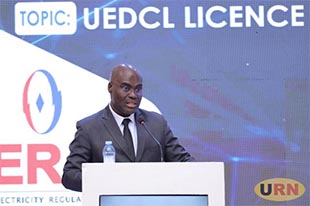
Kampala, Uganda | URN | The power sector is at a crossroads after a swift government crackdown at Uganda Electricity Distribution Company Limited, exposing the fragile path toward state-led distribution.
The May 2, 2026 decision saw Board Chairperson Lydia Ochieng-Obbo dismissed and Managing Director Paul Mwesigwa sent on forced leave pending a comprehensive review of the utility’s management and operations.
In her letter, Energy Minister Ruth Nankabirwa Ssentamu framed the intervention as a “routine governance and oversight procedure,” assuring the public that electricity supply would remain stable.

The leadership shake-up comes just over a year after UEDCL took over electricity distribution from Umeme Limited, whose 20-year concession ended on April 1, 2025. That transition marked a bold policy pivot toward greater public control of a sector central to industrialization and economic growth.
During its tenure, Umeme reduced system losses from roughly 33 percent to about 16 percent and expanded access significantly. By contrast, UEDCL inherited a vast and aging network, along with public expectations shaped by those efficiency gains.

Early indicators under UEDCL appeared promising. By early 2026, the company reported revenues of approximately UGX 1.71 trillion and a customer base exceeding 2.4 million connections. Tariffs fell by around 14 percent in 2025, driven partly by increased hydropower generation from projects such as Karuma Hydropower Plant.
But the honeymoon has been short-lived. Despite headline gains, complaints about outages, delayed repairs, and inconsistent service have grown. The Electricity Regulatory Authority (ERA) has flagged operational gaps, prompting earlier directives from the Ministry of Energy for internal reviews.
Distribution losses stood at about 17.1 percent in 2025, slightly above Umeme’s exit levels, while infrastructure vandalism, rising debt obligations, and the logistical burden of managing a nationwide grid have strained operations.
Uganda’s installed generation capacity now exceeds 2,000 megawatts, but peak demand remains significantly lower, exposing distribution, not generation, as the sector’s primary bottleneck.
The unfolding developments place Uganda’s Parliament squarely at the center of accountability. Under Article 79 of the Constitution of Uganda, lawmakers are mandated to legislate for good governance and oversee public expenditure.
That mandate is reinforced by the Electricity Act 1999 and broader national energy policies, which emphasize efficient service delivery, regulatory compliance, and sustainable sector financing.
Parliamentary committees, particularly those on Natural Resources and Public Accounts, are expected to scrutinize UEDCL’s performance, budget allocations, and procurement practices. With the government targeting more than $1 billion annually in sector financing, oversight is not merely procedural; it is fiscal necessity.
Among Ugandans, reactions to the shake-up reflect a mix of cautious optimism and growing impatience. Industrial users, who have benefited from relatively competitive tariffs, estimated at about UGX 203.6 per kWh for extra-large consumers, stress that affordability must be matched by reliability.
“Lower tariffs are good, but production losses from outages cost more,” said Hajji Issa Ssekitto, Chairperson of the Kampala City Traders Association (KACITA). Social media platforms and local reports are filled with complaints about prolonged outages and slow response times, with some users drawing unfavorable comparisons to the Umeme era.
Uganda’s electrification rate now stands at roughly 60–65 percent, with ambitions for universal access in the coming decade. Achieving that goal will require not only expanded infrastructure but also reliable and financially sustainable operations.
Energy Minister Nankabirwa has maintained that the latest intervention is part of “proactive stewardship,” not crisis management, an assertion that will ultimately be tested by results on the ground.
As interim leadership takes charge at UEDCL, the company faces a critical balancing act: maintaining operational stability while addressing systemic inefficiencies.
Key priorities include reducing distribution losses further, clearing connection backlogs, strengthening governance structures, and mobilizing financing for network expansion.