

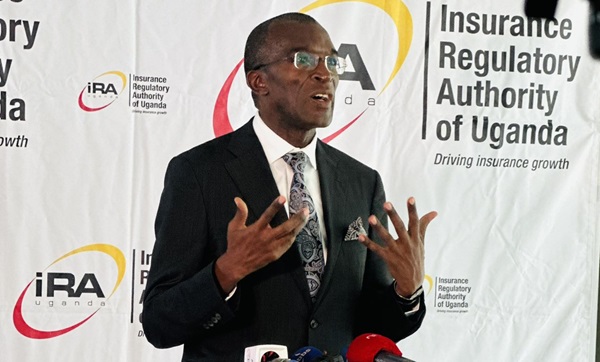
Kampala, Uganda | URN | The Insurance Regulatory Authority (IRA) has instructed general insurers to implement mandatory awareness and sensitization campaigns on workers’ compensation insurance.
This directive aims to address widespread non-compliance and ongoing gaps in claims management.
It also seeks to close the persistent knowledge gaps around requirements and procedures in claiming compensation when employees suffer injuries while at their workplaces.

Kaddunabbi Ibrahim Lubega, the IRA Chief Executive Officer, asked non-life insurance firms to undertake structured awareness and sensitisation initiatives for their policyholders on the procedures and requirements under the workers’ Compensation regime.
The insurers are required to directly engage with the employees and employers to understand their rights, responsibilities, and the protection available.

“The sensitization initiatives shall specifically target policyholders insured under Workers’ Compensation and Group Personal Accident policies, and shall cover the procedures for reporting workplace injuries and accidents and the documentation required to support compensation claims,” he says.
Other areas to sensitize employees and employers about are the role of medical practitioners in assessing incapacity and the proper process for submission and follow-up of claims.
“We believe that exhibiting transparency by sharing all the necessary information with the policyholders will enhance trust, build confidence, improve compliance, and strengthen workplace safety amongst the public,” Kaddunabbi says, adding that this will promote efficient administration of claims.
The sensitization activities with policyholders shall further include policy issuance processes, renewal communications, and other policyholder outreach initiatives.
The directive follows a recent meeting between the IRA and the Ministry of Gender, Labour and Social Development, which discovered several gaps in the current claims management practices for workers’ compensation insurance.
They include possible wrong conclusions on injuries, where workers are at times issued with premature permanent incapacity assessments, before an injured worker even attains full medical recovery, or who remains under active treatment.
Such practices, IRA says, have contributed to delays in resolving claims and led to an increase in the number of disputes being referred to the Medical Arbitration Board (MAB).
Lubega attributes the disputes to a lack of or limited awareness among policyholders and employers on the proper procedures and documentation requirements to file claims under the Workers’ Compensation framework.
The Medical Arbitration Board is a specialised, independent panel that was established to resolve disputes regarding workplace injuries, occupational diseases, and workers’ compensation assessments.
It focuses on resolving conflicting medical opinions regarding injury severity, incapacity, and compensation.
Workers’ compensation is covered under the Workers Compensation Act, Cap 233, and is mandatory for most employers: private companies, NGOs, schools, and even domestic employers with full-time house help or shamba boys.
Section 18(1) states: “Every employer shall insure and keep himself or herself insured in respect of any liability which he or she may incur under this Act to any worker employed by him or her.”
Any employer, apart from the self-employed, must have workers’ compensation insurance. It pays out if an employee gets injured, disabled, or dies, arising out of or in the course of employment.
The insurance covers medical expenses for work-related injuries or illnesses. Where a worker incurs temporary disability and is unable to work for some time, 60 percent of monthly earnings will be covered while the worker recovers, paid by the employer or insurer.
In case of permanent disability, a lump sum based on percentage disability and earnings, up to 60 months’ wages.
If the incident leads to death, the worker is entitled to 60 months’ wages to dependents, plus funeral expenses up to UGX 1M.
Occupational hazards like those listed in the Act, including dust, chemicals, and noise, are also catered for if they lead to disease or injury.
However, the law and the insurance do not cover injuries from alcohol, deliberate self-injury, or if the employee misrepresented themselves.
The law also provides for penalties for non-compliance, including a fine of 10 currency points (up to UGX 200,000) and/or 2 years jail for the employer who provided no insurance. Or 150 currency points (UGX 3m) for a third offender, plus any other out-of-pocket compensation.
Premiums can vary between 0.5 and 5.0 percent of the total payroll per year, depending on the risk levels at the workplace.
Surveys by the ministry and the insurance industry show that compliance is still very low, with only about 2,400 policies existing for 9.7 million workers. Many SMEs and informal employers do not have it because labour offices are understaffed and inspections aren’t systematic.
Some districts, for example, are said to have one staff member as a labour officer.
Alhaj Lubega says that just like Motor Third Party Insurance is mandatory for all motorists driving on Ugandan roads, Workers’ Compensation insurance is also mandatory for all businesses operating in Uganda, “irrespective of size”.
This law applies to all employees within Uganda, with the exception of active members of the armed forces.
He says the benefits of the insurance include transferring the financial risk of a workplace injury or accident to an insurance company the employer is insured with, giving the employer peace of mind.
”It also limits the liability associated with facing lawsuits for workplace-related injuries or illnesses”.
Lubega says the failure to take up Workers’ Compensation Insurance by most employers in Uganda has seen many continue to drain their budgets to foot the hefty medical bills of the injured employees and court cases that are brought against them.
The International Labour Organisation (ILO) estimates that 2.9 million workers die annually due to occupational accidents and diseases, and at least 402 million people suffer from non-fatal occupational injuries.
Additionally, 317 million accidents occur on the job annually, and many of these result in extended absence from work.
According to the Ministry of Gender, Labour and Social Development, these estimates indicate that 4 percent of Gross Domestic Product is lost due to accidents and work-related diseases.
The post IRA orders Insurers to educate employers on workers’ compensation appeared first on 1:.