

Uganda confronts new development reality
Kampala, Uganda | PATRICIA AKANKWATSA | Declining global aid flows and shifting geopolitical priorities are forcing a rethink of how Africa finances its development. Participants at the ninth Kampala Geopolitics Conference said this week, warning that traditional models are becoming increasingly unsustainable.

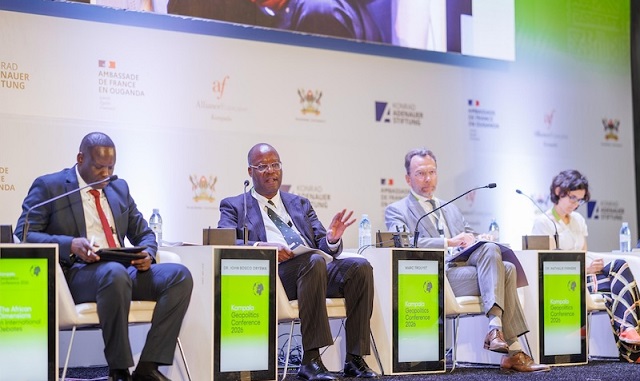
The conference, held at Makerere University under the theme “African Dimensions in International Debates,” brought together academicians, diplomats and development practitioners to examine Africa’s place in a rapidly changing global order.
At the centre of discussions was the future of development assistance, long a cornerstone of African economies but now under pressure as donor priorities shift and global crises stretch resources.
Moderating one of the panels, Dr John Bosco-Oryema pointed to the widening gap between global commitments and actual funding. He referenced United Nations General Assembly Resolution 2626, which urged developed countries to allocate one percent of GDP to development assistance—a target that remains largely unmet more than five decades later.
Funding squeeze and shifting realities

Leonard Zulu, the UN Resident Coordinator in Uganda, illustrated the scale of the funding shortfall, noting that the UN system in Uganda lost $165 million last year compared to confirmed budgets.
“The UN system in Uganda lost $165 million last year compared to confirmed budgets,” he said, adding that the cuts have affected programmes ranging from refugee support to health, education and nutrition.
Uganda hosts nearly two million refugees, making it one of the largest refugee-hosting countries globally, further stretching already constrained resources.
Despite the shortfall, Zulu argued that Africa’s challenge is not a lack of resources.
“Africa is not poor in resources,” he said, citing an estimated $1.3 trillion in pension assets, $483 billion in domestic revenues, $427 billion in private savings, and over $100 billion in diaspora remittances across the continent.
Uganda itself attracted more than $5 billion in foreign investment in the past year, which he described as evidence of “untapped potential” in mobilising domestic and private capital.
From aid to partnership
Marc Trouyet, Country Director of the French Development Agency (AFD) in Uganda, said development thinking is evolving.
“We are moving from the language of ‘aid’ to the language of ‘partnership,’” he said, reflecting growing criticism of dependency-driven models.
He also highlighted the increasing integration of aid and trade, pointing to regional efforts such as tariff harmonisation and economic integration in East Africa.
“The paradox is that there is money available, but not enough bankable projects,” Trouyet said, arguing that investors are actively seeking viable opportunities but face constraints in project preparation and structuring.
Nathalie Ferrier, an Associate Professor of Economics at Sciences Po Aix, said the shift toward investment-led development reflects structural changes in the global economy.
“The private sector is central to job creation and innovation,” she said, noting that development finance institutions already account for about 20 percent of foreign direct investment into Africa.
However, she cautioned that evidence on the effectiveness of such models remains limited.
“We still need more empirical data on what works,” she said, adding that traditional aid has had measurable, though uneven, impacts.
Asuman Guloba, Director at the National Planning Authority (NPA), said the country is pursuing an ambitious plan to grow the economy to $508 billion under its long-term development strategy. However, he warned that global financial shifts are complicating that goal.
“We are seeing reduced inflows and increased outflows, with about one-third of our budget going to debt servicing,” Guloba said.
In response, Uganda is prioritising domestic resource mobilization, seeking to raise more revenue locally while improving efficiency in public spending.
Beyond financing, speakers said global developments are increasingly shaping domestic realities.
Yusuf Kiranda, University Secretary at Makerere University speaking on behalf of the Vice Chancellor, said geopolitical shifts can no longer be treated as distant events.
“What happens in Washington, Brussels, Beijing or Riyadh does not stay there,” he said. “It affects the price of fuel, the availability of medicines, and even employment prospects for our graduates.”
Kiranda called for the institutionalisation of the conference through a dedicated secretariat to ensure sustained engagement.
Diplomatic partners echoed the need for more structured and balanced cooperation.
Virginie Leroy, France’s Ambassador to Uganda, said the conference has become an important platform for amplifying African perspectives in global debates.
“We must move beyond short-term responses and build partnerships that are more balanced, more resilient, and aligned to African realities,” she said.
She pointed to ongoing conflicts and shifts in global financial systems as factors accelerating the need for new approaches.
Participants described the current period as both disruptive and transformative.
Anna Reismann of the Konrad Adenauer Stiftung said long-standing institutions and practices are undergoing significant change.
“Long-standing institutions and practices are undergoing profound change,” she said. “But these transitions also open space to rethink and reshape how development is approached.”