

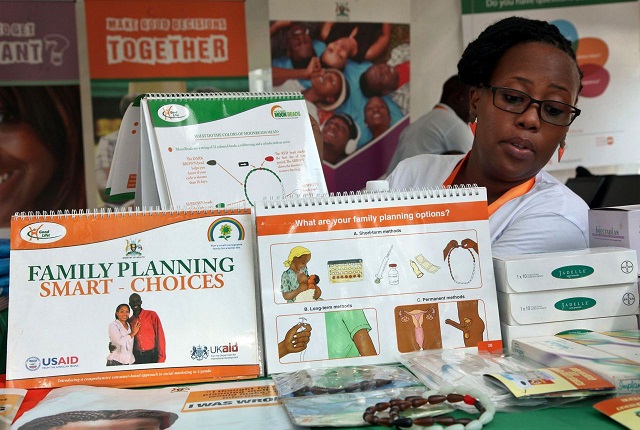
Kampala, Uganda | URN | 94.3 percent of women of reproductive age are aware of family planning service providers in Uganda but only 38 percent have access to modern contraceptives currently, a study conducted by researchers at Makerere University School of Public Health has revealed.
Dr Nazarius Mbona Tumwesigye, a Professor in the Department of Epidemiology and Biostatistics said they embarked on the study in December 2025 in eighty-seven districts where they among others conducted health facility-based assessment, interviews with users and reviewed data from the Demographic Health survey. They found injectable contraceptives to be the most preferred and condoms the least preferred.

According to findings in this study which is a baseline for a new project dubbed, Empowering Women for Better Reproductive Health Outcomes (EMPOWER) that’s aimed at improving reproductive health indicators, when respondents were asked whether they knew any modern family planning method, 90.9 percent correctly mentioned a method. Majority at 42% revealed their source of family planning information to be radio.
Mbona says 20% of the respondents reported poor quality as a barrier to access to contraceptives whereas 29% said it takes a lot of time to access a product. About 27% cited cost as a deterrent and another 11.8% of the women reported they knew about the different products however the decision to uptake family planning is exclusively made by their husbands who refused them from enrolling.
Apart from family planning access, researchers also analyzed other reproductive health indicators including delivery in health facilities, the rate of survival of mothers and their babies in addition to teenage pregnancies.

Generally, they found reproductive health services to have improved over time but at a very sub-optimal rate. Mbona cites maternal mortality rates where death reduced from the highs of 400 per 100,000 births to now 189 per 100,000 live births which he says is still sub-optimal considering that as per Sustainable Development Goals (SDGs) target, Uganda should have reduced these deaths to 70 per 100,000 live births by 2030. To him, four years to this target year, it’s quite impossible that they country will be able to achieve it within this timeframe.
With 297 deaths per 100,000 live births, Kampala topped the surveyed districts with highest deaths of mothers within health facilities also called institutional mortality. Kampala was followed by Bugisu with 239 deaths per 100,000 live births and Bunyoro with 154 per 100,000 live births.
Explaining these deaths, Prof Fredrick Makumbi, a Co- Investigator on the study said that the majority of the deaths recorded in Kampala are mothers who are referred to the national referral hospitals when it’s too late for them to be saved.
To cut down on maternal deaths, the Ministry of Health started a system requiring health facilities to audit all deaths that happen by recording the chronology of events and accounting for each and every death that happens.
But according to Makumbi when the research team reviewed this data, they found gaps whereby only one in every two maternal deaths is actually reviewed as required.
This was not the only gap in data found as there were also discrepancies in data for family planning products with many facilities suffering stock outs. The researchers recommend establishing buffer stock systems for these products.
When the study findings were put to Dr Deo Migadde, a Senior Medical Officer in the Ministry’s Department of Reproductive Health said these findings come in timely when they have just released their sharpened plan for maternal health which has strategies for improving many of the indicators analyzed.
He for instance said that to counter the challenge of data discrepancies, the ministry is in the process of standardizing reporting tools to clearly estimate health facility needs and their capacity.
The post 94% of women know family planning providers but only 38% using them appeared first on 1:.