

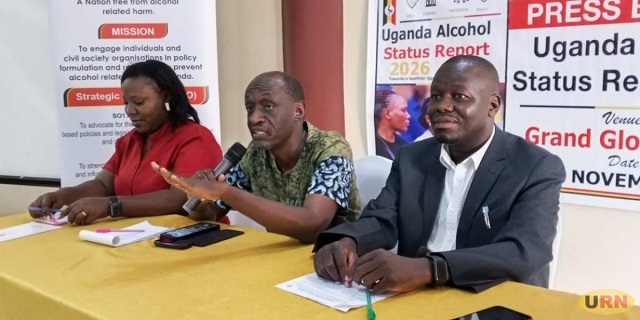
Kampala, Uganda | URN | Uganda is losing an estimated 17,000 people annually to alcohol-related harm, while the economic cost of excessive consumption is estimated at Shs11 trillion (about $2.95 billion) a year, according to research findings released Friday.
The findings presented by the Uganda Alcohol Policy Alliance (UAPA) at the Grand Global Hotel in Kampala, suggest that alcohol-related harm extends well beyond addiction, contributing to premature deaths, illness, road crashes, domestic violence, lost productivity and pressure on healthcare services.
The assessment, an 80-page synthesis of research compiled by specialists from Makerere University School of Public Health, Mbarara University of Science and Technology, the Uganda Cancer Institute and partner institutions, places Uganda among the world’s highest alcohol-consuming countries.

Researchers estimate annual consumption at 12.2 litres of pure alcohol per person aged 15 and above, a figure that underscores the scale of the public-health challenge facing the country.
The findings come amid renewed debate over alcohol regulation, following Parliament’s rejection of the Alcoholic Drinks Control Bill, 2023, in August 2024 and subsequent government efforts to encourage local authorities to regulate drinking establishments and operating hours.

Presenting the findings on behalf of lead investigator Francis Nsanga, co-investigator Dr David Kalema, an addiction specialist and executive director of rehabilitation centre Hope and Beyond, said alcohol consumption was increasingly associated with harmful drinking patterns and dependency.
The report estimates that approximately 42 per cent of Ugandans aged 15 and above consume alcohol, with 54 per cent of drinkers classified as heavy users.
It further estimates that 12 per cent of people in the age group have alcohol use disorder, compared with cited global and African averages of seven and six per cent, respectively. Alcohol is reportedly responsible for 7.5 per cent of deaths nationally, with men disproportionately affected.
Of the estimated 17,000 annual alcohol-attributable deaths, approximately 13,000 are men, according to the assessment. Alcohol accounts for an estimated 10 per cent of male deaths, compared with 3.4 per cent among women.
Kalema said the consequences were not confined to people who consume alcohol, noting that road crashes, violence and other alcohol-associated incidents also claim the lives of people who may not have been drinking.
“Alcohol-related harm is not simply an individual behavioural problem; it is deeply rooted in broader economic and social conditions,” Kalema said.
He identified unemployment, poverty and the availability of cheap, unregulated alcoholic products as factors contributing to harmful consumption, particularly among vulnerable communities.
“We must treat alcohol-related harm as a national public-health and development issue rather than a private moral failing,” he said.
The estimated Shs11 trillion annual economic burden, researchers say, includes lost productivity, healthcare costs and other social and economic consequences.
The research identifies substantial differences in alcohol consumption across geographical locations, occupations and socioeconomic groups.
Karamoja emerged as a high-consumption region, with researchers reporting particularly elevated drinking levels among women. West Nile was also identified as an area with concerning patterns of alcohol use.
The findings point to risks among fishing communities, where approximately half of fishmongers around landing sites reportedly consume alcohol, raising concerns about workplace safety, accidents and occupational hazards.
Researchers also identified elevated alcohol consumption among people living with HIV, warning that harmful drinking could undermine treatment adherence and worsen health outcomes.
Women in low-income households and informal urban settlements were also reported to experience higher rates of daily drinking in some socioeconomic categories. The findings suggest that alcohol-related harm intersects with poverty, gender inequality, insecure livelihoods and limited access to health and social support services.
Prudence Aturinde Mpairwe, a policy advocate specialist, said alcohol consumption was increasingly affecting household finances, children’s education and family welfare.
“People wake up in the morning and the first thing they think of is consuming alcohol,” Mpairwe said.
She warned that money intended for school fees and household necessities was increasingly being diverted towards alcohol, with consequences including school dropout and domestic violence.
“Without proper regulations in place, we are failing to protect the voiceless,” she said.
The report also raises concerns about underage drinking, with researchers pointing to cases of children beginning alcohol consumption before completing primary school and, in some instances, before entering school.
They attribute early exposure partly to alcohol marketing, entertainment, sports sponsorships, easy availability and weak enforcement of restrictions against selling alcohol to minors.
Uganda has adopted several measures aimed at reducing harmful alcohol consumption, but public-health advocates say enforcement remains inconsistent and regulatory gaps persist.
The 2019 National Alcohol Control Policy provides a framework for coordinated interventions covering alcohol availability, marketing, pricing, drink-driving, prevention, treatment and enforcement.
Government also banned alcohol packaged in small plastic sachets in 2019 as part of efforts to restrict access to cheap products and address harmful consumption.
However, the country’s regulatory framework has undergone changes following the repeal of older alcohol-related laws, including the Liquor Act and the Enguli (Manufacture and Licensing) Act, under the Law Revision (Miscellaneous Amendment) Act, 2023.
The changes intensified calls for comprehensive legislation to establish clearer and more coordinated controls over alcohol production, distribution, sale, advertising and consumption. Those efforts suffered a setback on August 13, 2024, when Parliament rejected the Alcoholic Drinks Control Bill, 2023, introduced former Tororo District Woman Member of Parliament Sarah Opendi.
The proposal sought to regulate the manufacture, importation, sale, consumption and advertising of alcoholic drinks, including restrictions on sales to minors and the places and times alcohol could be sold. But Parliament’s committees on Trade and Health argued that the Bill, in its proposed form, raised concerns about financial implications on the Consolidated Fund, enforcement, illicit alcohol, duplication of existing laws and its potential effects on businesses and economic activity.
The then Attorney General, Kiryowa Kiwanuka, also advised Parliament against proceeding, arguing that several provisions were already addressed under existing legislation and that licensing mechanisms could be used to regulate operating hours.
The House subsequently declined to proceed with the Bill. The rejection left advocates pushing for stronger alcohol regulation without the comprehensive national legislation they had sought.
In August 2026, Local Government Minister Balaam Barugahara had directed bars to observe restrictions on opening hours, including a weekday opening time of 3 p.m., while urging district authorities to develop local ordinances to address harmful drinking.
The attempts reflect growing reliance on local enforcement and district-level regulation in the absence of a comprehensive national alcohol-control law. But UAPA’s assessment suggests that only 14 per cent of districts have enforceable alcohol-related bylaws, potentially limiting the reach and consistency of local interventions.
In September 2026, the Uganda National Bureau of Standards reported seizing 17,770 litres of illicit alcohol during surveillance operations in Kampala’s Nakulabye and Kiwunya suburbs, alongside approximately 8,500 litres of unlabelled neutral spirit and uncertified gin.
The operation illustrates the continuing challenges around product quality, consumer protection and enforcement within the alcohol market.
Richard Baguma Tinkasimire, UAPA executive board chairperson and coordinator of the Uganda Health Communication Alliance, called for greater accountability from policymakers, tax authorities and institutions responsible for public-health protection.
He argued that alcohol-related harm was often treated as an individual behavioural problem despite its wider consequences for public expenditure, families and national development.
“We treat addiction as a problem of morality rather than a health crisis, yet our hospitals are overwhelmed by alcohol-linked cancers, cardiovascular disease, and road crashes,” Baguma said.
He challenged policymakers to weigh the industry’s tax contribution and commercial activity against the wider costs of alcohol-related disease, premature deaths and lost productivity.
“Those in finance and taxation know these figures, they know the Shs11 trillion lost versus what is collected,” he said. “We must hold elected leaders accountable to legislate in the public interest, free from commercial interference.”
The debate, however, involves competing public interests, including livelihoods, employment, agricultural supply chains, tax revenue, consumer rights and the protection of public health.
Achallenge for policymakers is to develop measures that are evidence-based, enforceable and proportionate, while protecting vulnerable populations without unnecessarily undermining legitimate economic activity.
The researchers recommend a comprehensive package of alcohol-control interventions aligned with the World Health Organisation’s SAFER initiative, which promotes measures to reduce harmful alcohol consumption.
The proposed interventions include tighter controls on alcohol availability, restrictions on marketing and sponsorship targeting young people, stronger enforcement of drink-driving laws, increased taxation, improved licensing and expanded access to treatment and rehabilitation services.
They also called for increased investment in community-based prevention programmes, public awareness campaigns and support for people affected by alcohol dependence.
The recommendations place renewed pressure on government, Parliament, local authorities and health institutions to develop a coordinated response to a problem researchers say is exacting a substantial toll on Ugandan society.
The full assessment is expected to be formally released at a forthcoming Uganda Alcohol Policy Conference, where researchers and policymakers wil discuss the findings and possible interventions.