

Plan targets $3 billion in annual exports by 2036, but delivery will hinge on investment and farm-level change
Kampala, Uganda | ENTEBBENEWS.NET | Uganda has launched its first national strategy for the cocoa sector, setting out to multiply production nearly sevenfold over the next decade while shifting more processing and profit into the country.

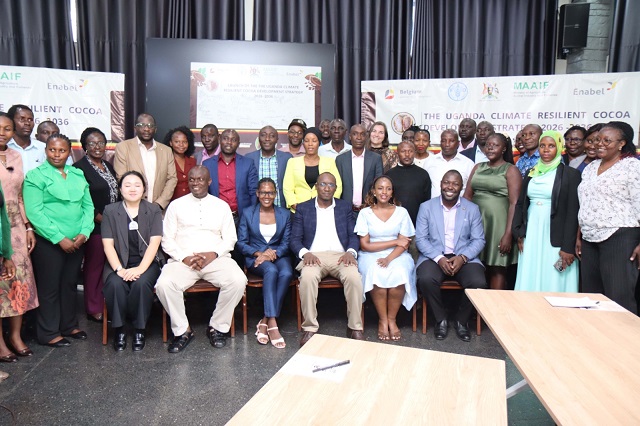
The Uganda Climate Resilient Cocoa Development Strategy (2026–2036) was launched on 18 November by the Ministry of Agriculture, Animal Industry and Fisheries (MAAIF). It was developed with support from the Food and Agriculture Organization of the United Nations (FAO), the Belgian development agency Enabel and other sector partners, and is meant to guide investment across the whole cocoa value chain.
The ambition rests on rapid recent growth. Cocoa export earnings rose from USD 70.6 million in the 2015/16 financial year to USD 620.4 million in 2024/25, according to MAAIF and Bank of Uganda figures cited in the strategy. That makes cocoa the country’s second-largest agricultural export and its third-largest foreign exchange earner after gold and coffee. The crop supports more than 100,000 farming households.
By 2036, the strategy aims to raise annual production from about 72,000 to 500,000 metric tonnes and grow annual export earnings to USD 3 billion. It also seeks to lift local processing from under five per cent to 30 per cent of national output, increase yields from 530 to 1,000 kilograms per hectare, and raise women’s and youth participation in the value chain to at least 45%.
Reaching those numbers means tackling problems that have held the sector back: low farm productivity, poor post-harvest handling, limited local processing, weak farmer organisation and restricted access to finance. The strategy also responds to climate risks and to export market demands for traceability and deforestation-free production.

Climate resilience is a central pillar. The plan promotes climate-smart production, agroforestry, sustainable land management and improved planting materials.
The strategy puts weight on retaining more of the crop’s value inside Uganda, through investment in fermentation, drying, aggregation and processing, including cocoa liquor and chocolate manufacturing. The aim is to create jobs and improve returns to farmers.
The estimated public and catalytic investment needed over ten years is $ 221.19 million. The document also calls for substantial private investment, alongside support from government, development partners, research institutions, financial institutions and farmer organisations.
Dr John Lodungokol, acting Commissioner for Crop Production and Protection at MAAIF, said the priority now is delivery. “Our priority now is to strengthen coordination across the value chain, mobilise the necessary investment and ensure that farmers, processors and other stakeholders are equipped to contribute to and benefit from the sector’s growth,” he said.
FAO’s Crop Production Specialist in Uganda, Dr Joseph Mudiope, said higher volume alone will not make Uganda competitive. “Realising this potential will require more than increasing production; it calls for sustained investment in research, innovation, climate resilience and value addition,” he said.
Enabel’s Agribusiness Expert, Sylivia Natandula, said success should be judged by outcomes for people rather than tonnage.
“Our success should not be measured only by the tonnes of cocoa produced or exported, but by the incomes improved, businesses strengthened, decent jobs created and communities transformed,” she said.
FAO backed the strategy through its Technical Cooperation Programme on strengthening Uganda’s capacity for climate-resilient cocoa value chain development. The process included technical reviews, expert consultations and engagement with government, the private sector, farmer organisations, academia and development partners.
The national launch will be followed by regional engagements in Eastern, Western and Northern Uganda to build awareness and local ownership and to set implementation priorities in existing and potential cocoa-growing areas.