

NEWS ANALYSIS | URN | Women and girls seeking healthcare, education, and employment in Uganda are facing demands for sexual favours from people who control access to these opportunities.
Sexual favors are increasingly being demanded as a form of payment for public services, employment, and other opportunities in Uganda’s health and education sectors, exposing women and girls to a form of corruption that often goes unreported.
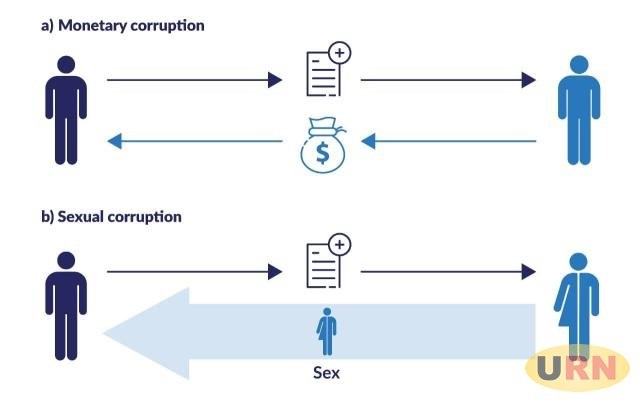
Unlike conventional bribery, where officials demand money to influence decisions or provide services, this form of corruption involves abuse of authority to solicit sexual favors. The practice, known as sextortion, turns sex into a currency for accessing services and opportunities.

Gender, Human Rights and Inclusion Specialist Evelyn Zake, who presented a background study on sex corruption in Uganda’s health and education sector, says the practice thrives because of the power imbalance between those demanding sexual favors and those seeking services.
“Victims, most often young women and girls with little power, face a brutal choice: submit or lose what they desperately need,” Zake said.

The scale of the problem is difficult to establish because victims rarely report such incidents, while official corruption records largely focus on financial transactions.
A 2025 report by the Inspectorate of Government on corruption in local government recruitment offers a glimpse into the practice. The investigation found evidence of applicants paying non-monetary bribes, although only one woman openly disclosed that she had been asked to exchange sex for a job.
“I was asked for Shs12 million but only managed to pay Shs4 million and sex on top of that. However, I did not get the job,” the woman told investigators.
This account illustrates how sexual exploitation has become intertwined with financial bribery in some recruitment processes, with applicants facing multiple demands from officials who control access to employment.
In education, the practice is commonly described as sex for marks, where students are pressured to exchange sexual favours for better grades, academic progression or favourable treatment. In the health sector, women seeking services also face risks when health workers exploit their positions of authority.
Although the practice has existed for years, it has received less public attention than other forms of corruption.
To establish a clearer picture of the problem, researchers at the U4 Anti-Corruption Resource Center and the Embassy of Denmark conducted a background study focusing on selected health facilities and secondary schools in Arua and Iganga districts.
The study examined experiences of sexual exploitation linked to access to maternal health and education services, alongside available data on the subject.
Presenting the findings Wednesday during a workshop on Gender and Corruption in Uganda, Zake said women and girls face particular risks because they frequently depend on public health and education services and often have limited alternatives when officials demand unofficial payments or sexual favours.
“It is not ordinary sexual harassment. It is the abuse of public or institutional power for personal sexual gain. Unlike a cash bribe that leaves a paper trail, this transaction is intimate, hidden and rarely reported,” she said.
She added that the lack of reporting had allowed the practice to persist even as the country intensified efforts to fight more visible forms of corruption.
Dr Asa Elden, the Co-Chair of the Global Civil Society Coalition for the United Nations Convention against Corruption (UNCAC), plainly described the practice as a form of corruption in which sex becomes the currency.
The study brings attention to a form of graft that is difficult to detect through conventional anti-corruption mechanisms.
Inspector General of Government Justice Aisha Naluzze Batala said sex as a form of corruption is often hidden, underreported, and difficult to prove, and said institutions need to be practical and collaborative to fight the vice because no single institution can solve the problem on its own fully.
For her experience of survivors and frontline workers, and community should shape conclusions to agree on the realities faced.
However, the problem is bigger and doesn’t stop with big offices.
Waiswa Abubaker, a labour officer in Iganga District, said the practice was more widespread in rural areas, where victims often suffer in silence because of fear, stigma and limited avenues for reporting abuse.
He said sexual exploitation was not confined to senior positions or lucrative employment opportunities but also occurred in casual and low-paying jobs. Some employers and supervisors reportedly demand sexual favours from job seekers before offering them work, while others exploit workers by withholding payment for work already completed until they submit to such demands.
Waiswa said the practice was particularly difficult to expose because many of the victims depend on the same employers for their livelihoods and fear losing their jobs or wages if they speak out. As a result, cases often go unreported, allowing perpetrators to continue exploiting vulnerable workers.
One of the most disturbing findings in the health sector was the reported prevalence of sexual corruption during labour and childbirth. The findings raised questions among participants about how women, at their most vulnerable moment, could be subjected to demands for sexual favours while seeking maternity care.
The revelation prompted concerns about who was demanding such favors from women in labor and under what circumstances, given the urgency and sensitivity of childbirth.
Lilian Byarugaba Adriko, Chief Executive Officer of FIDA Uganda (the Uganda Association of Women Lawyers), acknowledges that some reporting mechanisms already exist in different institutions, but they are not enough. According to Adriko, while reporting channels are available, the response remains incomplete. She argues that the country must press harder on three fronts: stronger reporting systems, meaningful sanctions, and reparations for victims.
On stronger reporting systems, Adriko notes that existing channels need to be made safer, more accessible and better trusted. Victims must be able to report without fear of stigma, retaliation or being ignored. Confidential options, clear timelines for investigation and protection for complainants are essential if more people are to come forward.
On sanctions, she points out that current punishments for sex corruption remain weak and inconsistent. Perpetrators often face light disciplinary action or no consequences at all.
Stronger, predictable sanctions, including dismissal, professional deregistration and criminal prosecution where appropriate, are needed to raise the cost of the offence and deter others.
Adriko also stresses that victims still lack proper redress. She said that beyond punishing the offender, survivors need practical support that helps them recover.
This includes medical and psychosocial care, remedies that restore lost academic or employment opportunities, and, where appropriate, compensation. Without meaningful reparations, many victims see little reason to report.
Jennifer Githu, the Anti-Corruption Programmes Coordinator at the UNODC corruption and financial crime hub for Africa, said some African countries, including Kenya, Tanzania and South Africa, had taken steps to address sextortion through legal and institutional frameworks.
She noted that Kenya and South Africa had gone further by establishing mechanisms to protect victims and providing dedicated support funds to assist those affected.
She said Uganda could draw lessons from these countries by strengthening its legal framework, establishing clear reporting and protection mechanisms, and setting aside resources to support victims of sexual exploitation linked to abuse of authority. Such measures, she argued, would encourage more victims to report cases without fear of retaliation or financial hardship.