

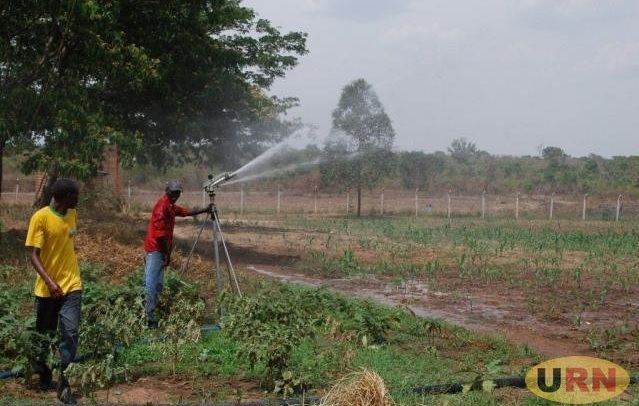
Kampala, Uganda | URN | Farmers and agricultural advocacy groups are calling for tighter regulation of suppliers of irrigation equipment and subsidies on farming technologies, saying poor-quality machinery and high costs are undermining efforts to promote regenerative agriculture and build resilience to climate change.
The government has been urged to strengthen regulation of agricultural equipment suppliers to ensure farmers have access to quality tools and machinery needed to adopt climate-smart and regenerative farming practices.
The call comes amid growing concerns about the vulnerability of Uganda’s predominantly rain-fed agricultural production to prolonged droughts, erratic rainfall and other effects of climate change.

Regenerative agriculture is an approach to food production that seeks not only to maintain agricultural productivity but also to restore the natural resources on which farming depends.
It focuses on rebuilding soil fertility, conserving water, increasing biodiversity and reducing dependence on chemical inputs through practices that work with natural ecological processes.

In Uganda, such practices include mulching, crop rotation, intercropping, agroforestry, minimum tillage, composting, using organic manure, integrating livestock into crop production, and conserving water through rainwater harvesting and irrigation.
Unlike conventional farming systems that can progressively deplete soil nutrients and expose land to erosion, regenerative agriculture seeks to improve the ability of farmland to retain moisture, maintain soil structure and sustain production over time.
These benefits are particularly important for smallholder farmers who depend heavily on rainfall and have limited capacity to recover from repeated crop failures.
The approach also complements climate-smart agriculture, which seeks to increase agricultural productivity, strengthen farmers’ resilience to climate change and, where possible, reduce greenhouse gas emissions. However, efforts to promote these practices are facing challenges, including the cost and quality of agricultural equipment available to farmers. F
lorence Nassuna, a Policy Officer at the Advocacy Coalition for Sustainable Agriculture (ACSA), a network of civil society organisations working with smallholder farmers, says the availability of substandard agricultural equipment is undermining efforts to encourage farmers to embrace sustainable technologies.
She says ACSA is finding it difficult to promote solar-powered irrigation systems among targeted farmers because poor-quality installation equipment discourages potential users.
Nassuna says farmers who invest their limited resources in irrigation systems risk losing confidence in the technology when components such as pipes, tubes, sprinklers and generators fail to perform as expected.
She is calling on the government to establish a stronger regulatory framework for suppliers of agricultural irrigation equipment to protect farmers from substandard products and ensure value for money.
Nassuna says the coalition is also intensifying efforts to mobilise smallholder farmers across the country to adopt sustainable agricultural technologies and reduce their dependence on increasingly unpredictable weather patterns.
The campaign involves working with organised farmers’ groups to promote renewable energy and other technologies that can improve agricultural production while reducing environmental degradation.
Apart from irrigation systems and natural pesticides, the initiative is promoting biogas and solar-powered drying technologies to help farmers adapt to changing weather conditions and minimise post-harvest losses.
Biogas technology allows farmers to convert animal waste and other organic materials into energy, while the resulting digestate can be used as organic fertiliser.
Solar dryers, meanwhile, help preserve agricultural produce without relying entirely on electricity or firewood. Nassuna says the technologies are intended to help farmers manage production risks while making better use of locally available resources.
Harith Kakooza and Gerevazio Ssebudde, farmers piloting regenerative agriculture practices in Buwunga Sub-county, Masaka District, have also called on the government to provide substantial subsidies on agricultural tools and equipment to make them affordable to smallholder farmers.
Kakooza says many farmers in the area were severely affected by the recent prolonged drought, which resulted in crop failures and financial losses that could take years to recover from.
He argues that access to affordable irrigation equipment and other appropriate farming technologies would help farmers reduce their dependence on rainfall and protect their livelihoods against future weather shocks.
The farmers say that while regenerative agriculture offers an opportunity to restore soil fertility and improve resilience, the initial cost of adopting some of the technologies remains beyond the reach of many rural households.
Uganda already has several policies and programmes that provide a foundation for promoting regenerative and climate-smart agriculture, although regenerative agriculture itself is not established as a distinct national policy framework.
The National Agriculture Policy, adopted in 2013, provides the broader framework for transforming subsistence farming into sustainable commercial agriculture.
It recognises the importance of agricultural research, appropriate technologies, sustainable natural resource management and improved service delivery in the sector.
The National Climate Change Policy, approved by Cabinet in 2015, also provides for interventions to build resilience to climate change.
It is complemented by the National Adaptation Plan for the Agricultural Sector, which brings together measures to strengthen the resilience of crop, livestock, fisheries and other agricultural production systems.
These include climate-resilient farming practices, irrigation, improved agricultural information and sustainable management of natural resources. Another relevant framework is the National Organic Agriculture Policy, approved in July 2020.
It promotes agricultural production systems that enhance soil fertility, biodiversity and ecosystem health while reducing reliance on synthetic agricultural inputs. It also provides for research, appropriate technologies, standards and certification in organic agriculture.
Although organic and regenerative agriculture are not interchangeable, they share several practices, including composting, biological pest management, crop diversification and sustainable soil management. agriculture.
The National Irrigation Policy, adopted in 2017, seeks to expand irrigation and improve the efficient use of water for agricultural production. It sets a target of bringing an additional 1.5 million hectares under irrigation by 2040.
The policy recognises irrigation as an important response to climate variability and a means of improving agricultural productivity and food security.
The government is also implementing the Uganda Climate-Smart Agricultural Transformation Project through the Ministry of Agriculture, Animal Industry and Fisheries (MAAIF), working with the National Agricultural Research Organisation and other agencies.
The six-year project seeks to increase agricultural productivity, market access and resilience by supporting the adoption of climate-smart technologies and farming practices.
In January 2026, the Ministry of Water and Environment also published the Uganda National Agroforestry Strategy, which promotes the integration of trees, shrubs and other woody plants into crop and livestock production to improve productivity, biodiversity and ecosystem sustainability.
However, the challenge raised by ACSA concerns not only the availability of agricultural technologies but also the quality assurance and enforcement mechanisms governing their supply.
The Uganda National Bureau of Standards (UNBS) already has standards covering some irrigation equipment. For example, its standard for agricultural irrigation emitters and emitting pipes specifies mechanical and functional requirements and testing procedures.
However, the particular standard is classified as voluntary, raising questions about how effectively farmers are protected against poor-quality products in the market.
MAAIF’s Department of Agricultural Infrastructure, Mechanisation and Water for Agricultural Production is mandated to formulate and enforce standards and regulations covering irrigation, agricultural engineering, mechanisation, soil fertility management and soil and water conservation. agriculture.
The department’s mandate provides an existing institutional basis for addressing concerns about agricultural equipment quality, including the need for better coordination with UNBS, suppliers and local government production officers.
The government’s Micro-scale Irrigation Programme also provides financial support to farmers acquiring irrigation equipment.
Under the cost-sharing arrangement, government contributes between 25 and 75 percent of the equipment cost, subject to a maximum contribution of 7.2 million shillings per acre.
The concerns raised by ACSA and the farmers therefore point to two related challenges: making agricultural technologies affordable and ensuring that equipment purchased with farmers’ or public money is reliable, properly installed and supported by after-sales services.
Without addressing both issues, efforts to encourage smallholder farmers to adopt climate-resilient farming practices risk remaining limited, particularly among households already struggling with the financial consequences of drought and crop failure.