

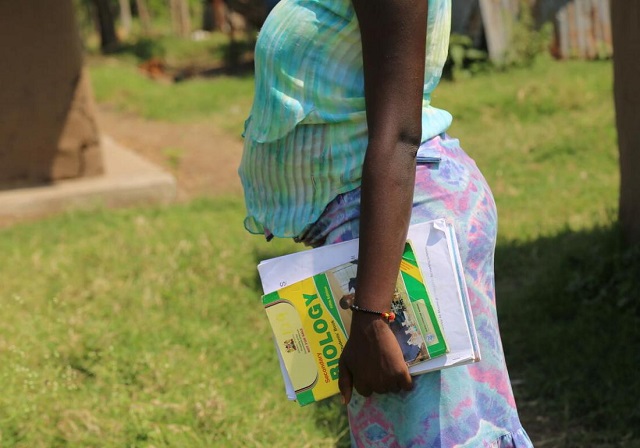
Kampala, Uganda | URN | Health experts have called for urgent, coordinated national action to address Uganda’s persistent teenage pregnancy crisis, which has remained largely unchanged for more than two decades, with rates fluctuating between 24 and 25 per cent.
The experts warn that the continued high prevalence of teenage pregnancy is undermining girls’ education, exposing adolescents to life-threatening reproductive health complications and threatening efforts to improve the country’s social and economic development.

Speaking at a Media Café organised by the Health Journalists Network Uganda (HEJNU) in partnership with Palladium and BBC Media Action, Dr Irene Mwenyango, the Assistant Commissioner for Adolescent and School Health at the Ministry of Health, said the stagnating figures depict a national crisis that cannot be resolved by the health sector alone.
Dr Mwenyango called for a multi-sectoral approach involving government institutions, communities, parents, schools and other stakeholders to tackle the underlying causes of teenage pregnancy.
Dr Mwenyango warned that pregnancy-related complications, unsafe abortions and childbirth remain among the leading causes of death and disability among Ugandan girls aged 15 to 19. She urged teenage mothers to embrace family planning immediately after childbirth to prevent unintended pregnancies, while encouraging them to return to school and continue their education.

She said Uganda has committed to reducing teenage pregnancy prevalence to 15 per cent by 2030, adding that the government has developed a joint intervention framework, the National Strategy to End Teenage Pregnancy and Child Marriage, to guide efforts towards achieving the target.
Francis Mondo Kyateeka, Assistant Commissioner for Youth and Children Affairs and Acting Commissioner at the Ministry of Gender and Social Development, said teenage pregnancy remains a complex challenge driven by cultural norms, inadequate parenting and community-level factors.
Kyateeka said the consequences extend beyond reproductive health, with teenage pregnancy contributing significantly to school dropout rates and limiting the prospects of young girls. He noted that although more than two million children enrol in Primary One, only about 900,000 eventually sit for the Primary Leaving Examinations (PLE), attributing the high dropout rate partly to teenage pregnancy, which he said stands at 24 per cent.
Kyateeka further warned that teenage pregnancy increases adolescents’ vulnerability to HIV/AIDS, arguing that the two challenges are linked to similar underlying factors. He called for improved access to family planning commodities and reproductive health guidance for adolescents, particularly teenage mothers.
He also revealed that the government is reviewing the National Employment Policy of 2006 to provide opportunities for teenagers who become pregnant to reintegrate into society and pursue productive livelihoods after childbirth.
Meanwhile, Dr Richard Kabanda, Commissioner for Health Promotion at the Ministry of Health, urged the media to deliberately integrate young people into their routine programming, warning that interventions designed without their participation are unlikely to achieve lasting impact at the community level.
Kabanda said young people constitute a significant proportion of Uganda’s population and must be actively involved in initiatives aimed at addressing challenges affecting them. He observed that although adolescents increasingly have access to information, they require supportive environments in which they can process, understand and apply the information meaningfully.
Kabanda called for the deliberate establishment of networks to support young people, while emphasising the importance of promoting a culture of reading, documentation and information sharing, particularly on the availability of reproductive health services, treatment and medicines.
National data from the Uganda Bureau of Statistics and UNFPA Uganda indicate significant regional disparities in teenage pregnancy prevalence, with some areas recording rates substantially above the national average. Teso Sub-region reportedly has the highest prevalence at 31 per cent, followed by Tooro and North-Central sub-regions at 30 per cent each.
Bunyoro records 29 per cent, while Eastern and East Central regions, including Busoga, have prevalence rates ranging between 30.1 and 31.6 per cent. Districts such as Kamuli and Mayuge continue to record thousands of teenage pregnancy cases.
Kampala City has the lowest regional prevalence at 17 per cent, although teenage pregnancy remains a concern in disadvantaged urban communities. Kigezi Sub-region records 16 per cent, the lowest rate among rural-associated regions.
The situation is even more concerning in refugee-hosting communities, where teenage pregnancy prevalence in areas such as Palabek has reportedly reached between 30 and 41 per cent.