

NEWS ANALYSIS | URN | As the country braces for an El Niño-influenced rainy season expected to bring above-normal rainfall and heightened flood risks in parts of the country, a new government-led roadmap is proposing a fundamental shift in disaster management, acting on forecasts before communities are hit.
Uganda Radio Network has previously reported that the government may know what is coming, but the money needed to act before the hazard arrives is not guaranteed.
In a September 15 report, “El Niño Preparedness Plan Awaits Funding as Rains Approach,” URN reported that the Office of the Prime Minister had prepared a costed contingency and response plan, but that it was still awaiting Cabinet approval and funding.

Two days later, we reported that “Government Knows El Niño Is Coming. Why Is Action Still Waiting?”
URN documented the same problem on the ground, including flooding in Kampala, as questions mounted over whether preparedness measures had translated into preventive action.

The Uganda Roadmap on Anticipatory Action 2026–2031 now provides a broader framework for addressing that gap.
Published in July and led by the Office of the Prime Minister with support from the IGAD Climate Prediction and Applications Centre and other partners, the roadmap seeks to move the country’s disaster management from reactive response to proactive, forecast-based action.
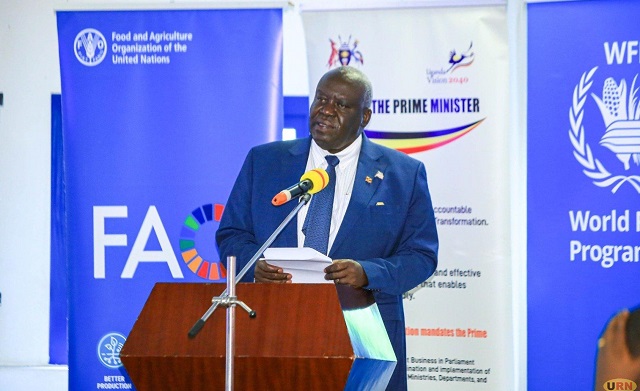
The 54-page document was discussed during a meeting led by the Office f the Prime Minister, attended by WFP and FAO officials, among others, on the shores of Lake Victoria in Entebbe.
The roadmap is built around six strategic pillars covering early warning, anticipatory action, policy and advocacy, governance and coordination, financing mechanisms, and monitoring, evaluation, research and learning.
It proposes that forecasts should not simply warn government and communities about an approaching hazard, but they should trigger action before the hazard becomes a disaster.
Under the proposed system, predetermined thresholds would trigger specific interventions, with responsibilities and resources agreed in advance.
That could mean releasing cash before a drought worsens, moving livestock away from threatened areas, clearing drainage channels before heavy rainfall, protecting critical infrastructure, pre-positioning emergency supplies or preparing evacuation arrangements before floodwaters arrive.
The roadmap’s financing problem, however, is now becoming clearer. At a donor conference in Entebbe on September 25, the Office of the Prime Minister said implementation of the anticipatory-action framework requires 207.6 billion shillings.
Existing project-based financing covers 110.3 billion shillings, leaving a gap of about 90.5 billion shillings if the system is to cover the entire country.
The Office of the Prime Minister said existing financing is concentrated in particular regions, including Karamoja, Acholi, Lango and parts of Bukedi, Bugisu and Teso, rather than providing nationwide coverage.
That disclosure resonates with a central concern raised by the roadmap: moving anticipatory action from individual projects into a nationally owned system will require financing that is predictable and available before hazards occur.
The roadmap’s publication also comes against the backdrop of Uganda’s existing disaster financing difficulties.
The country has a disaster contingency fund, but the roadmap identifies weaknesses in the financing arrangements for anticipatory action and calls for a more sustainable mechanism that can support early interventions.
The proposed reforms include integrating anticipatory action into disaster risk financing and government planning, while strengthening arrangements for pre-financing interventions.
The roadmap also proposes expanding multi-hazard early warning coverage and establishing clearer links between warnings, agreed triggers and action.
Forecasts for the September–December 2026 seasonal climate outlook indicate that most parts of the country are likely to receive near-normal to above-normal rainfall, with El Niño expected to intensify during the season.
The Ministry of Water and Environment has indicated that the combination of El Niño and a likely positive Indian Ocean Dipole could further enhance rainfall over much of the country.
The regional climate outlook from the IGAD Climate Prediction and Applications Centre also warns of increased rainfall over eastern parts of the Greater Horn of Africa, raising the risk of floods, crop destruction, infrastructure damage and outbreaks of water- and vector-borne diseases.
During the 2022/23 drought in Karamoja, government and humanitarian agencies vaccinated livestock, provided anticipatory cash, rehabilitated water infrastructure and disseminated early warning information.
During subsequent El Niño-related flooding, partners worked with government to desilt flood canals and rehabilitate water-harvesting structures before the peak of the rains.
The challenge now is whether such interventions can move beyond individual projects and become part of a nationally financed system.
That challenge was already visible when Uganda presented its preparedness position at the IGAD Regional High-Level Forum on El Niño Preparedness in Addis Ababa earlier this month.
Assistant Commissioner for Disaster Management Rose Nakabugo told the meeting that Uganda had developed a costed preparedness and response plan covering agriculture, food security, health, water and sanitation, education and disaster coordination, but the plan was yet to be approved by the Cabinet for funding.
Nakabugo also acknowledged that limited resources were affecting timely procurement and pre-positioning of relief supplies and emergency equipment, including equipment needed in landslide-prone areas such as the Elgon and Rwenzori regions.
That was the issue URN highlighted in Kampala. During heavy rains on September 17, flooding affected roads and businesses in several parts of the city.
In Namasuba, traders told URN that a drainage channel leading towards Kalidubi Swamp was silted and too narrow to cope with the water. At Shell Capital along Kampala Road, road users struggled with flooding around a pothole, while boda-boda riders said they were collecting money themselves to help clear drainage channels.
The incidents did not, by themselves, establish that Uganda’s entire disaster preparedness system had failed. Kampala is highly vulnerable to flooding, and intense rainfall can overwhelm drainage infrastructure.
But they provided a practical test of the question raised at the regional preparedness meeting: what happens after the forecast is issued?
The roadmap seeks to answer that question by establishing a system in which a warning is connected to a pre-agreed action, an institution responsible for taking that action, and financing that is available before the emergency.
Disaster risk reduction experts have held that a forecast tells government what may happen, while an early-warning system communicates the risk.
They further state that an anticipatory-action system is supposed to ensure that something happens because of that warning.
It is in that regard that the country now has a national roadmap designed around that principle. The question, however, is whether the financing and institutional arrangements can catch up with the ambition.
At the September 25 donor conference, Minister for Relief, Disaster Preparedness and Refugees Sam Engola said Uganda’s priority was to move from pilot projects to implementation at scale and called for predictable and sustainable financing.
“We must move from responding after disasters to acting before they become emergencies. Key progress includes the Uganda Roadmap for Anticipatory Action 2026–2031, the Multi-Hazard Integrated Early Warning System, and the National Anticipatory Action Dialogue Platform. Our priority now is implementation,” Engola Said.
That means the debate has moved beyond whether Uganda needs better forecasts. The government already has forecasts, early-warning systems and a national roadmap. The more difficult question is whether resources can be released early enough to act on those warnings.
The roadmap’s financing problem, however, is not simply a question of accounting. It goes to the heart of how Uganda has traditionally responded to disasters.
One of the country’s disaster experts, Martin Owor, has previously criticised the practice of releasing money only after disasters have occurred.
“I don’t support this idea of giving me money when a disaster has occurred. You get money from the contingency fund when a disaster has occurred, and then you are running around as if you are not trained,” Owor said.
He described the approach as an outdated model of disaster response.”The 1970’s, the 1960s approach of waiting for the disaster to occur, then resources are made available, then you are running around with confines, then vehicles are moving at high speed with flags on them moving to Bududa doesn’t help at all,” he said.
“What are you heading for? Stones have already rolled on people. Whether you are driving very fast, you are not going to rescue a life.”
Owor’s argument captures the distinction at the centre of the new roadmap: the objective is not simply to respond faster after a disaster, but to make resources available early enough to reduce the damage before the disaster occurs.
The roadmap makes a similar case in more institutional language.
“The reactive approach has proven inadequate in reducing the impact of these disasters,” it says, noting that funding for affected populations is “usually disbursed after predictable hazards escalate into disasters.
”The document proposes replacing that cycle with interventions that are “pre-planned, pre-financed, and timely” and triggered by agreed forecasts and thresholds.
Under the proposed system, a forecast reaching a predetermined threshold would activate agreed interventions, with the plan identifying who should act, when they should act, where the action should take place, and what resources should be used.
The roadmap says Anticipatory Action Plans should provide guidelines for “who takes action when, where, and with what funds.”
That is the point at which the roadmap’s financing problem becomes critical.
Uganda can have increasingly sophisticated forecasts and detailed contingency plans, but without money available before the hazard reaches its peak, the system risks falling back into the same reactive response that Owor criticised.
The roadmap says Uganda currently has “no dedicated and sustainable financing mechanism” for anticipatory action.
It also says that implementation remains “largely project-driven,” with different agencies developing and financing their own interventions.
The document says that since the contingency fund was established in 2018, less than 0.2 percent of the allocated budget has been approved because of fiscal constraints, while “no specific allocation exists for Anticipatory Action.
”The roadmap proposes a different financing model, including integrating anticipatory action into Uganda’s disaster-risk financing strategy and eventually moving from donor dependence towards a nationally owned system.
It proposes, among other measures, allocating at least 30 percent of contingency funds to anticipatory action.
The argument is therefore straightforward: money released after the stones have already rolled cannot undo the loss of life and destruction caused by the disaster.
The purpose of anticipatory action is to make some of that money available before the stones roll. For a country that has repeatedly dealt with floods, droughts and landslides through emergency response after communities have already suffered losses, the roadmap represents an attempt to change that cycle. But the 90.5 billion-Shillings financing gap now attached to its nationwide implementation shows the scale of the task.
As El Niño strengthens and the September–December rains begin, the country’s test is therefore no longer simply whether it can predict the next disaster. It is whether the warning will be followed by money, equipment and action before the water arrives.
The post Government has a plan to act before disasters strike, but where is the money? appeared first on 1:.